


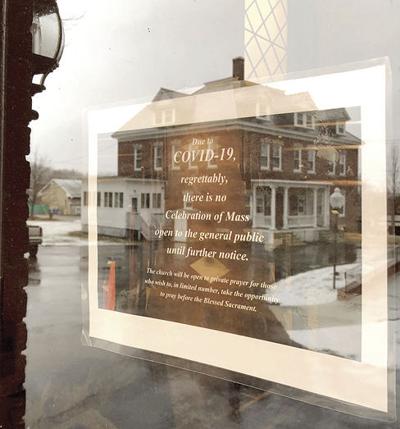
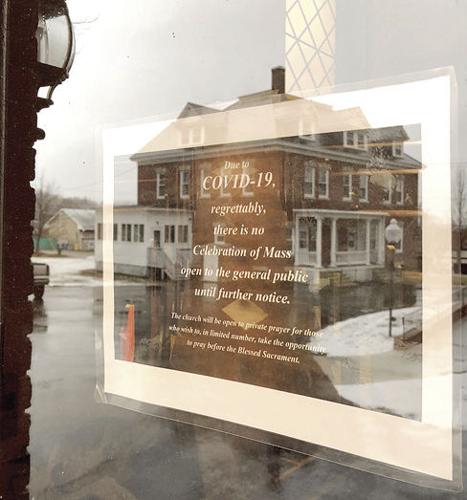
LACONIA — The Very Rev. Marc Drouin stood vested in the sanctuary and started to say Mass in St. Joseph Church on Thursday — the feast day of St. Joseph.
He spoke the opening words of the Mass: “The grace of our Lord Jesus Christ, and the love of God, and the communion of the Holy Spirit be with you all.”
At that point he should have heard the congregation respond, ”and with your spirit.”
Instead there was silence. Drouin was saying Mass to an empty church.
It’s a peculiar situation that Drouin and other Catholic priests are getting used to as the state’s Catholic bishop has ordered a halt to public Masses during the coronavirus emergency.
“We are complying with the guidance not to have large gatherings that we have received from the state and the CDC,” Drouin said in explaining what led to Bishop Peter Labasci’s order banning public Masses.
“It’s distressing,” Drouin acknowledged.
Concerns over the spread of the coronavirus have prompted faith communities generally to close their churches for the foreseeable future.
“So much of church is gathered around community,” said the Rev. Jim Shook, pastor of the First United Methodist Church of Laconia-Gilford, which is also now closed to public services. Instead, the church will offer an online service Sunday at 10:30 a.m.
The church is looking to use online platforms, like Zoom, for Bible study classes and meetings of the church’s governing council. Much face-to-face pastoral outreach has been suspended during the emergency.
Unable to make regular visits to congregants who are homebound, in nursing homes, or in the hospital, Shook said he and others in the church would instead be calling people on the phone or contacting them via email.
“We are going to do everything we can to maintain our sense of community,” Shook said. “Sundays are going to be different for all of us.”
That is also true for congregations such as the Gilford Community Church and the Laconia Congregational Church.
The Rev. Michael Graham, pastor of the Gilford Community Church, said an abbreviated service will be held in the church on Sunday, but Graham and few other worship leaders will be the only ones present. The service will be live-streamed for the members of the congregation.
That will also be the case at the Congregational Church, according to the Rev. Neil Wilson, the church’s senior pastor.
“Safety is first and foremost in our minds,” Wilson said.
Got Lunch Laconia volunteers will continue to use the church hall to assemble bags of food to be distributed to needy children while schools are closed, but Wilson pointed out that only 10 volunteers are working at any one time, in order to comply with President Donald Trump’s guidance that people not congregate in groups larger than 10.
The clergymen are beginning to wonder if the ban on large gatherings will mean there will be no public services on Easter — the most sacred day for Christians.
Drouin said a colleague who has been a priest for 50 years could not recall any other time when a public Mass was not celebrated on Easter, or during Holy Week — the seven days leading up to Easter, which includes Holy Thursday, the memorialization of the Last Supper; and Good Friday, which commemorates Jesus’s Crucifixion.
Druoin said many parishioners are troubled that they cannot receive Communion during this time, even privately.
“We just can’t take the chance of passing on an infection to another person,” he said of the rite in which a priest or designated minister typically places a wafer of consecrated bread into the hand or on the tongue of the communicant who then consumes it.
In an extraordinary move, St. Andre Bessette will be offering drive-through confessions at noon Sunday, when a priest will hear the confessions of people as they sit in their cars, to avoid both a public gathering and the sharing of common fixtures like kneelers, chairs and doorknobs.
The coronavirus pandemic has forced clergy, like so many others, into uncharted territory, using online services as the main way of reaching people, and taking extraordinary precautions in order not to spread any infection.
“There was no course in seminary on viral epidemiology,” Wilson said.
As challenging as the situation for both priests or ministers and their flocks, Shook said the situation would be much worse if the pandemic had struck 30 years ago.
“Can you imagine what this would be like without the internet?” he asked. “We at least have that blessing.”


(0) comments
Welcome to the discussion.
Log In
Keep it Clean. Please avoid obscene, vulgar, lewd, racist or sexually-oriented language.
PLEASE TURN OFF YOUR CAPS LOCK.
Don't Threaten. Threats of harming another person will not be tolerated.
Be Truthful. Don't knowingly lie about anyone or anything.
Be Nice. No racism, sexism or any sort of -ism that is degrading to another person.
Be Proactive. Use the 'Report' link on each comment to let us know of abusive posts.
Share with Us. We'd love to hear eyewitness accounts, the history behind an article.