


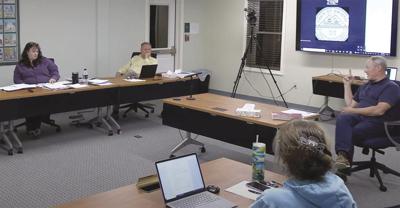
BRISTOL — Town officials are considering a request from the Bristol Energy Committee to sponsor a town meeting warrant article that would allow a property tax exemption for solar energy systems.
The recommendation would grant a 100% exemption from the portion of a residential property tax assessment attributable to the installation of a solar energy project. A state law, RSA 71:62, allows municipalities to adopt full or partial exemptions as a means of encouraging a transition to solar power.
The Department of Revenue Administration lists 135 New Hampshire communities participating in the program as of 2021, with 4,235 homes claiming the exemptions. The lost revenue in each community ranges from $18 in Ossipee to $129,816 in Nashua. The total cost of solar exemptions in the state was $1,605,140, making the average tax savings per homeowner about $379.
Bristol Energy Committee Chair Paul Bemis told the selectboard that “the future is definitely electric” but that large solar arrays involve cutting down trees, “and that is not necessarily beneficial to anyone.”
Bristol uses solar power for the Minot-Sleeper Library and recently installed an array by the wastewater treatment facility to power other municipal facilities. There are 19 residential solar arrays in Bristol at the moment, Bemis said.
The exemption would provide an incentive to install solar systems without much of an impact on taxes, according to Bemis. Some towns offer 100% exemptions while others provide partial exemptions; Bemis is recommending the full exemption.
He also argued that it is fair because assessors do not increase property valuations for people who install new furnaces.
Selectboard member Carroll Brown argued that, because a solar array adds resale value to a home, it should be taxed. He also argued that “there’s plenty of people in this area that will never be able to afford to spend $11,000 on a new system,” and he did not believe it would be right to grant the exemption to those who can afford to do so.
“There are so many people that live paycheck to paycheck,” Brown pointed out.
Selectboard member Don Milbrand agreed, saying that is also his problem with the proposal, even if the exemption does not amount to a lot of money.
Bemis countered that providing the incentive is important when there are so many questions about the state’s energy future.
“I generally have a problem with us telling people what the right thing to do is,” Brown responded.
“It is the cheapest thing we can do, and it’s the most effective thing we can do to satisfy both energy costs and do our part to reduce carbon emissions,” Bemis said.
Milbrand affirmed that “You won’t see a drop [in tax revenue collected]; you just won’t see as large an increase.”
Assessing manager Christine Goodwin noted that one resident is installing a wind turbine on their roof. “If you’re going to do something for solar, should you also do something for wind?” she asked.
“I don’t think all renewables are the same,” Bemis responded. “Solar is not obtrusive. You don’t see it, you don’t hear it, you don’t smell it. ... I think we need to be careful about which ones. Wind is always one that is controversial.”
The selectboard did not make a decision on the warrant article, saying there is time to consider it later, and that if they do not sponsor the article, Bemis could still put it on the warranty by petition.
Other communities
Communities in the Lakes Region that have allowed the solar exemption include Alton, which has 24 homeowners claiming solar discounts. The town’s lost revenue from the exemption in 2001 was $4,022, out of a total tax commitment of $24,430,829.
Belmont granted 25 solar exemptions, amounting to $21,990 in lost revenue out of a total of $19,495,457 collected.
Center Harbor’s 18 solar exemptions cost $4,079 in lost revenue out of total of $6,688,102 collected.
Franklin granted 29 solar exemptions, for $10,271 in lost revenue, while collecting $15,834,742 in taxes.
Gilmanton, with 19 exemptions, lost $5,470 in revenue, collecting $12,986,490.
Holderness granted $6,468 in exemptions to 17 homeowners, collecting $10,957,164 in taxes.
Sixty-five Meredith residents claimed the solar exemption, for $15,168 in lost revenue, while the town collected $30,975,450 in taxes.
Sanbornton granted 37 exemptions, amounting to $13,601, while collecting $9,704,173 in taxes.
Sandwich granted 80 exemptions, amounting to $5,763, while collecting $6,445,452 in taxes.
Wolfeboro granted 26 exemptions, amounting to $3,451, while collecting $32,426,043 in taxes.


(0) comments
Welcome to the discussion.
Log In
Keep it Clean. Please avoid obscene, vulgar, lewd, racist or sexually-oriented language.
PLEASE TURN OFF YOUR CAPS LOCK.
Don't Threaten. Threats of harming another person will not be tolerated.
Be Truthful. Don't knowingly lie about anyone or anything.
Be Nice. No racism, sexism or any sort of -ism that is degrading to another person.
Be Proactive. Use the 'Report' link on each comment to let us know of abusive posts.
Share with Us. We'd love to hear eyewitness accounts, the history behind an article.