


LACONIA — The response was resounding — and surprising: Within two and a half days of opening registration, 700 people signed up to receive COVID booster shots Saturday at Booster Blitz, the state’s vaccination clinic at Lakes Region Community College — and another 300 were added within the next two days.
For residents of Belknap County and the greater Winnipesaukee and Newfound regions, it’s a chance to bump up immunity to the coronavirus and its variants, delta and omicron, as New Hampshire experiences the country’s highest per capita rate of infection. The surge is stressing primary care providers and emergency rooms, and resulting in patients boarding in corridors and emergency rooms as they wait for hospital beds to open, according to local physicians. Available space at Concord-Hospital - Laconia is currently being adapted to handle the load, and medical support staff is being brought in as needed around the state to care for a spike in COVID cases.
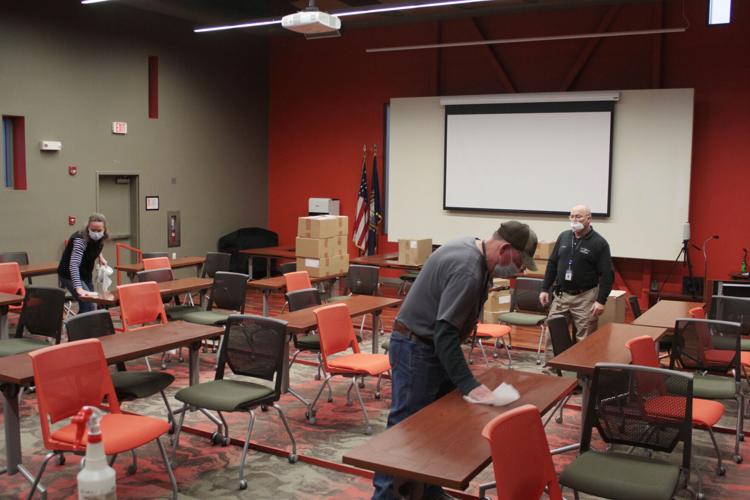
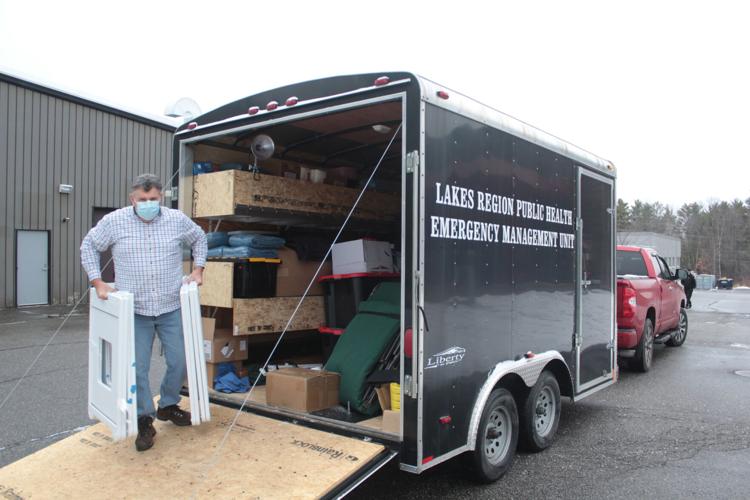
“I didn’t think we’d get more than 350” booking shots at Booster Blitz, said John Beland, director of emergency preparedness for the Partnership for Public Health – Winnepesaukee Region. Beland and a small army of public health and fire department staff and volunteers set up 16 vaccination stations Friday in the Turner building at LRCC, where 65 vaccinators, screeners, and check-in and parking lot attendants will funnel 1,000 in for the vaccine. It’s one of 14 clinics running concurrently across the state, including in Concord and Plymouth.
And it fills a critical niche. Interest in receiving the COVID booster is surpassing manpower and appointment availability at drug stores here and elsewhere, and some people have received calls canceling their pharmacy appointments, because of a shortage of staff to administer the shots, public health officials report. There is no room for walk-ins at the LRCC clinic, but a follow-up clinic will likely be held in January, depending on directions from the state’s Department of Health and Human Services, Beland said.
Concerns remain high, especially among people who feel vulnerable because of work exposure, age or chronic conditions.
“New Hampshire people are desperate to get the slots and there aren’t enough available,” said Kate Bruchacova, a health educator and emergency preparedness coordinator for PPH in Laconia. “Many people want it because the numbers (of current cases) are so bad.”
Belknap vies with Sullivan and Coos counties for the lowest vaccination rates in the state, said Beland. Public health and health care practitioners are desperate to slow transmission through vaccination, social distancing, masking in public, general hygiene and handwashing.
Health officials say people who are willing to get the vaccine, or who have been vaccinated, now outnumber those on the sidelines, who seem split between a wait-and-see attitude or dug-in opposition. Residents of rural areas may have a false sense of safety or their own disease resistance, and many people across the state have relaxed their personal habits of social distancing and masking.
At clinics the Winnipesaukee public health network has recently held at local businesses and public housing, the portion of first-time vaccines is low. At a clinic earlier this week at a factory in Laconia, 130 employees signed up. Only two were for the first dose, said Bruchacova.
Countering hesitancy is a challenge.
“Sometimes it helps to have a nurse meet with them and talk. That would help if more providers had vaccines on hand, which is not the case,” Bruchacova said. “It’s almost like someone in the family has to get really sick” to crack the resistance of skeptics and anti-vaxers.
“There’s so much misinformation. Social media does not help this effort one bit,” Beland said.
“The biggest thrust right now is the Delta and Omicron variants, to get people we know will take the vaccines so they’ll have heightened protection against the variants,” said Beland. “Raising their antibody level adds an extra level of protection.”
The public is encouraged to select vaccine brands they haven’t received before to add different mechanisms for fighting the virus and its changing mutations. COVID boosters from Pfizer, Moderna and Johnson & Johnson are heterologous, which means they can be used after another manufacturer’s vaccine. People who received the single J&J dose are urged to choose an MRNA-type booster from Moderna, said Beland.
Two months after a J&J or Janssen dose, a booster is recommended. For those who received the Moderna or Pfizer double dose, the guidelines are to wait six months before getting a booster.
Because of high demand, it’s important to call around or go online to find an available appointment at a wide range of drug stores, even some outside your local area, health authorities say.
In some locations, appointments have been canceled and not rescheduled because “staffing is so erratic. Some people will walk into a pharmacy and say, 'Can I get a booster shot?' And some will say, 'Sit down.' It’s hit or miss,” said Beland.
It’s too early to predict interest and turnout for PPH’s clinics for 5- to 11-year-olds, which will be held Tuesday through Friday from 4 to 7 p.m. at schools in the greater Lakes Region. This week 64 children were vaccinated at a Laconia School District clinic. By Wednesday only 40 had signed up for the pediatric clinic on Dec. 14 at Concord Hospital – Laconia, which has 200 available doses.
“Parents are hesitant. This is still new for that age group and they’re waiting to see,” said Beland. “We have a year of vaccines now, and by all scientific accounts they’re safe.”
Dr. Laura Niemela, a general pediatrican at Manodnock Community Hospital for 22 years, has seen a wide spectrum of vaccine mindsets among parents in that region – including pro-vaccine attitudes that extend toward protecting their children aged 5 to 11, which the CDC approved for vaccination in early November.
Niemela, who starts work at Health First in Franklin on Jan. 3, believes there’s a 60-40 split, with roughly 60% of parents enthusiastic about vaccinating their younger kids, and 40% opposed or sitting uneasily on the fence.
The shot approved for ages 5 to 11 is the Pfizer MRNA vaccine – one third of the dose used for ages 12 and up. Niemela said Pfizer did “a commendable job of bringing out a lighter dose with 90% efficacy and the least amount of side effects.”
In the four weeks that she’s been giving the shot to 5- to 11-year-olds, the after effects have been limited to “a little bit of a sore arm and some fatigue” but nearly every child is tolerating it well, Niemela said. Although children in this age range usually exhibit only mild respiratory symptoms from COVID or none at all, the point is to protect siblings, especially those who are age four and younger.
“We’ve been seeing children as young as two months old who are really sick with COVID pneumonia or seizures and most are in unvaccinated families,” said Niemela. “My experience is the four and younger and under two are at very high risk. We’ve been seeing them get very sick and hospitalized.”
Another reason to vaccinate children in the 5 to 11 group, said Niemela, is the cumulative effect on community immunity and virus spread. “The more people who have this vaccine, the higher the immunity and the less the transmission. New Hampshire has the highest transmission in the country right now. With less transmission, there will be less mutation of this virus,” she said.
Anywhere in New England where there are spikes, hospitals are stretched beyond room capacity and limited staff to care for both COVID patients and others who are sick with the flu, and other respiratory illnesses or life-threatening conditions, including heart attacks.
The goal is to keep as many out of the hospital as possible. Spikes travel around the country.
“I don’t think enough of us in New Hampshire are vaccinated or are being careful enough with activities outside the home, said Niemela. “The hospital emergency room and intensive care systems are just so stressed right now.”
Matthew Johnson, public affairs director of the Concord Hospital system said Concord Hospital – Laconia and its other campuses are in “incident command mode,” implementing emergency operations plans. This includes reallocating space and staff to provide COVID treatment and accommodate surges.
“We know social distancing, masks and vaccines work,” Niemela said. “We have a cure for this. We have a cure for this right now.”


(0) comments
Welcome to the discussion.
Log In
Keep it Clean. Please avoid obscene, vulgar, lewd, racist or sexually-oriented language.
PLEASE TURN OFF YOUR CAPS LOCK.
Don't Threaten. Threats of harming another person will not be tolerated.
Be Truthful. Don't knowingly lie about anyone or anything.
Be Nice. No racism, sexism or any sort of -ism that is degrading to another person.
Be Proactive. Use the 'Report' link on each comment to let us know of abusive posts.
Share with Us. We'd love to hear eyewitness accounts, the history behind an article.