


LACONIA — The Belknap Mill continues to rebound from a financial crisis which five years ago threatened the very existence of the nonprofit group that owns the 19th century downtown landmark.
At the annual meeting of the Belknap Mill Society on Wednesday, leaders pointed to improvements in membership, greater use of the building for functions and receipt of grant money as indications that the group is regaining its fiscal footing, and that the community sees the mill as a vital focal point of Laconia.
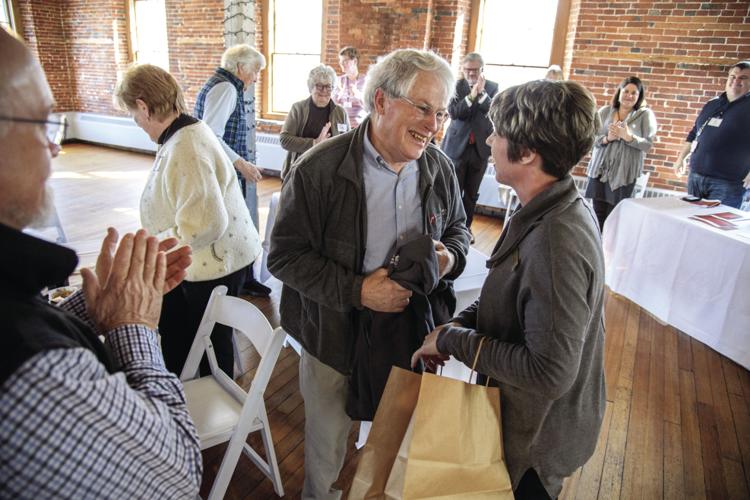
About 20 Mill Society members turned out for the hour-long meeting in the Mill’s Rose Chertok Gallery to hear a report on the mill’s finances and future plans. They also recognized volunteers who have been involved in various programs.
The society continues to seek a level of financial stability, Treasurer Martin Hough told the gathering. He said the mill had an operating loss of $20,000 last year, due to a one-time expense for temporary heating after the building’s boiler failed. On the other hand, he said, there had been a $217,000 increase in rental income, including $52,000 more from weddings and other functions.
“The challenge today is to keep the doors open,” Hough said, pointing out that the mill typically has $5,000 which makes very difficult for the mill to absorb unanticipated one-time expenses. He added that it is critical that the organization be able recruit tenants to occupy vacant rental space, book more events, increase its membership, and obtain more money from grants and fundraising.
Karen Prior, the Mill Society’s new executive director, said the society received nearly $100,000 in grant funding last year. She also said the mill will benefit from the sale of $350,000 in tax credits through the New Hampshire Community Development Finance Authority. The funds will be used for the ongoing renovation and restoration of the mill as well as to upgrade the building’s elevator, she said.
Next month the mill will launch a major drive to boost membership.
“If we could double or triple our membership that would make all the difference,” said Jared Guilmett, the society’s outgoing vice chairman and board member.
Guilmett also said the Mill will be participating in This Place Matters, a national campaign that encourages people to celebrate the places that are meaningful to them and to their communities. He hoped the program would help spur local interest, not only in the mill, but in the appreciation and preservation of other local landmarks and historic properties. The aim of the program, Guilmett said, is to encourage people to celebrate the places that are meaningful to them and the community.
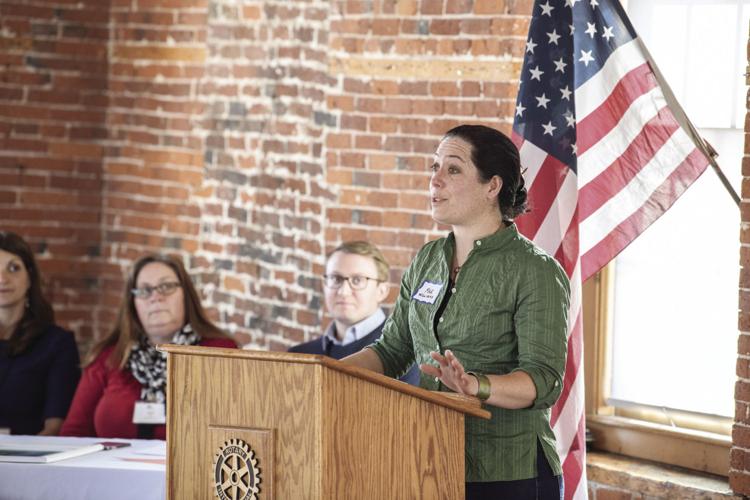
Keynote speaker Mae Williams said the Belknap Mill is living testimony to the value of preserving a community’s history.
“With preservation we have a chance to show our history over time,” she said.
Rehabilitation of old buildings is a way to promote sustainable practices, provide opportunities for skilled jobs during the renovation, and enhances the value of surrounding properties.
The meeting provided an occasion for the Mill Society to thank longtime volunteer Peter Ellis, who is working to create a display of the various pieces of knitting machinery used in Laconia’s hosiery mills, including the Belknap Mill where hosiery was made up until 1969. Also honored were volunteers who help with the Mill’s Industrial Heritage Program that provides school children a chance to experience firsthand what it was like to be a millworker in the early 20th century.
Attorney Rod Dyer, who has been a Mill Society member since the organization’s inception in 1971, said it was good to see how interest in the organization has rebounded in the past few years. He recalled that three years ago he and his wife, Gail, were the only members, aside from board members, who attended the annual meeting.
“This organization is being rejuvenated,” said member Helga Stamp. “We are back to what the Mill Society was like under Mary Rose Boswell.”
Boswell was the society’s executive director for nearly 20 years. She resigned in 2006.
Board member and former board Chair Allison Ambrose said the Mill Society has made significant progress compared to five years ago, when the society’s financial condition was so dire that the board felt it would have to sell the building. But faced with public opposition to that proposal, the society instead started to rebuild its membership and make necessary capital improvements, such as installation of a new roof.
Ambrose hoped the upcoming drive would boost membership to more than 100.
She said Prior’s efforts were responsible for the Mill’s new energy.
“She’s been key to moving this thing forward,” Ambrose said.


(0) comments
Welcome to the discussion.
Log In
Keep it Clean. Please avoid obscene, vulgar, lewd, racist or sexually-oriented language.
PLEASE TURN OFF YOUR CAPS LOCK.
Don't Threaten. Threats of harming another person will not be tolerated.
Be Truthful. Don't knowingly lie about anyone or anything.
Be Nice. No racism, sexism or any sort of -ism that is degrading to another person.
Be Proactive. Use the 'Report' link on each comment to let us know of abusive posts.
Share with Us. We'd love to hear eyewitness accounts, the history behind an article.