


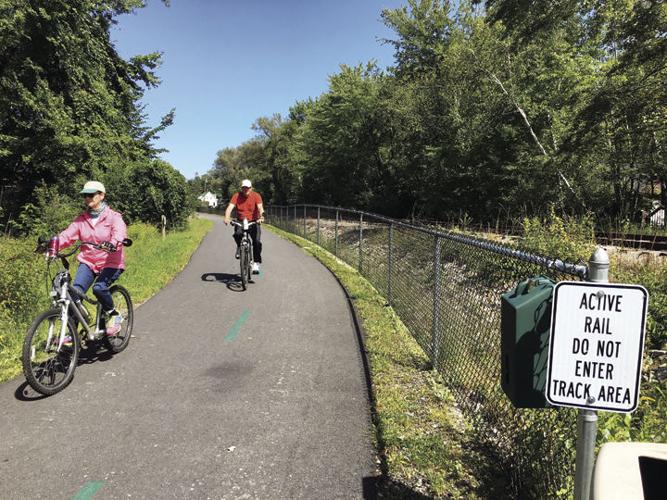
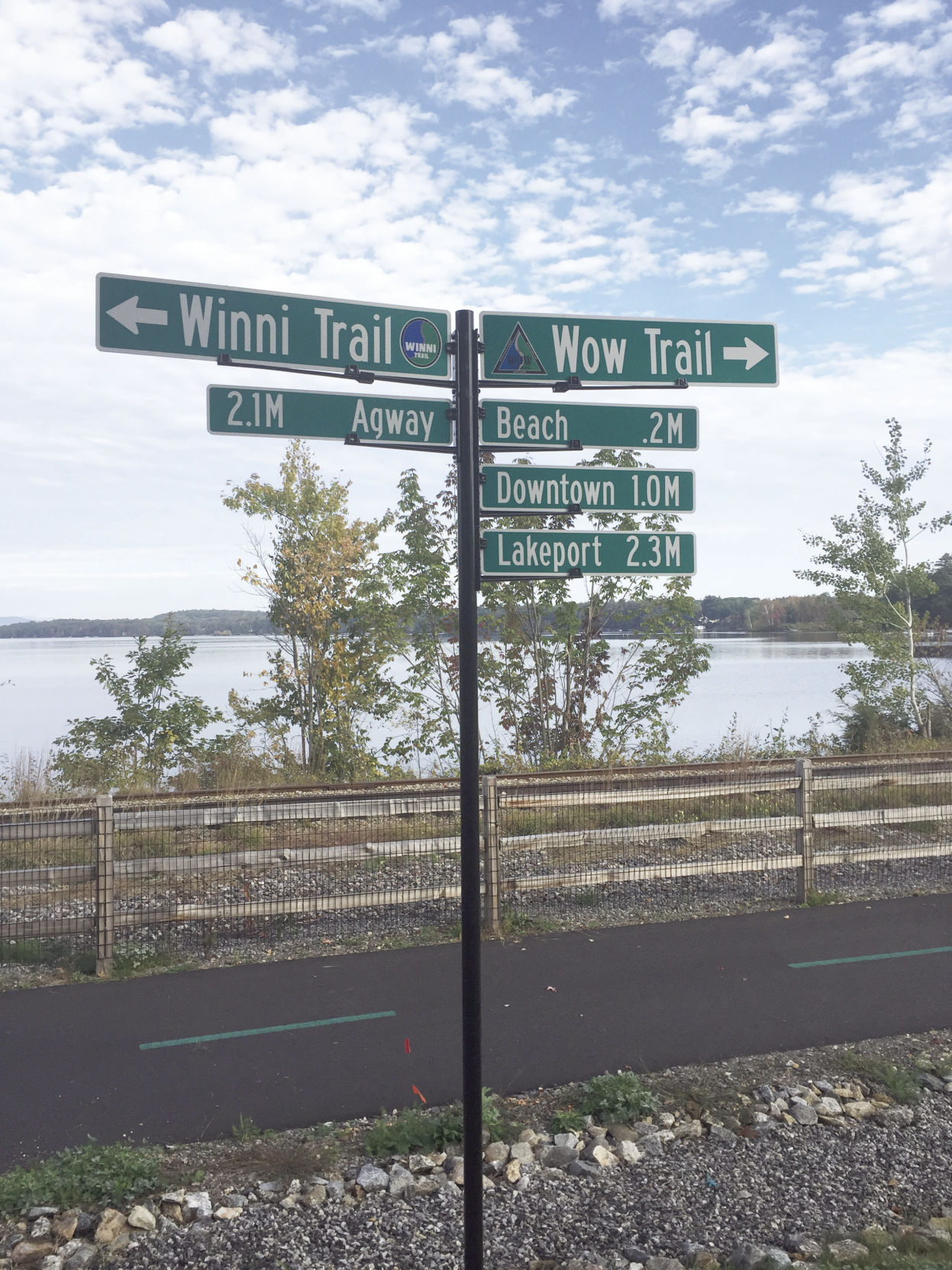
LACONIA — Robert and Dianne Conn of Manchester were putting on sunscreen at Bartlett Beach on Thursday in preparation for a bicycle ride on the WOW Trail.
They have ridden rail trails all over New England and speak highly of their fellow riders and walkers, with the exception of an occasional wandering dog.
“What I have seen has been very good,” Robert Conn said. “Most of the people on these trails who I have encountered are very respectful.
“The trails are very good, low-cost recreation.”
The Conns began riding south on the trail which extends a little over two miles, ending near the Agway store in Belmont.
“We’re going this way, because the other way would take us into the city,” Conn said.
If they did decide to go north, their trail ride would go through downtown and end in a couple miles at Union Avenue and Elm Street.
Allan Beetle, president of the WOW Trail Committee, and others would like to see the public path extended in the state-owned rail corridor another four miles north into The Weirs. The name of the trail derives from its path along the waters of Winnisquam, Opechee and Winnipesaukee
In a presentation to the Laconia Rotary Club on Thursday, Beetle said the most economical and practical thing would be to pull up the tracks in the expansion area along West Paugus Bay. Those tracks are now used at times by a tourist train, which has stations in Meredith and The Weirs.
Beetle acknowledged that hopes for a trail expansion face challenges.
A state law favors train use over recreational use in active rail corridors. Railroad interests don’t want the tracks removed. Some residents, including two homeowners associations along Paugus Bay, oppose any trail expansion in their area, citing privacy and safety concerns.
Frieda Yueh, president of South Down, and Dick Bordwell, president of Long Bay, issued a joint statement on Thursday:
“The South Down and Long Bay neighborhoods look forward to working with the City of Laconia on a lawful and more cost effective way forward on the WOW Trail. On the surface, it would appear the City and WOW promoters are focused on their current plan without considering how it would affect existing businesses, private property owners, and communities along the Lake.”
They said any proposal to remove railroad tracks along Paugus Bay would be detrimental to the tourist train.
“Most importantly, the City’s current approach would violate state and federal law, and will be faced with numerous legal challenges,” the statement said. “We sincerely hope the City will consider a more rational alternative. Salesmanship aside, the current plan misrepresents the facts and lacks substance.”
For his part, Beetle compared his task to that of the New England Patriots when they faced a 28-3 deficit and ended up victorious in the 2017 Super Bowl. He hopes to build enough support among communities along the trail to make an expansion possible.
“We’re all very proud of the four and a half miles that we have and we enjoy that and people are out there and they come into town with their bicycles, and it’s good, but we’re not quite there,” he said.
He said public trails are a community asset for local residents and a magnet for visitors.
“Our goal has always been Laconia, working with Belmont, working with the Tilton-Franklin groups, is a 20-mile regional trail, and some of that is done and some of that isn’t,” he said.
About eight miles is built. The Winnipesaukee River Trail runs from Franklin to Tilton. Trail advocates would like to link that through Belmont and into Laconia all the way to The Weirs.
He said the proposed section along West Paugus Bay to The Weirs is spectacular, skirting the water and offering breathtaking views.
“This would be a draw to the region from New England and beyond, to come here to ride this and see what they discover about Laconia, what they discover at Weirs Beach and Franklin,” Beetle said. “It would connect us all.”
He said it costs about a $1 million a mile to build trail alongside the tracks, much more than if the tracks were not there.
If the tracks stay, there are narrow areas where easements would be needed for the trail, if such easements could even be acquired. New causeways would likely be required.
Also, if the tracks are preserved, there is a greater need to use sections of the rail corridor that are closer to private property. Fences and gates would be needed as well.
The Laconia City Council commissioned a study, paid for by the WOW Trail organization and conducted by Alta Planning and Design, that is to show the pros and cons of building the trail alongside the current railroad tracks or in place of those tracks.
Delaying the completion of the study is the failure of 3M in Tilton to respond. Company officials are being asked to detail additional costs the company would incur if it no longer had access to freight rail service. 3M is apparently the last company to receive rail freight service between Tilton and Lincoln.
Beetle and various stakeholders have seen a draft copy of the study, but it hasn’t been released to the public yet.
“The study will tell you either option, putting the trail alongside the tracks or in place of the tracks, will be a remarkable economic benefit to this community, not to mention health benefits and transportation benefits,” Beetle said.
He said the study found that trail in place of rail is the preferred option.
“It’s obvious that you’re going to have a better end result, a safer, better trail at way less cost by building in place of the tracks,” he said.
He said a survey was done of 100 people living near the WOW Trail. Forty people replied and two-thirds felt the path had improved their neighborhood.
“The abutters are happy along with the rest of the community,” Beetle said. “But the abutters were the ones who were at City Hall saying, ‘Please don’t do this. This is not a good idea.’”
Beetle also addressed the needs of a tourist railroad that uses corridor. He said that if the WOW Trail were extended to The Weirs in place of the tracks, the train would gain new customers who want to ride the railroad from The Weirs to Meredith and points north.
“If we delivered thousands and thousands of tourists to Weirs Beach railroad platform every year, what is the impact on the tourist train?” he asked. “Our study is going to say they are going to get additional business by having a completed trail to Weirs Beach, and what about the rest of the businesses in Weirs Beach, what impact would it have on them?”
The Plymouth & Lincoln Railroad, which runs the tourist train, reports about $1 million in annual ticket sales and makes about $100,000 in land-rental payments to the state.
A report by Stone Consulting of Warren, Pennsylvania, found that the company’s scenic trains account for more than $17.4 million in total economic impact annually.
The report said 61 percent of its passengers traveled from outside of New Hampshire and that in 2018, the railroad welcomed more than 260 bus tours.


(0) comments
Welcome to the discussion.
Log In
Keep it Clean. Please avoid obscene, vulgar, lewd, racist or sexually-oriented language.
PLEASE TURN OFF YOUR CAPS LOCK.
Don't Threaten. Threats of harming another person will not be tolerated.
Be Truthful. Don't knowingly lie about anyone or anything.
Be Nice. No racism, sexism or any sort of -ism that is degrading to another person.
Be Proactive. Use the 'Report' link on each comment to let us know of abusive posts.
Share with Us. We'd love to hear eyewitness accounts, the history behind an article.