


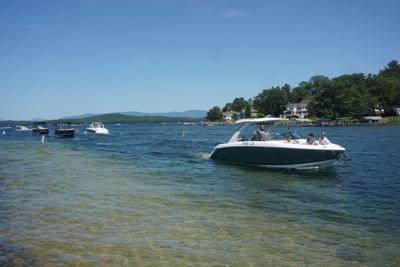
LACONIA — It’s been busy on Lake Winnipesaukee as of late, with runaway and capsized boats, three swimming fatalities, and other incidents occurring at all hours of the day. As a reminder to all recreational users of the lake, safety is paramount, and Marine Patrol officers caution boat operators to be vigilant at all times.
“There are lots of different situations that could constitute an emergency. Just being a little more situationally aware can help everyone,” said Marine Patrol Commander Lt. Irwin Malilay. “There’s unique situations to every vessel.”
Monitoring the weather is the single best thing a boat operator or lake visitor can do to keep themselves safe, he urged.
“We always just look at the forecast. It might be nice and sunny when you get to the docks and launch ... but in a moment’s notice, it can change,” he said. “There are typical early indicators of changing weather.”
And while many drivers already know, operating a boat is vastly different than a car. After all, there are no brakes, no marked lanes, no stoplights or stop signs.
But state laws like RSA 270:30d, the Powerboat Engine Cut-Off Switch requirement, requires an emergency lanyard or fob “specifically for the purpose of disabling propulsion or a vessel engine when the operator is unexpectedly displaced from the vessel's helm” to be worn at all times.
It would have been handy on Aug. 19, in Tuftonboro, when a runaway boat kept passersby from intervening in fear of being struck by the vessel. A Marine Patrol officer was eventually able to stop the boat, and no one was injured, including the operator, who was thrown off.
Other laws, like the Safe Passage Law, require boaters within 150 feet of shorelines to travel at headway speed. It also applies to areas near docks, permitted swimming areas, moorings, rafts, other boats and swimmers.
“It’s really prudent that the operators are familiar with the boating laws.
"Knowing the right of way, knowing navigational markers,” Malilay said. “Know your area.”
Some of these laws are unique to New Hampshire, so it’s important all operators know the law before heading out on the lakes.
“We have the safest state because of how well our boating education program works. It’s nationally recognized,” he continued. “However, if you get your education or certification for boating from a different state, that’s going to put you at a disadvantage.”
The best-prepared lakegoers are the ones who monitor the weather and have a float plan in place. And while Marine Patrol officers do not monitor the lake for swimmers, they do offer words of caution.
“We also advocate for filing a float plan. It’s a good plan for people recreationally swimming,” Malilay said. “Let someone know where you’re going, where you’re at.
"Someone should be aware of all that.”
A lone swimmer, Bonita Johnston, 73, of Laconia, was found unresponsive and laying face down in the water on Aug. 18. Good Samaritans rushed to her aid, but she died from the drowning.
And on Aug. 17, a sailboat capsized near Moultonborough, the lone occupant stranded on top, calling for help. A good Samaritan assisted at that scene also, leaving Marine Patrol officers with more questions than answers.
Police are also investigating the Aug. 14 death of Jack Bilodeau, 81, in Tilton. Bilodeau, of Westford, Massachusetts, was believed to have been swimming after his drifting boat on Winnisquam, near Mohawk Island. After suffering a suspected medical emergency, a good Samaritan jumped in in to help, but Westford was pronounced dead at a nearby hospital.
Finally, a body was recovered on Aug. 11, after 76-year-old Forrest Wells, of Virginia, went missing after swimming alone. Wells died of an accidental drowning.
Simply having a float plan can make all the difference in the world.
“It is concerning that a lot of people go out at the early hours of the day, and no one will know. Let someone know or go with them,” Malilay cautioned. “It’s as simple as making someone else aware that you’re out there.”
For more information on boating safety and boating laws, visit nhsp.dos.nh.gov/our-services/field-operations-bureau/marine-patrol.


(0) comments
Welcome to the discussion.
Log In
Keep it Clean. Please avoid obscene, vulgar, lewd, racist or sexually-oriented language.
PLEASE TURN OFF YOUR CAPS LOCK.
Don't Threaten. Threats of harming another person will not be tolerated.
Be Truthful. Don't knowingly lie about anyone or anything.
Be Nice. No racism, sexism or any sort of -ism that is degrading to another person.
Be Proactive. Use the 'Report' link on each comment to let us know of abusive posts.
Share with Us. We'd love to hear eyewitness accounts, the history behind an article.