


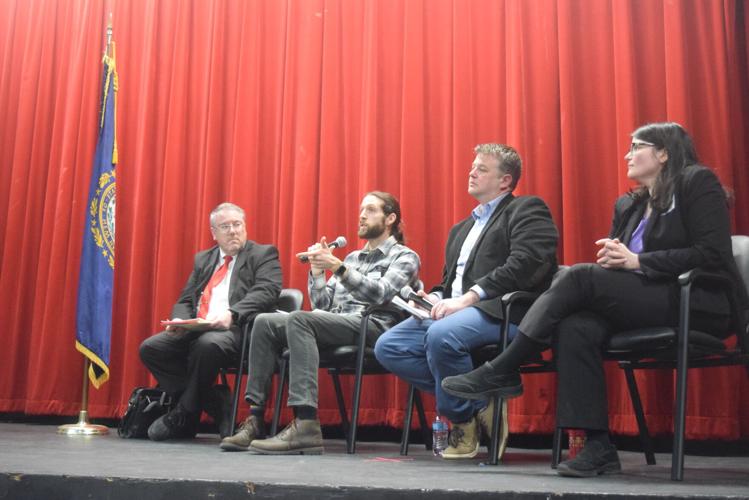
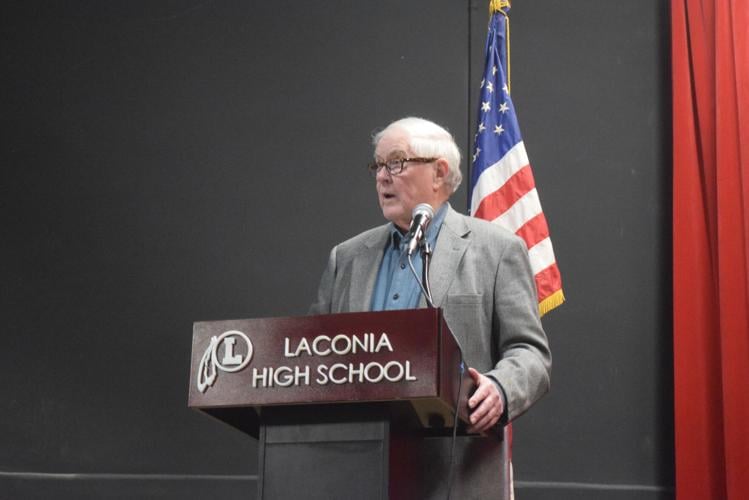
LACONIA — More than 80 local residents concerned about the relationship between school funding and property taxes gathered for a panel discussion at Laconia High School on Thursday, where attorneys and lobbyists gave their insights and fielded questions on the topic.
The event was put on by the New Hampshire School Funding Fairness Project, and moderated by Phil McLaughlin, a former attorney general who argued the state’s position in the Claremont cases of the 1990s and early 2000s. In these cases, the NH Supreme Court issued two rulings that the state government must adequately fund education.
“Those cases, and their progeny, underline this evening’s events,” McLaughlin said.
The panel included NH School Funding Fairness Project Executive Director Zack Sheehan; Louis Esposito, executive director of Advocates Building Lasting Equity in New Hampshire; and attorneys Michael Tierney and Natalie LaFlamme, both integral in litigating against the state in cases involving school funding.
Sheehan said public education in New Hampshire is funded mostly through property taxes, and at 70% is the highest in the nation. Only 20% comes from the state, the lowest in the country.
“That wouldn’t matter too much if property values were pretty similar throughput the state,” Sheehan said. “Obviously, they’re not.”
This creates a system where the ability to fund the schools, and the pressure property taxpayers are facing, varies by community.
Sheehan said the legislative process creates what the state faces, and voters have the opportunity to change this.
“We can choose to increase school funding, we can choose to change business taxes, we can choose to provide property tax relief, all through passing bills through the legislative process,” Sheehan said.
Esposito isn’t a funding expert, but instead leads a disability justice advocacy organization that encourages full inclusion for people with disabilities throughout the state. Focuses have included oral health care; inclusive housing; and Medicaid, to make sure people have access to benefits.
Esposito is a father of two and former special education teacher, and worked as a private provider to support adults with disabilities in community and vocational settings. Despite the cost often required to support students with individualized education programs — in the classroom or with transportation — to Esposito, it is necessary, and a civil right.
Tierney is a principal attorney in the ConVal decision of 2025, a case McLaughlin said added clarity to education adequacy and its cost. The case started in 2017, and involved 19 schools, led by ConVal High School, whose lawyers argued state aid doesn’t distribute enough money to districts for an adequate education.
Tierney said the recent ConVal decision was important, and reaffirmed that the state has a constitutional obligation to fully fund an adequate education.
“The Supreme Court was absolutely crystal clear, reaffirming Claremont and its progeny, there is an obligation of the state to fully fund an adequate education,” Tierney said.
In the case, attorneys looked at how the Legislature was trying to fund education, and proved the state wasn’t doing it properly. He said the money the state provides to districts for education to all students is hardly adequate.
The state argued it doesn’t need to pay for things like facilities and transportation, but the Supreme Court disagreed. The court ruled there are several components that go into education, with the state required to pay for all of them.
“That is really huge, because it was not something that had been previously determined,” Tierney said.
The court decided a lowest possible figure, and if the state isn’t providing funding at that level, it is unconstitutional. That number is roughly $7,300 per pupil, and Tierney said this is conservative, because it is probably double that to provide an education to all students.
The state’s request to reconsider was denied, but Tierney said it will probably come up again.
“It is not something that is going away any time soon,” Tierney said. “Also, something that is not going away any time soon is that we have students all throughout the state that have a right to a state funded adequate education. We need to make sure state funding is there for all students.”
LaFlamme was involved in Rand vs. State, a case which found NH is not adequately funding public schools. The Superior Court ruled it is unconstitutional that local property taxpayers are burdened because of underfunding.
LaFlamme said the Rand and ConVal cases differ, as plaintiffs are taxpayers, rather than districts. The adequacy claim was similar to the ConVal case, but Rand involved the property tax factor. LaFlamme said tax rates differ depending on the community, which is against the state constitution.
“It’s because the state is not providing enough funding that you have to rely on local property taxes,” LaFlamme said.
LaFlamme also discussed statewide education property taxes, or SWEPT, which was appealed. When looking at a tax bill, there is a SWEPT line separate from local education, but LaFlamme said it’s not really separate, as everything collected stays in the local community.
“It’s our position that is also unconstitutional, because if it is staying in your local community, you aren’t actually paying the SWEPT,” she said. “Therefore, that makes your other local property tax rate lower, so other places are paying more.”
“Donor towns,” which she calls “excess communities,” are towns with higher property wealth that raise lots of money. Local tax rates are low, but for communities without wealth are high, and LaFlamme argues this process is unconstitutional.
While ConVal and Rand were similar cases in time period and scope, there was a different panel of justices presiding, LaFlamme said.
“That’s what it comes down to,” LaFlamme said. “Why would this decision come out differently than it did the other four times? There were different justices on the court, and there will be different justices on the court the next time.”
The panel was asked about the largest drivers pushing costs onto local property owners. Sheehan said school taxes are a significant portion of all property taxes, and the state, for the past 25 years, has barely increased the amount contributed, while costs on everything have gone up.
“Then the only place to turn is local property taxes,” Sheehan said. “That is an active decision to not contribute more.”
Esposito has seen that families of special education students are often stigmatized as cost drivers. He said people are frustrated because their property taxes are high, and everything is expensive. In one instance he knows of, a school board recommended they “put a no vacancy sign up” in regards to special education.
“It’s disheartening,” Esposito said.
Sheehan said state legislators often say they don’t have the power to change anything, and point toward local school boards, going after administrators or even teachers.
“There is a lot of work being done by folks at the state level to actively deflect their own responsibility down to the local,” Sheehan said.
Sheehan said engaging with state representatives and senators is valuable, as they are neighbors facing the same concerns. LaFlamme said it might take more than that.
LaFlamme pointed out no matter how much she and Tierney are working for districts and taxpayers, the courts aren’t coming to save anyone.
“It takes some pressure for people on the Legislature, but I would go a step further, that it’s maybe not enough just to contact them or make your voice heard,” LaFlamme said.
“I think at a certain point it is vote them out. If people aren’t listening to you, or doing what you think, vote differently.”


(0) comments
Welcome to the discussion.
Log In
Keep it Clean. Please avoid obscene, vulgar, lewd, racist or sexually-oriented language.
PLEASE TURN OFF YOUR CAPS LOCK.
Don't Threaten. Threats of harming another person will not be tolerated.
Be Truthful. Don't knowingly lie about anyone or anything.
Be Nice. No racism, sexism or any sort of -ism that is degrading to another person.
Be Proactive. Use the 'Report' link on each comment to let us know of abusive posts.
Share with Us. We'd love to hear eyewitness accounts, the history behind an article.