


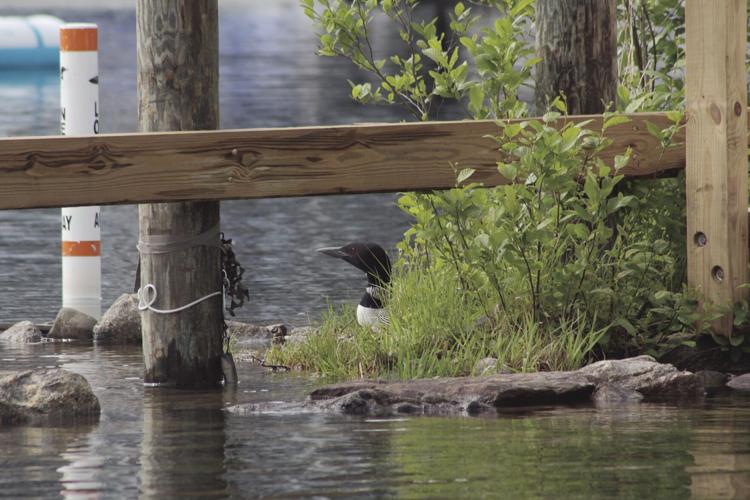
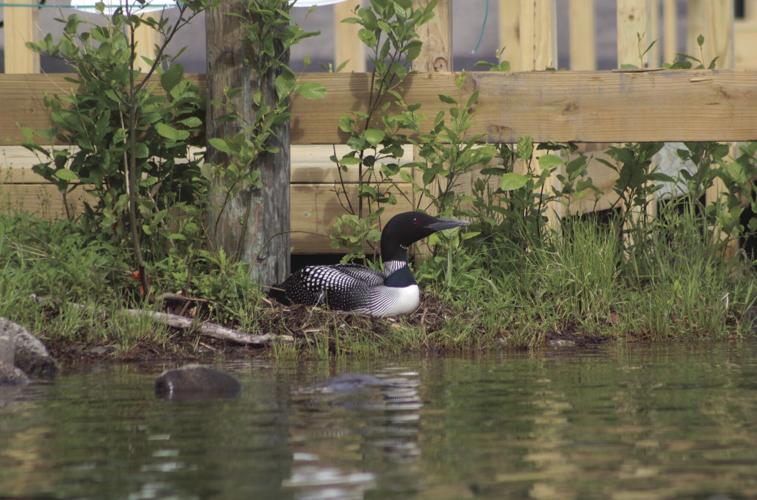
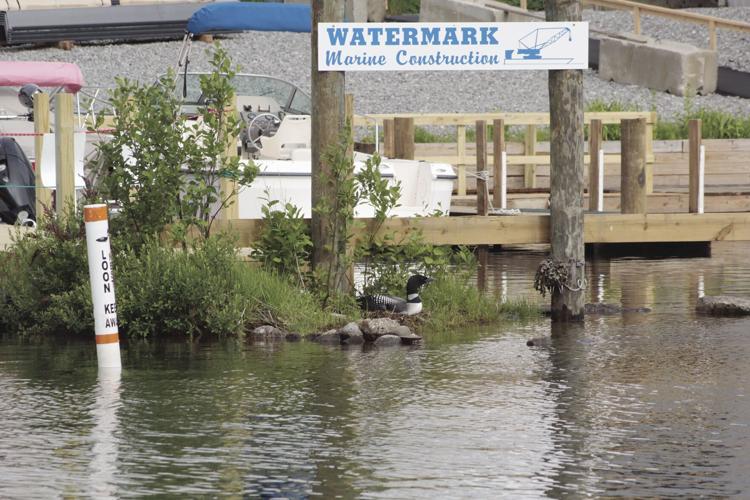
LACONIA — Surrounded by signs warding off humans, a pair of loons trade shifts atop their nest located, of all places, in the Weirs Channel to Paugus Bay. As one of the busiest and most congested areas on Lake Winnipesaukee, hundreds of boats pass by the nest daily, all far within the advised 150 buffer zone for loon nests. Amongst the traffic, the loon incubating its eggs keeps its head on a swivel, alertly but calmly scanning its surroundings for threats.
This begs the question: why would loons ever choose to build their nest in the Weirs Channel?
“It could be that these are inexperienced loon parents,” said Loon Preservation Committee biologist Caroline Hughes. “We’ve observed a pair of loons deeper in Paugus Bay before, but this is a new pair.”
Loons cannot walk on land well, and therefore build their nests on shorelines, typically favoring islands. The end of the North Water Marine dock where the nest is located fits this criteria, however loosely. The channel is not an ideal place for a loon nest, and not only for the obvious reason of boat traffic. Its proximity to human development makes the nest vulnerable to predation from gulls and raccoons who scavenge litter-prone areas.
“There are always loons that nest in spots that mystify us as biologists,” Hughes said, citing a similarly ill-placed nest in Smith Cove.
Loons do not mate for life, the Preservation Committee’s website notes, and rather are very territorial, returning each summer to the same lake, often the same location, to breed each year. This often results in repeated pairings of the same mates, though loons will accept a new mate if its previous partner is killed or pushed out of territory.
“These seem to be very tolerant loons,” Hughes said of the Weirs Channel parents. The Committee has observed no signs of distress in the pair. As the lake becomes increasingly busy and developed, many loons become more acclimated to human presence, Hughes said, which could contribute to the selection of nest locations that seem too hectic.
Boaters should still keep their distance.
Nest failure in loons can be caused by a number of factors. Loons may flush the nest, or flee to the water, if they perceive a threat to their own safety. When this happens frequently, loons will abandon the nest. If a loon flushes in hot weather, too much sun exposure to eggs may corrupt embryo development, Hughes said. Nest flooding is also a risk, especially in a busy channel.
When possible, boaters should move to the other side of the channel to give the loons space. In addition to giving loons maximum distance, boaters should not linger near the nest or try to get a loon’s attention, Hughes said.
Owner of North Water Marine Bob Conrad said he is excited by the loons and surprised at their coolness towards traffic.
“We saw the pair fishing around after ice out. I guess they liked the area,” Conrad said. North Water has been in regular contact with the Preservation Committee about how best support the loons. He commended the Preservation Committee for being “very on the ball” about caring for the loons and making recommendations to the marina.
Conrad said he and the biologists in touch with him are surprised that the loons have stuck around. “They nested during a period of construction on those docks, which surprised us. Then we thought maybe the holiday weekend would make them abandon it,” Conrad said. Though he has seen the loons flush a few times, and even spotted two large eggs, the loons remain seemingly committed to the nest.
Because they hatch only one brood of one or two eggs each year and are involved parents, the average loon pair successfully raises one chick every two years, according to the Preservation Committee. The success of the loon population, therefore, depends on the survival and repeated breeding of adult loons.
According to the Preservation Committee website and 2021 Loon Census, Loon populations have been slowly recovering in recent years, though increased shoreline development and climate change pose ongoing threats.
Learn more about loons and loon reproduction at loon.org/about-the-common-loon/loon-reproduction.


(0) comments
Welcome to the discussion.
Log In
Keep it Clean. Please avoid obscene, vulgar, lewd, racist or sexually-oriented language.
PLEASE TURN OFF YOUR CAPS LOCK.
Don't Threaten. Threats of harming another person will not be tolerated.
Be Truthful. Don't knowingly lie about anyone or anything.
Be Nice. No racism, sexism or any sort of -ism that is degrading to another person.
Be Proactive. Use the 'Report' link on each comment to let us know of abusive posts.
Share with Us. We'd love to hear eyewitness accounts, the history behind an article.