


LACONIA — More than 100 of the city’s middle schoolers got to spend a day at the top of the world — well, the top of New England, at least — as the culmination of a sequence of events that started several months earlier.
In the fall, the sixth grade class took a field trip to summit Mount Major, a hike that offers a commanding view of Lake Winnipesaukee and the White Mountains beyond. One of the students pointed at the distant, snowcapped Mount Washington and said, “Why can’t we go up there?”
That stuck in the mind of Jessica Rominger, a sixth grade teacher at Laconia Middle School. She heard about a program the Mount Washington Observatory had for educators, and she thought it might satisfy, in a way, that question. Called “Arctic Wednesdays,” the program brings a limited number of teachers up to the summit of New England’s highest peak on Wednesdays, the day when a specialized van transports supplies and crew members to and from the summit in the winter.
Rominger applied for the program, and was pleasantly surprised when her application, for her as well as seventh grade teacher Wes Bates, was accepted. The two spent a Wednesday in February at the 6,288-foot summit of Mount Washington, famously home to the “Worst Weather in the World.”
“We arrived when they were doing their staff swap-out,” Rominger said. “We got to experience the observatory, and we got to Zoom into our classroom. I taught a science class from the Mount Washington Observatory, which was really awesome. ... That’s what got the ball rolling.”
That was the conclusion of the “Arctic Wednesdays” program, but Rominger wasn’t satisfied with only experiencing it herself. She said that when she had a chance to debrief with Superintendent Steve Tucker, she told him, “The next coolest thing would be to get the kids up there,” and he responded, according to her, “Reach out to the board members and see if someone has an idea to raise some money to get the kids up there.”
Through Bob Champlin, former superintendent and current consultant to Tucker, Rominger learned the school district’s attorney, Paul Fitzgerald, had an affiliation with the observatory, and his firm, Wescott Law, agreed to give $2,500 to help fund a field trip to Mount Washington. Further, the district’s contact with Primex, a risk management exchange, was Ty Gagne, who found renown with his books about extreme weather in the White Mountains. Gagne came and spoke to the school about the conditions that make the climate atop the White Mountain's highest peak so unusual.
In addition to Wescott Law, two other donors stepped forward to help bring the cost of such a trip, which normally would be beyond the district’s budget, into the realm of possibility.
The total cost of the trip was $7,000. Students helped to cut that cost by selling concessions at sports games, and in the end, the only cost left to participants was $15 each.
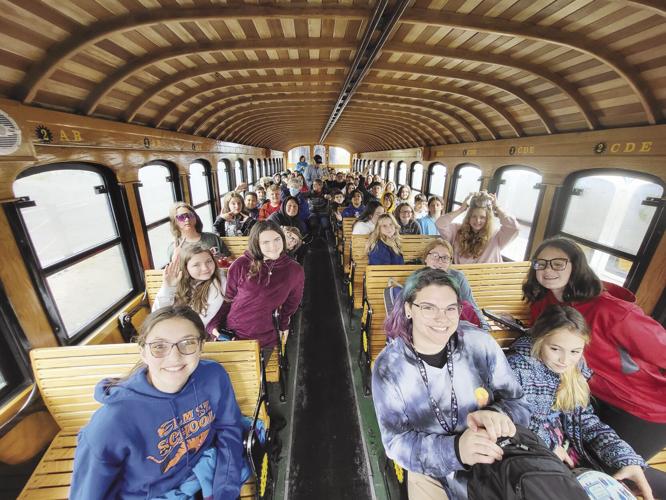
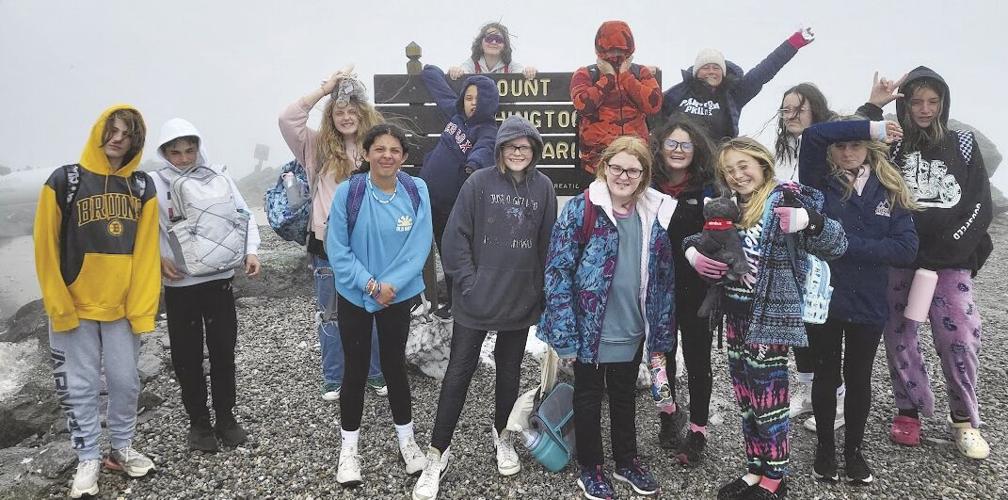
On the big day, or actually days, 140 middle schoolers from Laconia traveled by bus to the base of Mount Washington on June 5 and 6, then boarded the historic Cog Railway to the top, where they were able to see, first-hand, what it’s like to stand more than a mile above sea level, at a point where three weather systems collide.
The weather was, perhaps unsurprisingly, bad. Students were agog, she said, as the train approached, then passed through, clouds that enveloped the shoulders of the mountain, and could watch as raindrops formed on the windows of the train. It was 30 degrees at the summit, with snow and freezing rain whipped around by 50-mile-per-hour winds. In other words, perfect.
“It was one thing after another,” Rominger said about how the field trip took shape. “It all kind of snowballed into this magical experience.”
Students were able to experience weather monitoring, see researchers at work, talk to meteorologists, learn about the technological innovations of the Cog Railway and about how it is adapting by using biodiesel fuel and, one of the most exciting elements to Rominger, they discovered what she called “future learning pathways” — opportunities nearby to explore their curiosity and continue learning, even after they leave Laconia schools.
Of the more than 100 students who went on the trip, only a handful had ever been to Mount Washington’s summit prior, most had never been on a train before, and some hadn’t ever been that far north.
Rominger said the field trip took a year’s worth of planning and fundraising, but the payoff was immeasurable.
“I would do it again in a heartbeat,” she said.


(0) comments
Welcome to the discussion.
Log In
Keep it Clean. Please avoid obscene, vulgar, lewd, racist or sexually-oriented language.
PLEASE TURN OFF YOUR CAPS LOCK.
Don't Threaten. Threats of harming another person will not be tolerated.
Be Truthful. Don't knowingly lie about anyone or anything.
Be Nice. No racism, sexism or any sort of -ism that is degrading to another person.
Be Proactive. Use the 'Report' link on each comment to let us know of abusive posts.
Share with Us. We'd love to hear eyewitness accounts, the history behind an article.