


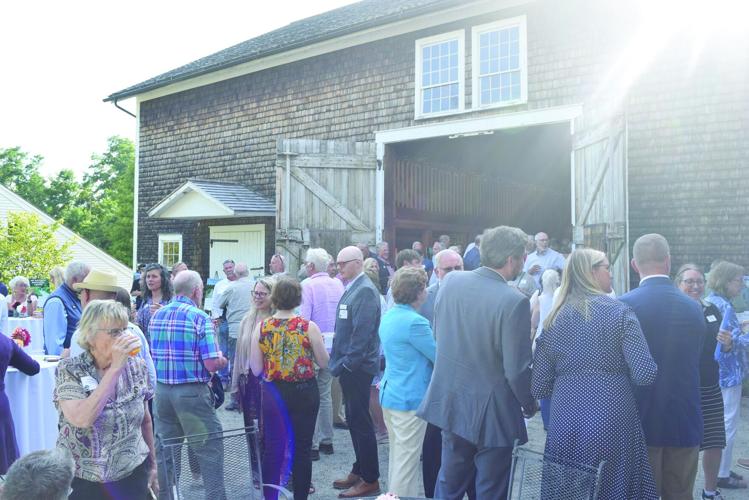
CANTEBURY — Nearly 200 supporters of the Land and Community Heritage Investment Program gathered at the Shaker Village Thursday, to celebrate 25 years of work on projects across the state, preserving historic buildings and properties.
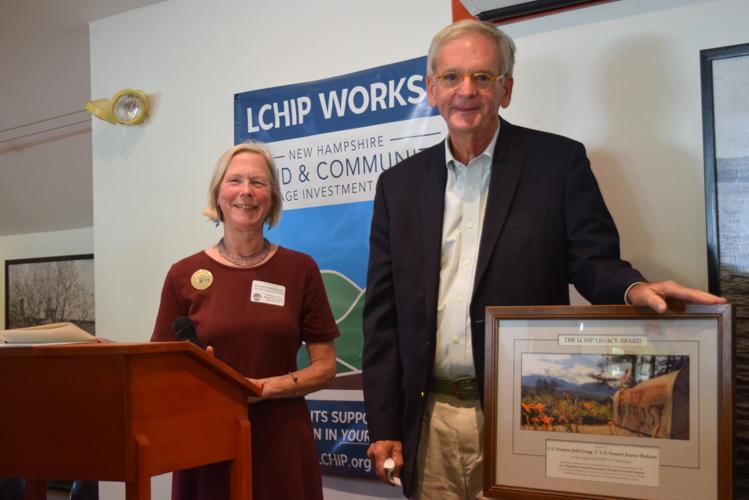
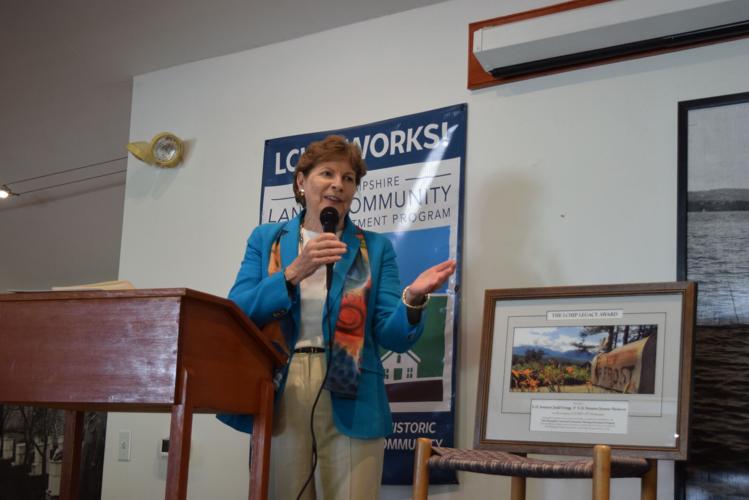
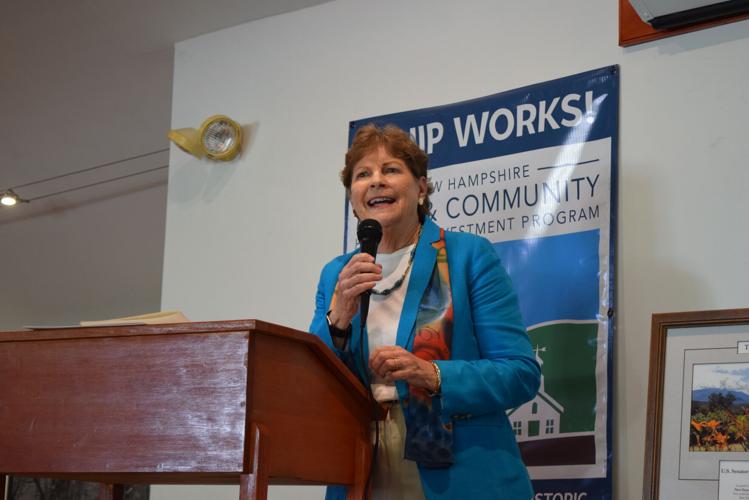
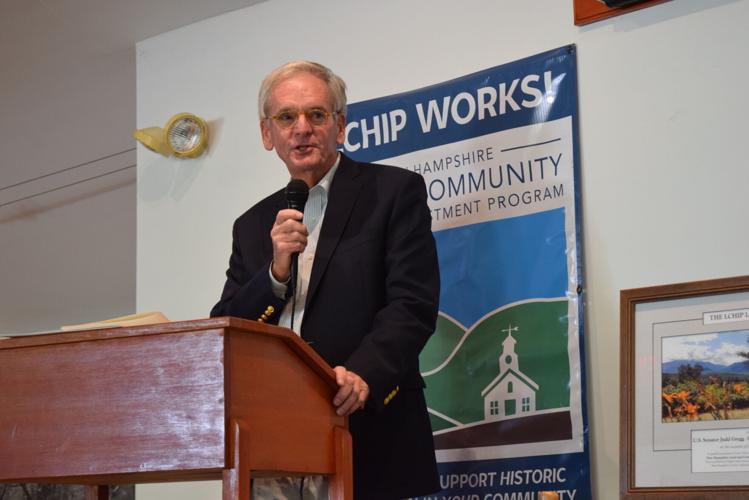
Former Sen. Judd Gregg (R-NH) and current Sen. Jeanne Shaheen (D-NH) accepted LCHIP Legacy Awards for their continued support of the program, which has funded more than 600 projects in the Granite State.
Introducing the award winners were two founding board members of LCHIP, Elizabeth Durfee Hengen and former state Sen. Rick Russman.
Durfee Hengen has been professionally active in historic preservation for 40 years. That whole time, she said Gregg was an instrumental figure in protecting what's special about the Granite State. While she was serving on the LCHIP commission, Durfee Hengen said Gregg was an early champion and bipartisan partner who helped secure federal funding to enable notable projects.
She said Gregg understands the state’s landscape is defined by the integration of natural and historical resources, including in the Lakes Region.
“His efforts directed half a million dollars of federal funds to Webster Farm in Franklin, a landscape of historic buildings surrounded by farmland,” she said. “This property is an important historic and cultural treasure in our state, he said at the time, and protecting it will help preserve Daniel Webster’s legacy.”
Durfee Hengen said Gregg’s efforts helped leverage investments made by LCHIP and others, achieving “remarkable and long lasting results.”
Gregg said he and his wife, Kathy, have always worked to keep New Hampshire a special place. He looked out into the audience, noting he recognized so many faces. He quoted Mark Twain, saying, “In the South, the people define the land, but in the North, the land defines the people.”
“That is the absolute truth about New Hampshire,” Gregg said. “Our state is defined by our unique natural environment, which is punctuated and increased by our architectural beauty that we have. But it doesn’t come easy, and LCHIP has played a major role in making sure it’s secure.”
Gregg said it takes a “matrix of people” from all different backgrounds and organizations to succeed.
“But we can’t live in the past; we have to look forward,” Gregg said. “In looking forward, I think we do have to confront something. That’s the centrifugal force in our culture today of single-interest groups, of social media anger, of organizations who aren’t interested in achieving, but are rather interested in agitating. We have to step back past that, and do it the New Hampshire way.”
In his term, more than 300,000 acres of land was preserved. Every acre was discussed, promoted and debated with all kinds of stakeholders.
“Whether it was the forestry industry, the ski mobilers, whether it was the people who wanted to walk in the woods, people who wanted to preserve the woods, the hunting community, they pulled together, and we reached agreements on these very important issues.”
Russman introduced Shaheen, saying she's a leader when it comes to conservation efforts that include land protection, historic preservation, and environmental issues. This dates back to when she was a governor, all the way through her final year as a senator.
“Importantly, without Jeanne’s steadfast support of signing the LCHIP bill into law, we would not be here today, celebrating 25 years with thousands of acres protected and dozens of historical sites preserved,” Russman said.
Shaheen said many in the room came to tell her about this great idea. She couldn’t get it through the Legislature herself, and asked them all to step up.
“Of course, that is exactly what happened,” Shaheen said. “Everybody stepped up, from both sides of the aisle, from communities across the state, to talk about why this was so important to preserving what makes New Hampshire so special.”
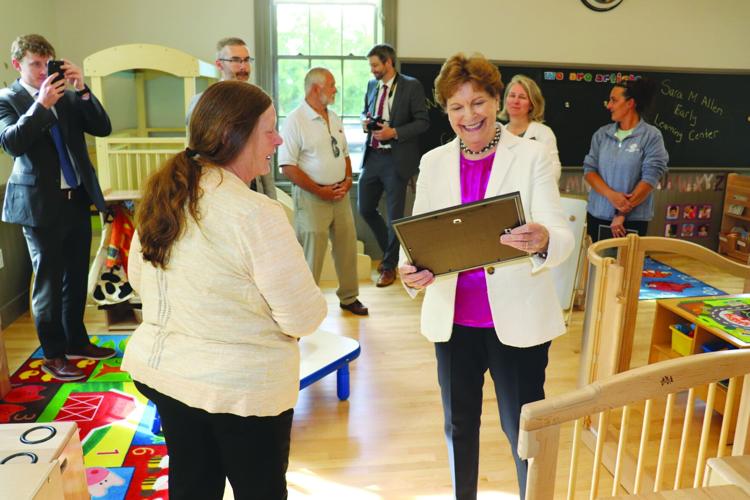
Shaheen is retiring, and said she has been making her final tour around the state, visiting projects she’s worked on and helped fund. She was in Belmont, to visit the Gale School, built in 1874, then had been empty and unused for many years.
She was told work preserving it began more than 20 years ago, and it was the community who helped physically move the structure. With the help of LCHIP funding and congressionally-directed spending, as well as other grants, and support from the community, they have restored the Gale School to its original beauty.
“The whole first floor is a childcare center, so it’s teaching kids again,” Shaheen said. “Looking at that project, listening to people who worked on it for so many years, it is exactly what LCHIP is trying to preserve.”
Shaheen thanked those who made the “experiment” work for so many years, and finished by saying, “let’s keep it up for at least another 50.”
Addressing the crowd, Ben Wilcox, LCHIP board chair, said LCHIP is larger than preservation, but rather gives a sense of place. He said historic buildings help anchor downtowns and communities across the state. Wilcox said today, there are 403 properties under LCHIP stewardship, with 157 organizations monitoring and reporting conditions.
“The scope of that is staggering,” Wilcox said. “LCHIP truly reflects our New Hampshire way of life, bringing together state investment, local matching funds, private philanthropy and community commitment.”
For over 25 years, LCHIP has assisted 348 different organizations in 210 of the state’s 234 communities.
“Ninety percent of the communities in our state have been touched by LCHIP,” Wilcox said. “As of July 31, the number of acres conserved with LCHIP support has surpassed 250,000 acres at this point. The number of historic buildings we have helped rehabilitate is now over 200.”
He added that 24 completed funding grant rounds have taken place, and there have been 646 awarded grants for $68 million, and projects representing $358 million in total project costs have been carried out due to LCHIP.
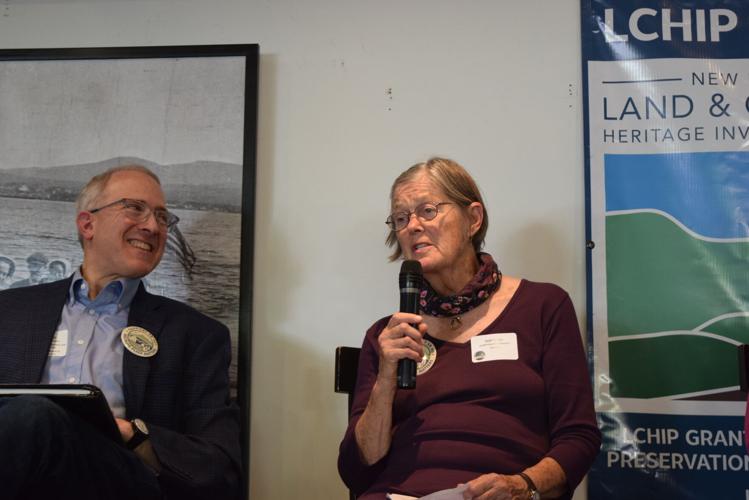
Remarks were followed by a panel discussion with former state Department of Environmental Services Commissioner Tom Burack, former longtime LCHIP Executive Director Dijit Taylor, and Rep. Debra Altschiller (D-Stratham), who is also an LCHIP board member.
Each told stories about their years of hard work, fielding questions from current Executive Director Paula Bellemore.
Burack was on the Land and Community Heritage Commission, whose members wrote the report that recommended the program 25 years ago. The commission worked for more than a year, holding 22 meetings across the state, and heard universally towns were starting to look like each other.
“It’s fair to say the commission did a tremendous amount of listening,” Burack said.
He said they didn’t want to lose the charm that defined who they were, nor the rural character of Main Streets, affected by more and more development. They heard from communities who wanted to protect these places, and some towns had a list of as many as 100 natural, cultural, historical resources they thought worthy of protection.
While there were 629 state properties on the National Register of Historic Places, nearly 60% had no level of protection.
“These historic properties were really at risk,” Burack said. “All these towns have things that were part of their heritage, that they wanted to hold on to, and the state couldn’t afford to lose them.”
Taylor said LCHIP is doing something no other program is doing nationwide by protecting both natural resources and history. This makes for many sets of rules to be mastered. Then money comes from two spots, but sits in four pots. In the end, it all goes toward the success of the program.
“People in New Hampshire love their resources,” Taylor said. “It may be a historic resource, or a natural resource, but the people that apply to LCHIP are passionate about their projects.”
Altschiller said LCHIP figured out 25 years ago a sense of place isn’t preserved just by writing a check.
“You preserve it by staying in a relationship with the people who live there, and help these projects along,” Altschiller said.


(0) comments
Welcome to the discussion.
Log In
Keep it Clean. Please avoid obscene, vulgar, lewd, racist or sexually-oriented language.
PLEASE TURN OFF YOUR CAPS LOCK.
Don't Threaten. Threats of harming another person will not be tolerated.
Be Truthful. Don't knowingly lie about anyone or anything.
Be Nice. No racism, sexism or any sort of -ism that is degrading to another person.
Be Proactive. Use the 'Report' link on each comment to let us know of abusive posts.
Share with Us. We'd love to hear eyewitness accounts, the history behind an article.