


After community issues came to define local and state races in September’s primary in Belknap County, it was national issues that set the tone for voters during the general election Tuesday.
At polling places in Gilford and Laconia’s Wards 2, 5 and 6, voters listed inflation, energy prices, cost of living, reproductive rights, preservation of democracy and protections for Medicare and Social Security as their weightiest issues.
For Chuck Clark of Gilford, inflation and the economy left no question in his mind about who he would vote for. “I think that’s why it’s so busy today,” he said.
“The cost of living is just so high now, older folks like me won’t be able to afford to live like this much longer,” said Sara Levasseur, of Laconia’s Ward 2.
Another Ward 2 voter said protections for Medicare and Social Security were top of mind. “I don’t want to see them go anywhere,” she said. While concerned about high costs and economic slowdown, “I’m not sure one person is responsible for all of that. No matter what they say.”
Joan from Laconia’s Ward 5 and Kathryn L. from Ward 6 do not identify with a party, and both said they split the ticket during this midterm, and were quick to identify abortion as their top issue. Kathryn said the state’s abortion ban had made her torn about whether to vote for Gov. Chris Sununu, of whom she otherwise approves.
Marty Bloom of Gilford said that, though she didn’t want it to be, “women’s rights” was the determinant issue in her ballot choices. Bloom said she was frustrated by New Hampshire’s new 24-week abortion ban and feels there is a middle ground on the issue that politicians haven’t found.
Bloom said she doesn't buy it when Republican candidates, notably congressional candidate Karoline Leavitt and Senate candidate Don Bolduc, say that though they are pro-life, they wouldn’t support a national abortion ban.
“It’s like they’re saying ‘I’m pro-life, but not really.’ They don’t mean it,” she said.
The handful of voters who highlighted local issues didn’t point to county-level controversies — such as Gunstock Mountain Resort and the county budget — that dominated conversation during the primaries.
Edgar Conroy of Laconia, a recent high school graduate, said he was balancing concerns about homelessness with his broader concerns about the economy and crime, especially in state-level races.
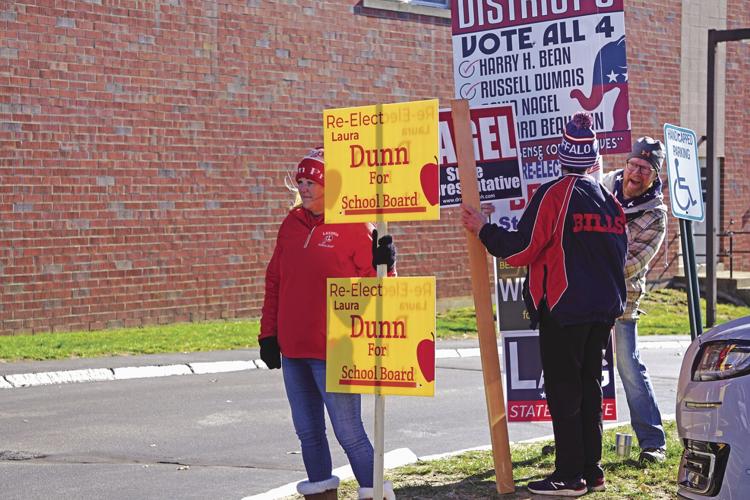
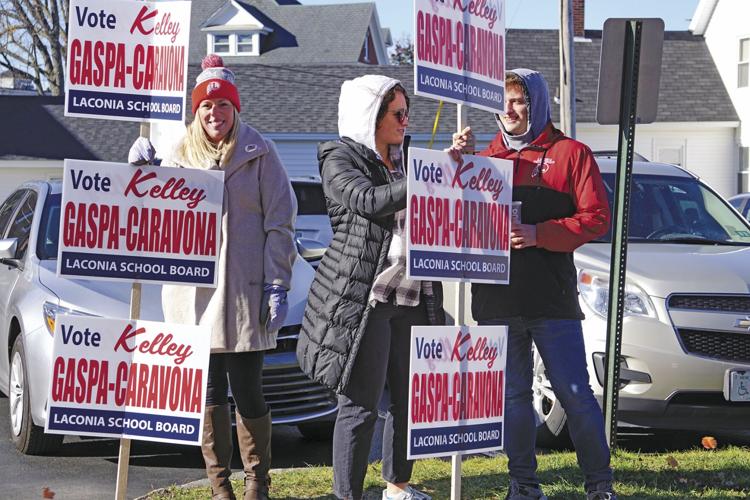
Conroy, in doing his own research, reached out to trusted community members on both sides of the aisle, including for the contentious Laconia Ward 2 school board race.
McKenna Caldwell, a teacher from Laconia, said she and some coworkers researched state and federal candidates' positions on education and women's rights before heading to the polls.
“I’m a teacher, so I want to see people that support public schools,” she said. “The goal is to find candidates that align with most of my beliefs, if not all.”
For the school board race, she said examining both candidates' backgrounds and involvement in the community equipped her in her decision.
Many voters said they split the ticket, voting for candidates in both parties. These voters largely said they chose candidates based on their character, rather than their party affiliation or policy promises.
Self-described split ticket voter from Ward 5 Warren Bailey shared an affinity for Democratic causes in his vote this year. He felt there should be privacy around medical decisions for everyone, including women, and didn’t think that inflation could be blamed on any person or party.
“We’re talking about inflation like we’re the only country in the world suffering from it,” Bailey said. “It’s a global issue right now, and nobody, no party, has a magic bullet to fix it.” Bailey said that, overall, he looked for a compromise-minded and forward-thinking approach to governing in candidates.
Kathryn L. said that in the past she had voted more on policy, but now, because “it seems to be an issue currently,” she first looks at a candidate’s character. She included respect for democracy and acceptance of election results as a key character quality.
Joan emphasized that for a candidate anywhere on the political spectrum, a sense of trustworthiness is what earns her vote.
“I just want to feel like I can believe them,” she said. She cross-references incumbents’ voting records with what they say on the stump and, for newcomers, uses her gut.
She paid special attention to the congressional race between incumbent Democratic Rep. Chris Pappas and Leavitt.
“I couldn’t figure out Leavitt,” she said. “She’s certainly very bold for a girl her age. I suspect she’s a Libertarian.” This suspected affinity, as well as Leavitt’s associations with former President Donald Trump, took her out of contention for Joan’s vote.
With increasing polarization and dominance of specific issues up and down the ballot, many voters were certain of choices long before entering the voting booth.
Those who had a harder time deciding largely identified the U.S. Senate matchup between incumbent Democratic Sen. Maggie Hassan and Bolduc as the race that had them torn.
“I voted for Hassan for governor because I didn’t like the Republican option in the race at the time,” said a voter in Gilford who voted “straight-ticket Republican” on Tuesday because of high energy prices and inflation, which he blamed on Democrats in Washington.
In the local races, he added, “there are about two or so Democrats that I would have voted for under different circumstances.”
Steve G., another Gilford voter, said making a decision on the Senate race was tough. Energy prices, and Congress’ actions to stymie fracking, tipped the scale for him in the end.
Steve Walsh of Laconia Ward 6, who said that though he’s registered with a party, he “crosses the aisle regularly” with his vote, and is a former Department of Defense employee. For this reason, he said, he is partial to candidates with military affiliations.
In the end, though, “I based my decision on who was the more moderate candidate,” he said.
One thing voters, candidates and campaigners alike agreed on was that turnout appeared to meet or exceed predictions for a high rate of participation this midterm election.
In Laconia Wards 2, 5, and 6, campaigners said the stream of voters had been steady and busier than they expected. In Gilford, voters could be seen taking laps around the parking lot, waiting for open spaces well past 10 a.m., when a mid-morning slump would typically set in.


(0) comments
Welcome to the discussion.
Log In
Keep it Clean. Please avoid obscene, vulgar, lewd, racist or sexually-oriented language.
PLEASE TURN OFF YOUR CAPS LOCK.
Don't Threaten. Threats of harming another person will not be tolerated.
Be Truthful. Don't knowingly lie about anyone or anything.
Be Nice. No racism, sexism or any sort of -ism that is degrading to another person.
Be Proactive. Use the 'Report' link on each comment to let us know of abusive posts.
Share with Us. We'd love to hear eyewitness accounts, the history behind an article.