


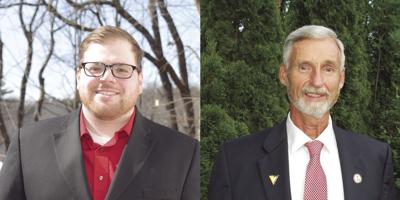
BELMONT — Redistricting often creates atypical campaigns: districts might be combined or moved, and incumbents — rather than take on challengers — sometimes face one of their colleagues. In such races, the advantages of incumbency are swept aside as candidates’ records can be compared directly.
In the newly formed Belknap District 4, Reps. Travis O’Hara and Michael Sylvia — currently representing Districts 9 and 6, respectively — vie for the Republican nomination to a single seat.
The race is closely watched for several reasons.
The new Belmont district is the only race in the county delegation with more incumbents than open seats and without any challengers. In this race, the typical strengths of incumbency — name recognition and established record, especially — could pose as weaknesses.
Yet there is also an imbalance to this incumbency factor. Sylvia is the chair of the Belknap County delegation and running for his sixth term in Concord. O’Hara is in his first reelection campaign against an opponent who sparked his involvement in politics in the first place.
Next, because of the New York Times’ coverage of Croydon’s “come-to-Jefferson moment” with the Free State Project, the spotlight on some candidates’ status as Free Staters has intensified in primary races this fall.
Finally, Gunstock Mountain Resort is top of mind for many voters in the primary.
This race is about far more than recent mountain events. Each candidate's service and responsibilities extend far beyond their role appointing the Gunstock Area Commission, the volunteer group with oversight of the mountain. Nor do the voters of one district speak for where the entire county stands on any given issue.
Nevertheless, its incumbency face-off and Sylvia’s prominent role as county delegation chair mean that this race — more than any other county contest — will be seen as a referendum on how a divided delegation mobilized in the mountain’s turmoil.
O’Hara, a business consultant with an accounting degree, is a Laconia native who moved to Belmont as a teenager when he and his now wife became young parents.
He became interested in politics during Donald Trump's presidency by calling up his state representative at the time, who happened to be Sylvia.
“I wanted to watch a little closer because everyone was freaking out about things,” O’Hara said. “[Sylvia] actually told me to come to the county meetings and that's what got me involved with politics.”
O’Hara said that his approach to politics is rooted in his outgoing and accessible nature.
“I'm not scared to speak my mind,” O’Hara said. “But I'm not the type of person that will be mad over someone with a different opinion than me.”
He emphasized that the will of his constituents takes precedence over his own personal stance.
“If there's a vote that, in my gut, I would want to vote for, but my people don't want me to, I would vote against it,” he said.
In his first term, O’Hara was appointed to the Special Committee on Redistricting and the House Transportation Committee. He highlighted his vocal support to increase the amount of Meals and Rentals Tax revenue distributed to municipalities. In the upcoming session, he is passionate about adoption rights — namely, decreasing the restrictions on who can adopt so that anyone equipped and enthusiastic to do so can.
He also plans, in concert with other reps., to reintroduce legislation to make the GAC an elected position. He believes this will increase citizen engagement with and awareness of Gunstock as a county-owned asset.
O’Hara was one of the 10 delegates who attended an emergency Aug. 1 meeting that ousted controversial commissioner David Strang and brought back Gunstock’s management team. Sylvia did not attend and has challenged the legality of the meeting and its actions.
O’Hara distinguishes himself from Sylvia largely in approach, rather than in policy.
“I'm willing and able to go out and listen to the people more and, you know, actually respond to emails and try and always be available to the people,” O’Hara said. He said, during the campaign, he’s heard complaints from Belmont residents that Sylvia is not a responsive communicator.
When it comes to the delegation, O’Hara said he feels that many delegates’ personal agendas have gotten in the way of good governance.
“I'm not saying Sylvia is a bad person, a bad leader,” O’Hara said. “We just need someone that can reach across the divides among our party on the delegation and be honest with both sides... There's zero communication right now from leadership.”
He said he is ready to listen and collaborate practically. "If both sides are honest, they always can find common ground,” he said.
Sylvia is a retired FedEx employee first elected to the legislature in 2012. He declined to do an interview or provide a written statement for this story.
Sylvia is a member of the House Judiciary Committee. According to his website, his policy agenda includes government transparency and civil asset forfeiture reform. It also emphasizes his high scores from the House Republican Alliance and, during his career, customer service and team leadership experience. Sylvia describes himself as someone who works toward “smaller and more accountable government which uses less coercion and is more reliant on voluntary interactions.”
In the last term, Sylvia sponsored an unsuccessful Right to Know law reform where municipalities would have to disclose how much they offer or pay for property sales and leases. He additionally sponsored a bill to legalize cannabis possession and home cultivation.
In January, Sylvia proposed a constitutional amendment — which received 13 total votes, with 4 from Belknap County representatives — for New Hampshire to secede from the United States.
Sylvia is a member of the Free State Project, a Libertarian movement of “liberty activists” who are migrating to New Hampshire, a small state with Libertarian leanings. Their mission is to permeate and overtake politics to create a haven of limited government.
Sylvia does not put his status as a member of the project on his website beyond noting his membership in Lakes Region Porcupines, a Libertarian-associated service group. He has appeared on the project’s podcast and website, been praised by movement leaders — notably for the secession amendment — and attended the movement’s “Porcfest” festival several times. He moved to the Granite State in 2010; his blog describes himself as a refugee to New Hampshire from Democratic New York.
Sylvia has advocated for more stringent government control of county-owned Gunstock and its management. His blog states that government should not try to run a competitive business, though he signed a pledge not to lease or sell the area. The Gunstock Area Commission’s Audit Subcommittee was founded as an olive branch to Sylvia and other delegates who thought the delegation should have more direct oversight to Gunstock’s finances. The GAC’s Legal Services Subcommittee, which led an internal investigation into past GAC litigation, was formed per a request from Sylvia.
Sylvia supports former commissioner Strang, who has contested that he resigned: tension between Strang and the management led to their mass resignation, and they conditioned their return on his departure. Sylvia and Strang have both accused Gunstock’s management of financial malfeasance — Sylvia maintains that they walked out because they might face accountability.
State representatives serve two-year legislative terms in the 400-member New Hampshire House. It is a nearly volunteer post, paying just $100 per year, plus mileage. Representatives in Belknap County also perform duties in county government as part of the Belknap County Delegation. The 18-member delegation is responsible for approving the county budget, which is drafted by the County Board of Commissioners. The delegation also appoints members of the GAC, the five-member, non-partisan body tasked with overseeing mountain operations, similar to a board of directors.
The state primary is Sept. 13 and the general election is Nov. 8.


(0) comments
Welcome to the discussion.
Log In
Keep it Clean. Please avoid obscene, vulgar, lewd, racist or sexually-oriented language.
PLEASE TURN OFF YOUR CAPS LOCK.
Don't Threaten. Threats of harming another person will not be tolerated.
Be Truthful. Don't knowingly lie about anyone or anything.
Be Nice. No racism, sexism or any sort of -ism that is degrading to another person.
Be Proactive. Use the 'Report' link on each comment to let us know of abusive posts.
Share with Us. We'd love to hear eyewitness accounts, the history behind an article.