


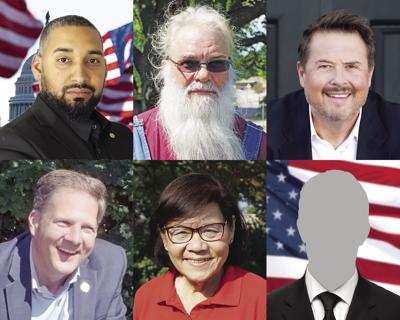
A field of challengers must climb a steep hill of public opinion if they hope to unseat incumbent Gov. Chris Sununu in this year’s primary. A recent University of New Hampshire poll reported that 72% of likely Republican primary voters favored Sununu. Less than 15% favored the other candidates, combined, and only 14% were undecided.
The challengers, all to the ideological right of Sununu, each differentiate themselves from him from a different angle. One, Karen Testerman of Franklin, has faced off against Sununu before: she received 9% of the vote in the 2020 primary. Most of the candidates accuse Sununu of being out of touch with the state’s Republican base, especially on his approach to the pandemic, education and women's reproductive rights.
Despite these claims, only 11% of likely Republican voters have an unfavorable view of him. More than 50% of those polled said they did not know enough about the other candidates to make any statement about them.
Julian Acciard is a former homeless veteran who grew up in New Hampshire who hopes to raise awareness for others facing similar circumstances.
Acciard comes from a military family and is a former U.S. Marine himself. After being medically retired from service, he experienced homelessness in San Diego.
Then, “I basically rebuilt my life from scratch and I went back to school, studying Homeland Security, anti-terrorism with an emphasis in behavioral psychology,” Acciard said. He and his young family moved to New Hampshire. He now works for his family’s business and as a policy consultant.
Acciard said his experience has led him to believe that most citizens’ distaste for politics comes from not being spoken to with respect.
“Republicans have, I truly believe, great policy. But we have dismal marketing for that great policy,” he said.
On the issues, Acciard said that addressing the veteran homelessness crisis is at the forefront. He believes the promises of both parties on that issue have been hollow. “The reality is I have not seen a single Republican or Democrat come to help homeless veterans,” he said.
Acciard also said there needs to be more choice and flexibility in the school system and advocated for education freedom accounts. He is also pro-Second Amendment and pro-life, he said.
Acciard said he is both unabashed and also practical about where he stands. “I don't believe in grandiose statements because they are meant to elicit people opening up their wallets for donation dollars. With me it’s honesty and integrity. I won't lie to you, even if it'll make you happy.”
Jay Lewis is a 35-year Laconia resident who, as he puts it, is “the only biker running for governor.” Like many candidates before him, Lewis is running because he’s faced a specific obstacle in state government and, as conventional wisdom goes, the best way to fix something is to do it oneself.
Lewis has been frustrated by many of his interactions with the Department of Motor Vehicles regarding titling and how his documents are mailed. After years of asking elected officials to step in, he’s doing so himself.
“After three, four years of fighting with the DMV, how do you fix something?” Lewis said. As a former electronic technician, getting his hands dirty to find solutions is “the only way I know how to fix something.”
Lewis’ politics, however, go beyond the catalyst for his campaign. He actually used to work in the mailroom at the statehouse, and believes his background in business and technician work will equip him to understand where the metaphorical broken cogs are in New Hampshire's government machine.
Other policy passions for Lewis are marijuana legalization and paring down what he sees as frivolous parts of the Liquor Commission’s enforcement practices. He is also pro-choice.
Lewis has centered his biker identity in the race because he feels the biker network in New Hampshire is a large, community-minded and down-to-earth community.
Richard McMenamon II of Gilmanton Iron Works could not be reached for an interview. McMenamon is a professional logger. He sued the New Hampshire Department of Health and Human Services in 2021 over allegations of child neglect and abuse by the mother of his children, a DHHS employee. His claims were dismissed by a judge.
Thaddeus Riley has made education policy the cornerstone of his campaign. He listed parental rights, banning critical race theory and addressing the teacher shortage as needed next steps in elevating the public school system in New Hampshire.
“None of the others” in this primary, he said, “have the experience that I do in public education.” He was a school board member in his hometown of Brentwood from 2018 to 2021.
Because Sununu’s children attended private school, Riley said, the governor is not sufficiently equipped to handle the issues facing public schools now. Riley said his lack of political experience is an asset because he is not a career politician who will play games with stakeholders.
“I am the true outsider coming in, somebody able to get a problem solved and somebody who's been trusted in times when times are tough,” he said.
Riley jumped into a race for school board because he heard that there were disappointingly few candidates. On the board, he focused on things like the lunch program and the idea of outdoor classrooms. He highlighted his fiscal prudence at that role, and the fact that Brentwood was one of the first districts in the state to return to in-person learning.
Riley describes himself as a conservative Christian. Outside of education, he said election integrity is a policy priority.
Before serving three terms as governor, Sununu was a three-term executive councilor. He also worked as an environmental engineer and chief executive officer of Waterville Valley Resort.
The incumbent is running on his record: he highlighted that New Hampshire was able to endure the pandemic with low death rates while also retaining its title of first in the nation for overall freedom, as determined by the Cato Institute.
“It's about having the right management team in place to take on whatever tomorrow's challenge might be,” Sununu said. Given continuing pandemic concerns, inflation and other unpredictable challenges facing the state, it is “absolutely the wrong time to start switching out the team.”
Solutions have come — and will come — Sununu said, from finding both balance and flexibility in governance.
“My approach has always been customer service,” he said. “How do I wrap our system and our availability of programs around your individual needs, your kids' needs, your business needs, your family? It's not about me, it's about you.”
Responding to the critiques from challengers, Sununu emphasized that public opinion stands by him. He also noted that the governor must serve all citizens before serving his party.
“I’m a rational conservative,” he said. But there are “1.4 million people I've been elected to represent and I will represent each of them with 110% of my effort without prejudice or political bias in any single way.”
Karen Testerman believes that the best governors are those who understand the limitations of their office as well as the powers.
Testerman, a nonprofit leader, former Franklin city councilor, and former teacher, has put social issues and rejection of pandemic restrictions at the forefront of her campaign.
In 2000, Testerman founded Cornerstone Policy Research — a “nonpartisan, nonprofit Christian advocacy organization,” according to its website — so that the state could have an organization “looking at how policy affects the family,” she said. She has been involved with numerous other advocacy groups, notably including time as vice president of the NH Federation of Republican Women and chair of the Merrimack County Republican Committee.
Testerman first ran for governor in 2010 “to keep social issues in the discussion.” She decided to run in 2020, and again this year, because of concerns for individual liberty.
“We've strayed from our Constitution so far that the people's rights are no longer protected, but they're now being controlled and dictated,” she said. Testerman criticized Sununu’s pandemic actions, saying that they stripped people of their ability to make decisions about themselves and their families and hamstrung small businesses.
Testerman said people might have a misconception that she is “just a nice lady” and “lacks the intestinal fortitude” to deliver. She asserts that her activist background has given her years of experience and groundwork on a range of issues — everything from school curriculum to nuclear energy — and makes her more in touch with everyday voters.
The winner of this primary will face Democrat Tom Sherman, a state senator who was unopposed for the Democratic nomination.
The state primary is Sept. 13 and the general election is Nov. 8.


(0) comments
Welcome to the discussion.
Log In
Keep it Clean. Please avoid obscene, vulgar, lewd, racist or sexually-oriented language.
PLEASE TURN OFF YOUR CAPS LOCK.
Don't Threaten. Threats of harming another person will not be tolerated.
Be Truthful. Don't knowingly lie about anyone or anything.
Be Nice. No racism, sexism or any sort of -ism that is degrading to another person.
Be Proactive. Use the 'Report' link on each comment to let us know of abusive posts.
Share with Us. We'd love to hear eyewitness accounts, the history behind an article.