


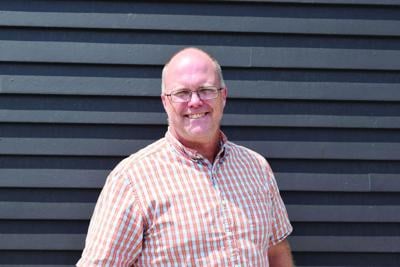
MEREDITH — Republican Edward Twaddell is running to represent for Belknap's District 2. The West Point graduate and member of the Inter-Lakes School Board thinks there are plenty of issues to address, all intertwined.
“People just want to beat the drum in a single issue,” Twaddell said. “I’m not saying they’re bad people, but it makes it more difficult to take somebody seriously, if all they worry about is one issue.”
Who is Twaddell?
Twaddell has lived in New Hampshire since he was 8, when his father was stationed with the U.S. Army at the former Fort Devens, in northern Massachusetts. They lived in Jaffrey, and his parents still live in the house where he grew up.
Following his father’s military footsteps, Twaddell headed off to the United States Military Academy, graduated in 1997, and was commissioned as an infantry officer. While initially he was involved in peacekeeping missions in The Balkans and Haiti, the world drastically changed on Sept. 11.
What he thought might be a six-years-and-out scenario turned into an Army career, spanning more than 25 years, ending with retirement as a colonel. He was stationed stateside and in Italy, and deployed to Egypt, Iraq, Djibouti, and Afghanistan.
During his time in the Army, Twaddell worked in the embassy in Baghdad, on foreign military sales with large international budgets, and as deputy commander for large-scale training exercises.
Just before retiring in spring 2020, Twaddell and his family moved to Meredith, and have been here ever since, running a small farm raising pastured lamb and producing honey.
Twaddell serves on the Meredith Conservation Commission and is a Boy Scout leader. While his two daughters attend Tilton School and Sant Bani, Twaddell is a current member of the Inter-Lakes School Board, and said his knowledge of the ins and outs is vital.
“It’s important to give back, whatever it is, whether it is working with the youth in scouts or public office, everybody has a way that they can give back,” Twaddell said. “I think a lot of people don’t, because they haven’t figured out what the best way for them is.”
Why he's running
“I like big problems. I like complex problems.”
Twaddell defines a complex problem as one when you apply pressure, you can’t undo it, for better or worse. He said with economics, and people’s lives, he enjoys thinking about “second and third order effects.” Twaddell said he thinks society has become “wickedly reductive,” and thinks he is the candidate to address these issues.
“You know, like planning for success,” Twaddell said. “There’s four people in the primary. I’m going to plan that I’m going to be one of the two that comes out of the primary on the other side.”
Twaddell likes how there is an intersection between state and local government in this seat, as two seats represent one town.
“You could make an argument that it is both a position that is both local, as well as state, because you’re not crossing town boundaries,” Twaddell said. “As a state rep., I could liaise directly with the selectboard without worrying about irritating another selectboard.”
Platform
The top three issues he sees facing the people of New Hampshire and Meredith are housing, business environment, and education.
He said other candidates, notably Democrats Dean Cascadden and Seth Wheeler, have spoken about education, keeping water clean, and nature. He said they haven’t identified how they will make changes.
“Education, education, education,” Twaddell said. “OK, well, there’s other problems, too. They are all interrelated, and I tried to touch on that.”
Twaddell wrote a letter to The Laconia Daily Sun, and praised education, but said a business environment is needed.
“Whatever you think of business taxes, you can have all the business taxes in the world, or none of the business taxes in the world,” Twaddell said. “But if you don’t have any businesses, you don’t have any revenue. Period.”
He said Wheeler said the state is aging, and agreed, noting demographically, New Hampshire is the second oldest state in the country.
“OK, well, we’ve got to bring this workforce in to support this aging population, but how are we going to get them to stay and raise a family here?” Twaddell asked. “Well, you’re going to have good schools. OK. Hey, there’s housing. Nobody wants to live in a tent. Even if they’re sending their kids to the greatest school on the planet, no one wants to live in a tent 365 days a year, especially in January here. So, you’ve got a housing problem that’s interwoven, and they’ve got to have a job in order to pay for housing. It’s all interwoven.”
Housing
“Needless to say, housing in the State of New Hampshire is expensive,” Twaddell said.
Twaddell said there has been plenty of talk about property taxes and how to lower them. He noted people are getting priced out.
“It’s not OK for someone that’s lived in their house that’s on a fixed income at 70 years old and, hey, 'I’ve owned this house for 30 years, because I paid it off when I was 40. Now, you raised my property tax, and I’m getting kicked out because I can’t pay my property. Not because I didn’t pay it off, not because I haven’t paid it in the past, but because you’ve raised it on me.'”
Twaddell bought a large piece of land when he moved to town, because he wanted his privacy. He said if you can afford to purchase and maintain a chunk of land, it should be allowed.
There's been talk about accessory dwelling units, and he said they should be allowed, in an effort to improve property.
He isn’t a fan of short-term rentals, however, saying some become short-term hotels instead of housing. He said there could be strains on infrastructure, and doesn’t think tax structures have kept up with that concept.
“I don’t know where the break point is, of where it is no longer a town issue and now it is a state issue. But somewhere in there, one of the things I love about this state is that so much resides at the local level.”
Education
Twaddell said, like seemingly everyone, he is concerned about funding schools. He said public school is not the only way to achieve education.
“In order to better, more efficiently achieve public education, we need to look at more and different ways beyond the existing public school system,” Twaddell said.
Inter-Lakes has a declining enrollment, but budgets are increasing. He said there is an increasing number and proportion of special education needs. Not only is the number of children with special education requirements going up, but since enrollment overall is decreasing, the percentage of those requiring special needs is rising.
Twaddell said 60% of the operating budget goes toward 40% of the student body. He is not suggesting “for one second” they shouldn’t provide services students need, but used an analogy.
“What we’re doing is moving 60% of the peanut butter to 40% of the bread, and that leaves 40% of the peanut butter for the other 60% to scrap over. And, OK, how do we allocate that 40%? Now we have kids that aren’t seeing the opportunities that they deserve.”
Twaddell said if someone wants to challenge him on this, he would fight all day, but this is why his children don’t attend Inter-Lakes. He said his girls work exceedingly hard, and he’s grateful he doesn’t have to deal with some of the problems Inter-Lakes is facing.
“As a father, I have a responsibility to provide for my daughters the best opportunities that I can,” he said. “Those were not present in Inter-Lakes because of this. As an example, my oldest daughter, as a sophomore, took three advanced placement classes. You cannot even take an advanced placement class at Inter-Lakes until you’re a junior.”
Economic development
Intertwined with schooling, Twaddell feels strongly about promoting trades, in programs like those offered at the Huot Technical and Career Center, in Laconia. He said, locally, when someone wants work done on their summer homes, Massachusetts businesses pick up and drive to New Hampshire for plumbing and carpentry, because it is that profitable, with that much demand.
Twaddell said trades, technology, finance, and medical people are needed, and this should be a focus.
“Whether it is the trades, whether it is microchip development, whatever it might be, I would be really interested in seeing, what New Hampshire is looking at developing, and what are our shortfalls?” Twaddell said. “If there’s demand for tradesmen coming up from Massachusetts, as a state, why are we letting that happen?”
As the state ages, he said, the medical field is growing, like for live-in nurses and geriatric specialists.
“We’re going to need more of these people,” he said. “What are we doing to attract these folks? I’m just an idea guy, right? But there is somebody out there that owns this, that has the smarts to say, 'Hey, this is where this bubble of folks is, this is when the demand is going to be the greatest based on the current aging trends.'”
Why vote for him
“We are being wickedly reductive in a very complex system,” Twaddell said, and all the issues tend to relate. He said education relates to business environment, which relates to housing, which can relate to things like food insecurity and cost of living. That, he said, continues down the line, and bigger pictures need to be examined.
“I think of more than one thing. There is more than one problem out there.”
Twaddell will appear on the ballot Tuesday, Sept. 8.


(0) comments
Welcome to the discussion.
Log In
Keep it Clean. Please avoid obscene, vulgar, lewd, racist or sexually-oriented language.
PLEASE TURN OFF YOUR CAPS LOCK.
Don't Threaten. Threats of harming another person will not be tolerated.
Be Truthful. Don't knowingly lie about anyone or anything.
Be Nice. No racism, sexism or any sort of -ism that is degrading to another person.
Be Proactive. Use the 'Report' link on each comment to let us know of abusive posts.
Share with Us. We'd love to hear eyewitness accounts, the history behind an article.