





(Photo by Total Shape via Pexels)
By Stephen Beech
The trendy keto diet provides greater health benefits than other popular weight-loss plans, according to new research.
Clinical trials showed that the very low-carb diet — followed by celebrities including Gwyneth Paltrow, Halle Berry and Kourtney Kardashian — also boosts the liver as well as helping to shed weight.
The keto diet that severely limits carbohydrates but is high in fat has the greatest health benefits for obese people compared to a Mediterranean diet or a low-fat diet, say American scientists.
The findings, published in the journal Cell Metabolism, showed that after following a ketogenic — or "keto" diet — for four or five months, about half of participants with obesity and prediabetes no longer met the criteria for prediabetes.

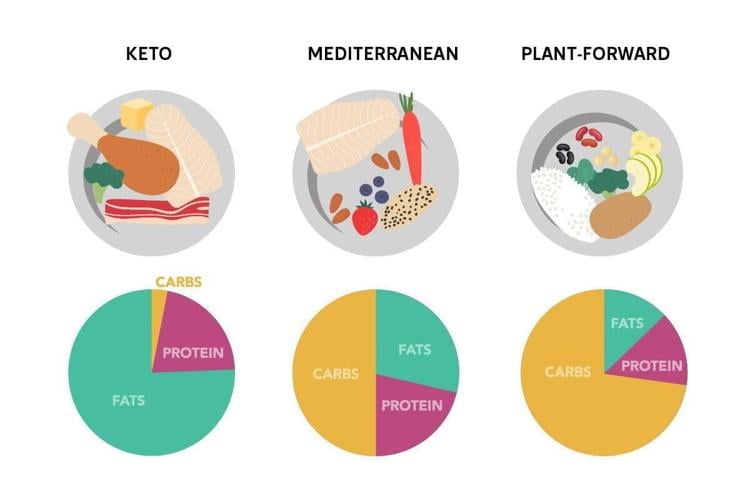
WashU Medicine researchers led a clinical trial testing three diets with different proportions of carbohydrates, fats and proteins and found all of them improved metabolic health, but a very low-carb ketogenic diet had additional benefits for liver health and blood sugar control. (Katie Gertler/WashU Medicine via SWNS)
Study senior author Dr. Samuel Klein, from Washington University School of Medicine in Missouri, said: "We know weight loss can improve metabolic health in people who are obese."
"Our data suggest that if you have high liver fat content and prediabetes, reducing carbohydrate intake can have important therapeutic effects on metabolism beyond just weight loss alone."
Healthcare providers often recommend low-fat, low-carb or Mediterranean diets to promote weight loss.
But, until now, it has been unclear if any of those diets provide additional metabolic benefits beyond weight loss itself, or if one offers greater health benefits than the others.
The three popular diets differ significantly in their major nutrient composition.
For example, a low-carb diet, also known as Atkins or ketogenic diet, severely restricts carbohydrate intake, while a low-fat diet can source as much as 70% of its energy from carbohydrates.

(Photo by Laura Tancredi via Pexels)
A Mediterranean diet contains mostly plant-based foods, such as vegetables, olive oil and nuts, with moderate amounts of fish and dairy, while a ketogenic diet can include foods high in saturated fat, including animal products.
To understand the diets' metabolic effects in people, Dr. Klein and his team conducted a clinical trial with 42 participants who had obesity, prediabetes and fatty liver disease.
The research team randomly assigned them to one of three diet groups: a ketogenic diet, a Mediterranean diet, or a low-fat, plant-forward diet.
Participants received all of their food from the researchers and met weekly with a dietitian to help them stick to their assigned diet.
In the study, the ketogenic diet provided only 4% of calories from carbohydrates and 73% from fat.
The Mediterranean diet had 50% of its calories from carbohydrates and 35% from fat, while the plant-forward diet sourced 70% of calories from carbs and 15% from fat.
The researchers tailored each participant's calorie intake so that everyone lost about 10% of their body weight, which took about four to five months.


By the end of the trial, all three diets led to a significant reduction in the participants' body fat.
Their bodies also became more sensitive to insulin, improving their ability to regulate blood sugar.
But the ketogenic diet produced the greatest improvements in several markers of liver and metabolic health.

(Photo by JJ Jordan via Pexels)
Participants' liver fat decreased by an average of 67% in the ketogenic group, compared with 45% in both the Mediterranean and the plant-forward groups.
When the team monitored the participants' metabolic activities over 24 hours by testing their blood throughout, they found that the ketogenic diet group had the biggest increase in glucagon — a hormone that promotes fat loss in the liver.
That group also experienced the greatest reduction in blood insulin levels, which also reduces fat content in the liver, compared to the other two groups.
Study first author Dr. Max Petersen, also from Washington University School of Medicine, said: "The most surprising finding was that participants in the ketogenic diet group didn't experience an increase in blood fat or cholesterol levels despite consuming the most fat."
Following the weight-loss intervention, about half of the participants in the keto group no longer met the criteria for prediabetes, compared with 29% in the Mediterranean group and 7% in the plant-forward group.
Dr. Petersen "GLP-1-based medications have revolutionized the therapy of obesity.
"We now have a very effective pharmacotherapy for achieving significant weight loss.
"But in addition, our study shows that the specific composition of the diet can give you added benefits."

(Photo by Laura Tancredi via Pexels)
Dr. Klein added: "For patients with obesity, prediabetes and fatty liver disease, weight loss induced by a very low-carbohydrate diet provides additional therapeutic effects on glucose and lipid metabolism that should further help prevent the progression to more severe metabolic diseases than weight loss alone.
"But all three diets — despite vastly different macronutrient makeups, from very low carbohydrates to very high carbohydrates — successfully improved metabolic health through weight loss alone."
Dr. Petersen said: "Fatty liver disease affects about 75% of adults with obesity worldwide and has become the fastest-growing cause of chronic liver disease and liver cirrhosis.
"Our study shows that for people with obesity and fatty liver disease, a low-carbohydrate ketogenic diet could help reduce that statistic."
He added: "Weight loss — even just a moderate amount — is universally beneficial in people who are metabolically unhealthy.
"Many metabolically unhealthy patients also are candidates for GLP-1 medicines, which have been very useful tools for helping people lose weight.
"But our results show that choice of diet remains important because it has an impact on specific health outcomes that go beyond weight loss alone."


(0) comments
Welcome to the discussion.
Log In
Keep it Clean. Please avoid obscene, vulgar, lewd, racist or sexually-oriented language.
PLEASE TURN OFF YOUR CAPS LOCK.
Don't Threaten. Threats of harming another person will not be tolerated.
Be Truthful. Don't knowingly lie about anyone or anything.
Be Nice. No racism, sexism or any sort of -ism that is degrading to another person.
Be Proactive. Use the 'Report' link on each comment to let us know of abusive posts.
Share with Us. We'd love to hear eyewitness accounts, the history behind an article.