







Vitaly Gariev
By Stephen Beech
Children who spend hours in front of a screen are more likely to develop severe attention-deficit disorder symptoms, according to new research.
The study provides "clear evidence" of a developmental link between longer daily screen time and increased ADHD symptoms after two years.
Japanese researchers also found that higher screen time at a young age even alters brain development, leading to "abnormalities".
They say their findings, published in the journal Translational Psychiatry, provide "crucial insights" into the underlying neural mechanisms associating screen time and behavioral issues among school children.
The digital age has made phone and computer screens an integral part of learning, socializing and entertainment.
Globally, screen time among teenagers has surged, accelerated by the isolation and remote learning periods during the COVID-19 pandemic.

Kelly Sikkema
But, despite digital screens being essential tools, their excessive use has been linked to problems including disrupted sleep, reduced physical activity, and behavioral symptoms.
Scientists have previously pointed out a correlation between higher screen time and more severe attention-deficit/hyperactivity disorder (ADHD) symptoms - a condition marked by difficulties with attention, hyperactivity, and impulse control.
But the Japanese team said existing evidence supporting the correlation was obtained mainly through "cross-sectional" studies, which can only offer a single "snapshot in time" across the researched population.
The researchers from the University of Fukui explained that understanding of whether and how screen time influences the development of ADHD, as well as its underlying neural mechanisms affecting brain development, remained limited as a result.
To bridge the gap, they conducted a large-scale study on the impact of screen time on brain development and ADHD symptoms.
The team used data from the large-scale Adolescent Brain Cognitive Development study in the United States, tracking 11,878 children initially aged nine or 10 over a two-year period.
Co-author Assistant Professor Qiulu Shou said: “This study is the first to examine the relationship between screen time, ADHD symptoms, and brain structure from a developmental perspective using such a large-scale database."
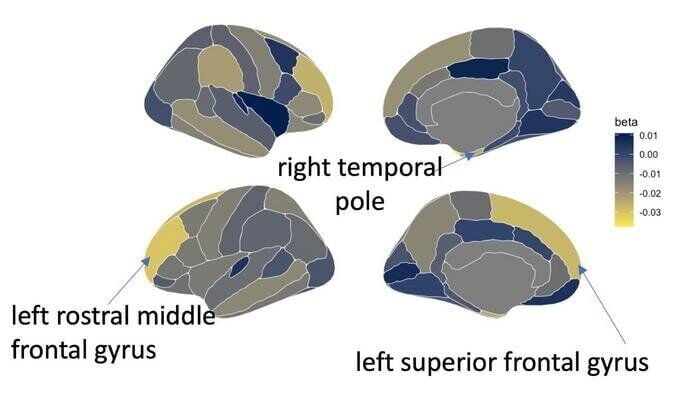
This study found evidence that children with higher screen time exhibit measurable differences in the volume and thickness of several key brain areas. (Dr. Yoshifumi Mizuno from the University of Fukui, Japan via SWNS)


Based on advanced MRI data and parent-reported behavior assessments, the team carefully analyzed the direct associations between screen time and ADHD symptom severity, its development over two years, and the resulting changes in brain structure.
Dr. Shou said: "The results provided clear evidence of a developmental link: longer daily screen time at baseline was a significant predictor of increased ADHD symptoms after two years, even after controlling for initial symptom severity levels.
"Notably, screen time was also associated with developmental abnormalities in multiple key brain structures.
"At baseline, it was linked to a smaller total volume of the cortex and reduced volume in a region known as the right putamen, which plays a key role in language learning, addiction, and reward-related processes.
"After two years, screen time was associated with hindered development of cortical thickness in regions vital for cognitive functions, including the right temporal pole and specific areas of the left frontal gyrus."
One of the findings of this study centered on the role of brain structure as a mediator of ADHD symptoms.
Dr. Shou said: "Statistical analyses suggests that total cortical volume partially mediates the relationship between screen time and ADHD symptoms at baseline.

Dixit Dhinakaran
"In essence, this means that the observed association between longer screen time and greater ADHD symptom severity is, at least in part, explained by the observed smaller cortical volume."
The team suggests that excessive screen exposure may contribute to a delayed brain maturation pattern that is often observed in children with ADHD.
By providing evidence of a neural mechanism, they say study bolsters our understanding of the link between digital habits and behavior in developing children.
Co-author Assistant Professor Masatoshi Yamashita said: "Our work provided some evidence toward growing concern about the association between digital media exposure and children’s mental and cognitive health.
“The results provide some neuroscientific evidences for the need to control screen time.”
The researchers say their findings add to growing evidence that strongly suggests reducing screen exposure among school-aged children is pivotal to their development.
Dr. Mizuno added: “Our findings provide evidence that longer screen time is associated with increased ADHD symptoms and brain structural development.
"The findings of our research enhance our understanding of the link between screen time and ADHD symptoms, as well as the neural mechanisms underlying ADHD.”
The team said the study paves the way for further investigation that may guide both the technology industry and the educational sector toward designing digital environments that support, rather than hinder, children’s cognitive growth.


(0) comments
Welcome to the discussion.
Log In
Keep it Clean. Please avoid obscene, vulgar, lewd, racist or sexually-oriented language.
PLEASE TURN OFF YOUR CAPS LOCK.
Don't Threaten. Threats of harming another person will not be tolerated.
Be Truthful. Don't knowingly lie about anyone or anything.
Be Nice. No racism, sexism or any sort of -ism that is degrading to another person.
Be Proactive. Use the 'Report' link on each comment to let us know of abusive posts.
Share with Us. We'd love to hear eyewitness accounts, the history behind an article.