



My fiancé, Steve Roberts, and I climbed Belknap and Gunstock mountains in one afternoon in September 2018. We’d hiked about six miles and seen some great views of the White Mountains and Lake Winnipesaukee and were descending on the Gunstock Mountain Trail when Steve slipped on a wet rock and fell hard.
Gripping his right leg at the ankle joint, prone on the ground, he said, “I think I broke it. I heard it snap, and when I lifted it up, it just hung there.”
I was panicked, wondering how we would ever make it back to our car. We had not passed one person that afternoon, but in that moment a woman emerged, ascending the trail. She called 911 for us. Only 18 minutes passed before a member of the Gilford Fire-Rescue team appeared on the trail.
Scott Davis, an on-call firefighter/emergency medical technician, had a duffle bag slung over one shoulder. He offered Steve pain medication, which Steve declined; then he took Steve’s blood pressure and immobilized his right leg. “My crew will be up soon,” Scott told us.
Soon after, six additional men and one woman arrived, including Capt. Rick Andrews.
Rescues of all kinds
Rick was hired as a full-time firefighter/EMT for the Gilford Fire Department 27 years ago. He said he and 15 other full-timers ,and roughly 15 on-call members like Scott, respond to hundreds of emergencies each year — primarily medical crises, but also fires, wilderness and hiking rescues, and car and hunting accidents. Because of the diversity of the calls, the department changed its name to Gilford Fire-Rescue 15 years ago.
In 2019, Rick said there were a total of about 1,700 calls, ranging from dire emergencies to the more mundane.
“We get calls to change the batteries in smoke detectors, for pets that are stuck in a tree or under a porch,” he said. “We hear from people locked out of their houses, or locked in their house, such as a child locked in a bathroom.”
The wilderness calls are the most infrequent, Rick said, noting that his team probably only does a half-dozen a year. The majority are hikers who are lost or injured, he said.
How a wilderness rescue works
Gilford Fire-Rescue assists neighboring towns most often, but it is part of a mutual aid system of 32 communities and can be dispatched where there is a need; Rick said they have gone as far as Sandwich and Franconia Notch to help.
Locally, when a crisis occurs in the woods, and a 911 call comes in to the regional dispatch center, the GPS coordinates are pulled from the cell phone calling in, or the caller attempts to describe his or her location; the dispatch center passes the information on to the Gilford Fire-Rescue team.
The coordinates are then entered into one of the team’s mapping programs, team members discern what equipment is needed, and members are dispatched. They travel to the general location in a rescue vehicle and either head into the woods on foot or on an all-terrain vehicle that can be adapted for winter conditions.
“When there is a critical injury, the resources we would call in would change, or we would call more people to get equipment up quicker — say if it was someone having a heart attack, and they needed oxygen, a heart monitor, IV supplies, or maybe different medications,” Rick said. “Who responds depends on the level of the emergency medical personnel who are there. We have advanced EMTs who can do IVs and limited meds and paramedics like myself who can administer pain and additional medications.”
In addition to calling for mutual aid, Gilford Fire-Rescue can lean on the New Hampshire Fish and Game Department for help.
“Fish and Game has the ultimate authority for searches in the state,” Rick said. “A lot of times, we’ll notify them that we have a lost person or an injured hiker, and they’ll call back and ask if we know where they are; do we have the people we need? If we do, they ask us to contact them if we need anything else, and they’ll let us continue on.”
Steve’s rescue
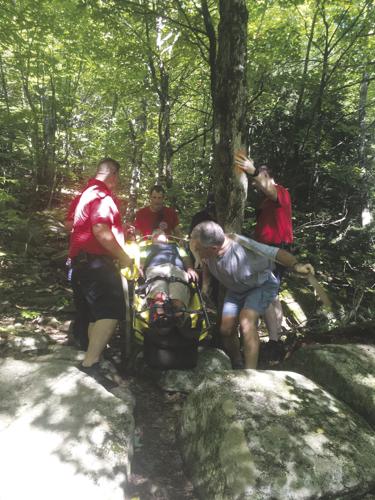
Nine rescuers in all came to Steve’s assistance, using directions offered by the hiker who dialed 911 on our behalf. They arrived with a stretcher — called a Stokes litter — which they mounted on a large wheel; imagine a bed where a unicycle seat would be.
Scott, Rick, and the other team members lifted Steve onto the Stokes litter, strapped him in, and then strapped themselves to the litter as well, giving them more stability and control.
As they descended, I heard the rescuers checking in with Steve occasionally; more often, they were communicating with one another, alerting each other to large rocks or roots, paying careful attention to the terrain.
It took just over an hour to travel what I believe was about a half-mile of trail. An ambulance and several other firefighters were waiting at the bottom to whisk Steve off to Lakes Region General Hospital, where a doctor told him he had spiral and displaced fractures in his leg, near the right ankle joint, which did require surgery; he also had torn all the tendons and ligaments in the joint.
Other recent rescues
Rick said the most recent wilderness rescues in Gilford were similar to Steve’s. On Oct. 20, two people who had been hiking Piper Mountain realized they were off-trail and heading in the wrong direction when it got dark.
“They stopped and called 911,” Rick said. “They weren’t exactly sure where they were.”
Rescuers took the coordinates from their cell phone and determined the hikers were near the Gilford-Gilmanton line. A crew from Gilford hiked in from Piper Mountain, and a crew from Gilmanton entered the woods on an all-terrain vehicle. The Gilmanton crew located the lost hikers, and the Gilford crew met up with them at about the same time. Everyone was transported out of the woods near Gilmanton.
In late November, a hiker on Piper Mountain slipped on ice and had a leg injury. Again, rescuers used the GPS phone coordinates, and a team went up the mountain with the Stokes litter.
Challenges
Locating the person who is lost or injured is one of the biggest challenges in a rescue, Rick said.
“Coordinates from phones through 911 aren’t 100 percent accurate,” he said, adding that sometimes people who are lost panic and keep moving. “As we’re looking for them, they’re moving. People need to stay in the same spot.”
Rugged terrain also adds a layer of complication because the wheel then can’t be used with the Stokes litter.
“Then, we need to carry the person, and the number of people we need responding goes up to 18 people per mile,” Rick said. “You have to keep trading off. We use six people at a time, trading off.”
He adds: “That does happen. We’re fairly lucky. In this area it’s not too bad, but up in Alton on Mount Major, there are times when we can’t use the wheel. We have attached the litter to a rope and lowered the person down over the ledges.”
To help supplement local response teams, Rick said the Lakes Regional Search-and-Rescue team was created this summer. It is only activated through Fish and Game. Rick is one of roughly 30 volunteers but has been so busy since it was formed he has yet to be deployed.
Training
Rick says training for rescuers happens mostly on the job. Firefighters and EMTs learn the emotional side of the work — such as calming people who are panicked and in pain — and they learn how to use the various pieces of equipment.
Rick is particularly interested in search-and-rescue, and he is also an avid hiker who has hiked most of the local trails and mapped them into the department’s system to bolster its effectiveness.
“I have a good understanding of most of the trails that are in town, which has helped a lot when we’ve gotten calls,” he said. “People can say, ‘I went past this trail sign, or the blazes changed from this color to this color,’ and I have a sense of where they are.”
•••
Janice Beetle is an author, editor, and owner of Beetle Press, a public relations and marketing company. Contact her at janice@beetlepress.com.


(0) comments
Welcome to the discussion.
Log In
Keep it Clean. Please avoid obscene, vulgar, lewd, racist or sexually-oriented language.
PLEASE TURN OFF YOUR CAPS LOCK.
Don't Threaten. Threats of harming another person will not be tolerated.
Be Truthful. Don't knowingly lie about anyone or anything.
Be Nice. No racism, sexism or any sort of -ism that is degrading to another person.
Be Proactive. Use the 'Report' link on each comment to let us know of abusive posts.
Share with Us. We'd love to hear eyewitness accounts, the history behind an article.