


I have hiked very little in the southeastern area of New Hampshire, near the border with Maine. I have traveled through the area from my home in New Hampton to hike in the Maine mountains. I’ve driven by the trails to Green Mountain as well as the Nature Conservancy’s trails in the Ossipee Pine Barrens, never stopping. This week was different. I planned to hike to the summit of Green Mountain and walk the trails of the Ossipee Pine Barrens, two unique and distinctly different natural areas.
With Reuben on board, knowing that these two hikes would not be taxing on his aging body, we drove first to Effingham via Routes 25 east to 153 south. The route took us along the Ossipee River and into the small historic village of Effingham.
When I turned onto Hobbs Road to reach the Green Mountain Trailhead, I noticed an historic marker indicating that New Hampshire’s first normal school (teachers’ preparatory school) was located a short distance away. The school was established in 1830 by James Bradbury on the second floor of the Effingham Union Academy building. Continuing on Hobbs Road, I passed the historic academy building that has been maintained meticulously by the Effingham Historical Society.
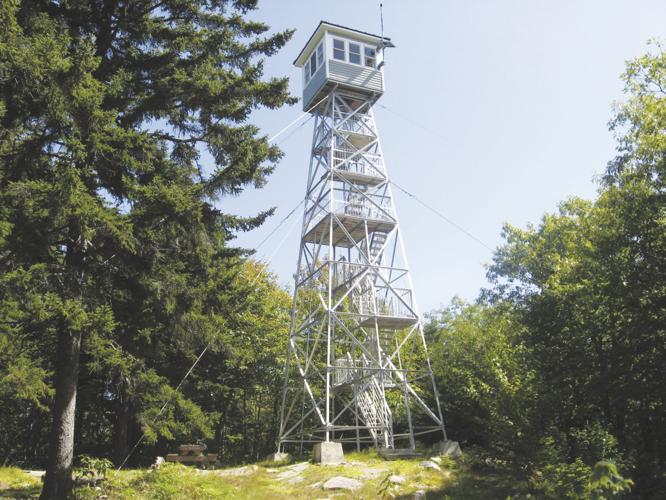
After a short drive, I arrived at the Dearborn trailhead parking lot. I gave Reuben some water, knowing that there would be no water available on the trail, hoisted my day pack onto my back, and started up the 1.4-mile trail to the summit. The trail climbed gradually for the first half-mile and then began a steep climb to the summit fire tower. It was a short 45-minute hike with few views along the way, but I knew a climb to the top of the fire tower would offer superb vistas on this cloudless day. Upon reaching the summit, I was struck by the 60-foot fire tower that rose before me.
In 1921, the fire tower was moved from Cedar Mountain, Maine, to its current location. It was opened in 1922 and was used continuously until around 1960 when fire towers became obsolete. Most of the 85 towers that were once spread across the state have been dismantled, but 16 still stand. They can be found in a variety of locations throughout the state, from Mount Magalloway in Pittsburg to Federal Hill in Milford. There is a complete list of the towers on the New Hampshire Department of Forests and Lands website.
After climbing the fire tower and admiring the view, Reuben and I enjoyed our lunch at a picnic table shaded under a grove of hemlocks. After lunch, we decided to check out a spur trail that leads to Hansom Top, a ledge that provides wonderful views. After a short rest on the ledges, we returned to the summit and hiked back down the Dearborn Trail.
Our day was slipping by and we had another hike on our itinerary, but, before we started for the Ossipee Pine Barrens, I wanted to explore the historic district of Effingham.
Effingham was originally called Leavitt’s Town, named for Capt. John Leavitt, founder of the colonial community. In 1749, the land was granted by Governor Benning Wentworth, and he renamed it Effingham for the Howard family, who were Earls of Effingham and related to the Wentworth family by marriage.
The center of the community is called Lord’s Hill Historic District and is listed on the National Register of Historic Places. The district is dominated by the Isaac Lord Mansion, a three-story Federal house with a domed octagonal cupola. The historic district is made up of 21 properties containing 36 buildings, all built in the late 1700s-early 1800s. There is a bandstand, church, school-academy, and 16 houses, still private residences. All structures are painted white with clapboard siding and in a style which represents the vernacular of the 18th and 19th centuries: the Georgian, Federal, and Colonial Revival. The Lord mansion, adjacent to the Academy building, is the most magnificent of all the homes.
Reuben and I strolled around the village, immersed in the history and architecture of this well-preserved historic district. I wanted to learn more about Effingham, but I would have to wait until I got home. The Ossipee Pine barrens were waiting for us.
If you do want to climb a mountain with a fire tower and visit a town steeped in history with incredible colonial architecture, then put this destination on your bucket list. Effingham and Green Mountain are only an hour’s drive from Laconia.
The Ossipee Pine Barrens are a unique and enchanting forest of mostly scrub oak and pitch pine. What makes this 2,700-acre preserve so special is the fact that it’s the only forest of its kind in New Hampshire and a globally rare forest type. Due to its ecological significance, it was identified by several conservation organizations, as well as the Nature Conservancy, as needing protection. Since 1988, the Conservancy has worked to protect critical habitat, including large, excellent examples of the rare pitch pine-scrub oak woodland; a quarter-mile of undeveloped shoreline on Ossipee Lake; much of Cook’s Pond; and a stream connecting it with Silver Lake, a popular destination for local paddlers. There are many opportunities for hiking, kayaking, cross-country skiing, hunting and snowmobiling.
The Pine Barrens and the surrounding area, including Ossipee and Silver Lakes, were formed more than 10,000 years ago when the last ice sheet covering North America retreated, leaving behind a broad, outwash plain of sand and gravel. The name "pine barrens" refers to the area's sandy, acidic, nutrient-poor soil. Although European settlers could not cultivate their familiar crops there, the unique area supports a diverse spectrum of plant life. The sandy-gravely soil, New Hampshire’s largest “stratified-drift” aquifer, serves as a natural water filter for area homes and businesses. The forest is also home to rare and threatened wildlife, including two dozen butterflies and moths, whip-poor-wills, common nighthawks, brown thrashers and Eastern towhees.
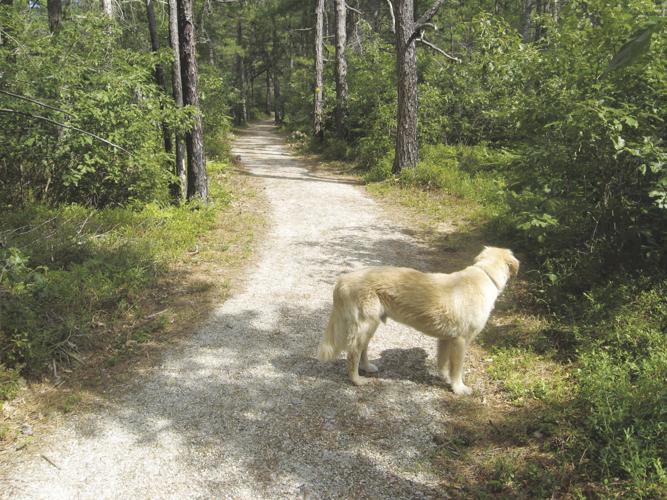
I drove to the Pine Barrens-Nature Conservancy trailhead by taking Route 153 north into Freedom (one of my favorite town names), onto Ossipee Lake Road, turning right onto Route 41. The trail was a short distance from the junction with Route 41. What’s unique about this trail system, besides running through a rare ecosystem, is the beautifully maintained disability access trail. The flat, well-graded trail wends thought the barrens, surrounded not only by the rare pitch pine but also scrub oak, black huckleberry, low-sweet blueberry, sweet fern and woodland sedge, as well as rare hairy hudsonia and slender-leaved goldenrod.
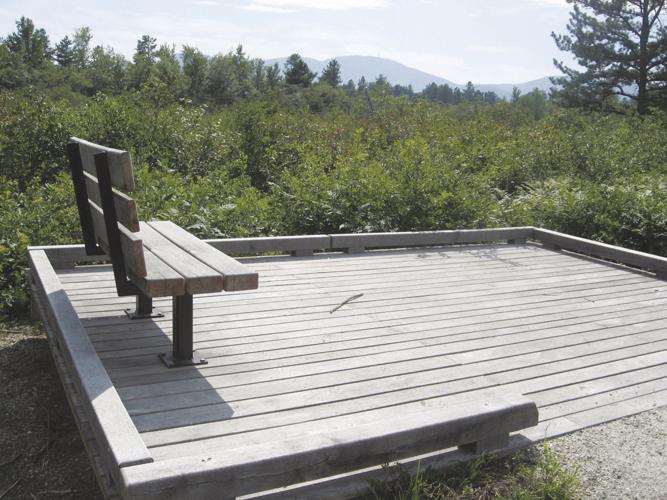
After a leisurely walk, Reuben and I found ourselves at the end of the trail and an observation platform, overlooking a large wetland. Reuben decided to cool off in a pool of water at the base of the platform and I set my eyes on following a warbler as it darted in and out of the alders. I wished I had brought my binoculars. With Reuben well-refreshed from his swim, I decided to “beat feet” to Hobbs Tavern for a cold beverage on this hot, dry day.
To read more about the Ossipee Pine Barrens, go to the Nature Conservancy Website and discover a unique and rare ecosystem.


(0) comments
Welcome to the discussion.
Log In
Keep it Clean. Please avoid obscene, vulgar, lewd, racist or sexually-oriented language.
PLEASE TURN OFF YOUR CAPS LOCK.
Don't Threaten. Threats of harming another person will not be tolerated.
Be Truthful. Don't knowingly lie about anyone or anything.
Be Nice. No racism, sexism or any sort of -ism that is degrading to another person.
Be Proactive. Use the 'Report' link on each comment to let us know of abusive posts.
Share with Us. We'd love to hear eyewitness accounts, the history behind an article.