


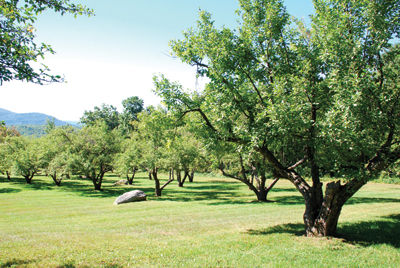
This orchard of heirloom apples in Sandwich is beautifully maintained. Many other century-old trees are struggling to survive in abandoned orchards that have returned to forest. (Laconia Daily Sun photo/Adam Drapcho)
By ADAM DRAPCHO, LACONIA DAILY SUN
SANDWICH — Centuries ago, apples were big business in Sandwich. Historical documents describe wagon after wagon, loaded with bushels of apples, leaving town and heading toward the train station in Ossipee, where they would be taken to Boston. One year, town records show, apples from Sandwich filled a dozen train cars.
The history of apples in Sandwich begins well before the railroads came to the Lakes Region. The first colonial settlers of Sandwich planted apple trees nearly as soon as they began clearing land for a homestead. The fruit was a food source that could be kept through the cold weather, of course, but it served other critical purposes. Hard cider provided a safe drink when groundwater couldn't be trusted, and apple cider vinegar was used to pickle vegetables – the only safe way to preserve food prior to refrigeration or canning – and was also important as an early antiseptic.
"In the colonial period, almost everyone had apple trees," said Monty Carlson. "It was really a staple of their diet and part of their home remedy kit." Apples varieties were bred for every purpose. There were apples that came ripe in late summer, and others that weren't ready until weeks later. Some were ideal for eating right away, while others could be stored in a root cellar, where they would still be crisp in mid-winter. And some varieties were good only for cider and vinegar.
As modern storage, and appetites, changed, so did the varieties. Apples commonly available today are the descendants of varieties such as those cultivated by people who lived in Sandwich in the 18th and 19th centuries. And, although those residents are long gone, it is not uncommon to find clusters of ancient apple trees, gangly and overgrown, in the middle of forests in Sandwich.
But, some of those old orchards are still loved and maintained by the people who live there. That's what John Pries, a former information technology professional and entrepreneur, noticed last year when his left behind his corporate life in Boston and moved into a hill-side home on a dirt road in town. Nearby, he discovered such an orchard, pristine and ancient, full of several varieties of apples unlike anything seen in the supermarket.
"Some of them are spectacular," Pries said. Most of the fruit, though, are left to the yellow jackets and black bears. He was puzzled by the fruit trees, relics of a passed era, and was inspired to learn more. His curiosity led him to join the town's agricultural commission, where he and Carlson created the Sandwich Apple Project, which held its first meeting in the spring. The project's goal is to identify the surviving heirloom varietals, and to propagate some of them by grafting scion wood – newly grown twigs – from the old trees onto new stock.
On Oct. 1, the Apple Project will host a meeting from 1 to 5 p.m. at Range View Farm, located at 342 Vittum Hill Road in Sandwich. Anyone is welcome to attend. Pries and Carlson especially hope that attendees will bring a sack of apples foraged from an abandoned or historic orchard, or an apple product to share with the group. Heirloom apple expert Ben Watson will be on hand to help identify apple varieties.
"It turns out that apples were the cornerstone of Sandwich's export agricultural market," Pries said, "and now they're rotting on the ground."
"We've asked people to bring apples, we'll have a (cider) press going," said Pries. Apples that are brought to the workshop will be passed around for sampling, and those interested in pressing their apples should bring jugs to collect the cider. Late in the coming winter, scions will be cut from the trees that produced the preferred apples, and in April they'll be grafted onto root stock.
"Maybe next year we'll have more apples, more grafts," said Pries.
A couple of centuries ago, the apple crop was a point of pride for the town. A booklet produced by the town's Historical Society reported that, in one year, the McCrillis Farm in the Whiteface-Intervale region delivered 100 barrels of apples to the Ossipee Junction train depot. And, that in an orchard on the side of Young Mountain, a young girl was able to pick more than a hundred baskets of apples in a single day.
"There were orchards all over the place," Carlson said. She looks forward to seeing the diversity of heirloom apples brought to the meeting on Oct. 1. "If we can find the good ones and propagate them, we could replant the orchards that once covered Sandwich."
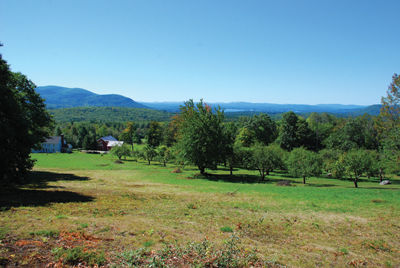
From the time that the first colonists arrived in Sandwich, and through the 19th Century, apples played an essential role, providing food, beverage and vinegar. (Laconia Daily Sun photo/Adam Drapcho)


(0) comments
Welcome to the discussion.
Log In
Keep it Clean. Please avoid obscene, vulgar, lewd, racist or sexually-oriented language.
PLEASE TURN OFF YOUR CAPS LOCK.
Don't Threaten. Threats of harming another person will not be tolerated.
Be Truthful. Don't knowingly lie about anyone or anything.
Be Nice. No racism, sexism or any sort of -ism that is degrading to another person.
Be Proactive. Use the 'Report' link on each comment to let us know of abusive posts.
Share with Us. We'd love to hear eyewitness accounts, the history behind an article.