


By: Special Operations Command Africa Public Affairs
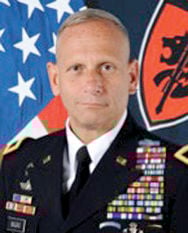
U.S. Army Brig. Gen. Donald C. Bolduc, former commander of Special Operations Command Africa, has elected to retire from active duty military service effective Oct. 1, 2017.
A change of command ceremony at the SOCAFRICA Headquarters in Stuttgart, Germany on June 29 marked the transition of the Special Operations Forces-focused command to a new commander and set the path towards Bolduc’s personal transition to civilian service to our country.
During his career, Bolduc spent more than 80 months deployed in support of military operations around the world. Kindly referred to as “Everyone’s General,” Bolduc had become famous for his walking meetings, shaking everyone’s hand at gatherings, and fierce loyalty to those under his command — so much so the mantra “Mission, People, Family” became a core tenant of his unit’s ethos.
“I’ve always felt military officers need to adopt the attitude that they work for the men and women they lead, trusting and empowering the people who execute the mission while working to provide the resources necessary for them to be successful,” said Bolduc.
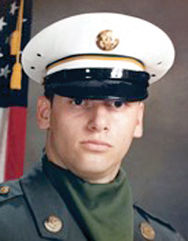
The general started his career as Private Bolduc on June 29, 1981, exactly 36 years before his final change of command, working as an artillery operator prior to enrolling in college at Salem State University in Salem, Massachusetts. It was during his Reserve Officer Training Corps years he met the former Sharon Whitman, also an Army cadet in the same unit. The two wed shortly after graduation and welcomed their first son Joshua later the same year.
Bolduc then fulfilled his childhood dream to become an Army Special Forces operator after completing Ranger School in 1990 and Special Forces selection in 1993. The newly minted operator then headed to Kuwait to help secure the nation from Iraqi aggression. Bolduc subsequently deployed multiple times to Central Asia, Africa and the Middle East throughout the 1990s.
At home, the Bolduc family grew with the addition of Zachary in 1996 and Matthew in 1998, born just months before their company-grade father would depart on the missions which would come to define their military experience.
After the terrorist attacks of 9/11, then-Maj. Bolduc led one of the first teams into Afghanistan, riding on horseback through Kandahar Province with Hamid Karzai and other ad hoc forces to take southern Afghanistan from Taliban rule. On December 5, 2001, a U.S. aircraft dropped a 2,000-pound bomb on their position as a Joint Terminal Attack Controller attached to the Special Forces team inadvertently targeted them. Bolduc was one of the few survivors. Though gravely injured, he refused to leave the battlefield and continued on with the remaining men to take the next objective. After the battle, Bolduc was awarded his first of several combat valor awards and a Purple Heart for injuries suffered in combat. (He was later awarded a second Purple Heart following a helicopter crash in 2005).
“Brig. Gen. Bolduc wasn’t talk,” said retired Maj. Jim Gant, a soldier who served under Bolduc in Afghanistan. “He was about action and results. He took risks when appropriate and cast away the normal bureaucratic methods of operating that were so suffocating to small elements of warriors on the ground fighting the enemy face to face.”
Throughout his distinguished career, Bolduc commanded at multiple levels, including Combined Forces Special Operations Component Command, Afghanistan; Combined Joint Special Operation Task Force – Afghanistan; 1st Battalion, 3rd Special Forces Group, Afghanistan; C Company, 2nd Battalion, 5th Special Forces Group (Airborne); and HHC, 5th Special Forces Group (Airborne).
According to many of Bolduc’s former soldiers, the general took extreme care to ensure they were fully supported, both in the fight and with their families.
“Brig. Gen. Bolduc never once second guessed my decisions as ground commander and he did everything he could to support my unit with air drops of ammunition, food, fuel, and water,” said retired Lt. Col. Jared Hill, another soldier who worked for Bolduc in Afghanistan. “He is a heartfelt commander and ask me privately numerous times during commander-to-commander conversation what the men really needed.”
Bolduc’s unwavering commitment to his soldiers is best exemplified by two separate engagement from his time in Afghanistan.
In 2005, a helicopter then-Lt. Col. Bolduc was in was downed by enemy action in Oruzgan Province. One of the first soldiers who responded to the site found Bolduc, his battalion commander, hanging upside down and unconscious.
As Bolduc was pulled out of the aircraft, he regained consciousness. His first response upon coming to was to find the nearest sergeant and ask “What do you need me to do?”
The sergeant, somewhat taken aback at Bolduc’s willingness to personally join the fight, nonetheless handed him a weapon and directed Bolduc to “pull security” on the perimeter. Bolduc did so, trusting in his soldiers’ ability to do their jobs without interference from above. He was satisfied with simply supporting his men wherever and whenever they needed rather than trying to wrest control of an already chaotic situation.
Then, in 2006, Bolduc was on duty at a headquarters unit when a team of his Army Special Forces operators found themselves surrounded by enemy forces for more than two hours in Helmand Province.
Bolduc, still a lieutenant colonel at the time, was actively engaged in monitoring the situation and providing support to his soldiers. Upon learning that the designated response force would be unable to provide reinforcements to the besieged members, Bolduc sprang into action. He organized an emergency force and personally led it into enemy fire, providing much needed support to the team on the ground.
As Bolduc’s career advanced, he found himself in more and more challenging, strategically vital position. As the Combined Joint Special Operations Task Force commander from 2011 through 2012, he was credited with the creation of the “Village Stability Operations” concept in Afghanistan, largely responsible for changing the course of operations and stabilizing large swaths of the war-torn country.
Bolduc also served on the Joint Staff in the Office of the Secretary of Defense and the Secretary of the Army at the Pentagon before transferring to United States Africa Command where he was the Deputy Director of Operations. His years at USAFRICOM prepared him to assume command of Special Operations Command Africa in 2014, a position he held until his final change of command.
Perhaps his most personal and impactful contribution to the military came about in 2013 when Bolduc sought treatment for traumatic brain injury and post-traumatic stress after years of battling persistent pain, mood swings and dizziness brought on from multiple blast injuries and combat deployments.
“It was only at the urging of my wife that I sought help — and it changed my life and my approach to leadership,” said Bolduc. “That’s when I realized there are thousands of other service members who need the same encouragement and support. That has become a personal mission: to get the message to those effected by PTS and TBI that there is no stigma attached to getting treatment and that they’re still a valued member of our team.”
Bolduc is one of the few military officers, and the only active duty general officer on record, to openly discuss his own struggles with post-traumatic stress and traumatic brain injury. He used his leadership position to change the dialogue in the SOF unit to one of understanding and open dialogue, often retelling his story to turn reluctant staffs into powerful advocates.
“I’m proud of the 52 military members who have been diagnosed with PTS and the 471 with TBI in our ranks since I took command,” said Bolduc. “Those are lives saved, careers saved, marriages and families saved from the pain of ruined relationships. There are treatments that work and a path to wellness if we can only let teammates know that there are no impacts to their career, their status on the team, and that leadership cares about them as individuals. It’s that simple.”
As his career came to a conclusion, Bolduc’s main concern wasn’t his own accomplishments or even those of the units he served with. His thoughts were with the service members that paid the ultimate sacrifice under his command, and the debt the military and the nation has toward their memory.
“I saw 81 teammates fall in combat during my career,” said Bolduc. “At the end of the day, this is what’s it’s all about. This is one of the main reasons that we should continue our mission, finish our mission and win. That’s the absolute best way to honor their sacrifice and that of their families.”
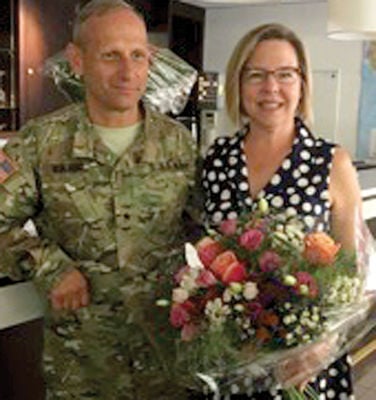
U.S. Army Brig. Gen. Donald C. Bolduc, former Special Operations Command Africa commander, and his wife, Sharon Bolduc, enjoy a going-away party following the general’s change of command June 29 in Stuttgart, Germany.
Bolduc in 1981


(0) comments
Welcome to the discussion.
Log In
Keep it Clean. Please avoid obscene, vulgar, lewd, racist or sexually-oriented language.
PLEASE TURN OFF YOUR CAPS LOCK.
Don't Threaten. Threats of harming another person will not be tolerated.
Be Truthful. Don't knowingly lie about anyone or anything.
Be Nice. No racism, sexism or any sort of -ism that is degrading to another person.
Be Proactive. Use the 'Report' link on each comment to let us know of abusive posts.
Share with Us. We'd love to hear eyewitness accounts, the history behind an article.