


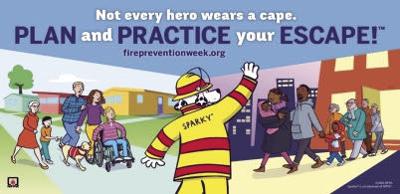
QUINCY, Massachusetts — The National Fire Protection Association selected “Not Every Hero Wears a Cape. Plan and Practice Your Escape!” as the theme for Fire Prevention Week, Oct. 6-12. The campaign recognizes the everyday people who motivate their households to develop and practice a home fire escape plan, behaviors that can have life-saving impact.
“This year’s campaign works to celebrate people of all ages who learn about home fire escape planning and practice, bring that information home, and spur their families to action,” said Lorraine Carli, vice president of outreach and advocacy at NFPA. “From young students who learn about the campaign at school to parents who attend a community event like a fire station open house - all of them truly are heroes because they’re taking steps to make their households much, much safer from fire.”
The campaign also focuses on what a home escape plan entails and the value of practicing it. Messages like these are more important than ever, as today’s homes burn faster than ever. Carli notes that synthetic fibers used in modern home furnishings, along with designs in newer homes that feature open spaces and unprotected lightweight construction, are contributing factors to the increased burn rate.
“People tend to underestimate their risk to fire, particularly at home. That over-confidence lends itself to a complacency toward home escape planning and practice,” said Carli. “But in a fire situation, we’ve seen time and again that advance planning can make a potentially life-saving difference.”
A home escape plan includes working smoke alarms on every level of the home, in every bedroom, and near all sleeping areas. It also includes two ways out of every room, usually a door and a window, with a clear path to an outside meeting place like a tree, light pole or mailbox, that’s a safe distance from the home. Home escape plans should be practiced twice a year by all household members.
For more information about Fire Prevention Week and “Not Every Hero Wears a Cape. Plan and Practice Your Escape!” visit fpw.org.
For more information about the National Fire Protection Association, visit www.nfpa.org, and visit www.firepreventionweek.org for more safety information.


(0) comments
Welcome to the discussion.
Log In
Keep it Clean. Please avoid obscene, vulgar, lewd, racist or sexually-oriented language.
PLEASE TURN OFF YOUR CAPS LOCK.
Don't Threaten. Threats of harming another person will not be tolerated.
Be Truthful. Don't knowingly lie about anyone or anything.
Be Nice. No racism, sexism or any sort of -ism that is degrading to another person.
Be Proactive. Use the 'Report' link on each comment to let us know of abusive posts.
Share with Us. We'd love to hear eyewitness accounts, the history behind an article.