


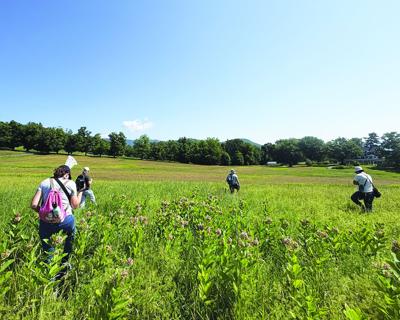
HOLDERNESS ― Twenty-three butterfly enthusiasts gathered at Squam Lakes Natural Science Center for the inaugural Squam Lakes Region July Butterfly Count, launching a new annual community science effort to monitor butterfly populations across the Squam Lakes watershed.
The new count is the eighth circle in the New Hampshire Butterfly Monitoring Network, a statewide volunteer program that collects data to help scientists track long-term butterfly population trends. The information also supports the work of the North American Butterfly Association, a nonprofit organization dedicated to butterfly conservation.
Participants of all ages and experience levels, from first-time volunteers to experienced butterfly experts, divided into four teams to survey 18 properties throughout the 15-mile-diameter count circle. Teams explored fields, forests, wetlands, conservation areas, and private lands across several towns, with each group accompanied by a butterfly expert who assisted with species identification and shared knowledge about butterfly habitats and behavior.
By the end of the day, volunteers documented 373 butterflies representing 22 species, establishing an important baseline for future monitoring in the Squam Lakes Region. After the butterfly count, participants gathered to compare observations, share stories from the field, and celebrate a successful first count. As this new annual tradition takes flight, each year's count will deepen our understanding of the region's butterflies and help guide conservation efforts for generations to come.
The Butterfly Count is just one of several community science opportunities offered by the Science Center.
Monarch Monitoring Mondays continue through Aug. 31 as part of the national Monarch Larva Monitoring Project. Volunteers help count monarch eggs and caterpillars on milkweed to provide data that supports monarch conservation across North America. The program is free to attend, but advance registration is required.
Participants may attend weekly or join whenever they can.
To learn more about Monarch Monitoring Mondays and other community science programs, visit nhnature.org.


(0) comments
Welcome to the discussion.
Log In
Keep it Clean. Please avoid obscene, vulgar, lewd, racist or sexually-oriented language.
PLEASE TURN OFF YOUR CAPS LOCK.
Don't Threaten. Threats of harming another person will not be tolerated.
Be Truthful. Don't knowingly lie about anyone or anything.
Be Nice. No racism, sexism or any sort of -ism that is degrading to another person.
Be Proactive. Use the 'Report' link on each comment to let us know of abusive posts.
Share with Us. We'd love to hear eyewitness accounts, the history behind an article.