


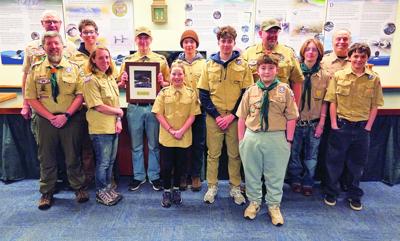
MOULTONBOROUGH — The Loon Preservation Committee recently awarded the first annual Loon Safe Troop Award to Scouting America’s Moultonborough Troop 142. This award, part of the Loon Safe Patch Program created in partnership between the Loon Preservation Committee and Scouting America New Hampshire, honors the New Hampshire scout troop that collects the largest cumulative amount of lead fishing tackle during the calendar year.
The Loon Safe Patch program encourages scouts to help protect New Hampshire’s Common Loons by removing harmful lead fishing tackle from their communities and turning it in to LPC for safe disposal. Scouts earn the Loon Safe Patch by collecting at least eight ounces of the lead fishing tackle that is illegal for sale or freshwater use in New Hampshire (lead sinkers and lead-headed jigs individually weighing 1 ounce or less). In addition to the patches earned by individual scouts, troops can collectively compete for the Loon Safe Troop award, which recognizes the troop with the largest overall impact. In 2025, Moultonborough Troop 142 distinguished itself by collecting 448 pieces of tackle, weighing a combined total of over three pounds, more than any other New Hampshire troop.
Lead fishing tackle can be inadvertently ingested by loons if they catch a fish that’s broken an angler’s line or if they strike at tackle or a fish attached to a line that’s being reeled in through the water. Because loons reproduce slowly and depend on high adult survival rates to sustain their population, mortalities from preventable causes like lead tackle ingestion have significantly impacted New Hampshire’s loon population.
“Lead poisoning resulting from lead tackle ingestion continues to be the leading cause of known adult loon mortality in New Hampshire. We worked with Scouting America to create the Loon Safe Patch and the Loon Safe Troop Award as a way to educate young people about this issue and to recruit their help in working to solve it,” said Harry Vogel, senior biologist and executive director of the Loon Preservation Committee. “Any one of the 448 pieces of tackle collected by Troop 142 could have killed a loon had it stayed in use and been ingested. We’re grateful for their help in keeping this tackle out of lakes, and out of loons, in New Hampshire.”
LPC launched the Loon Safe Patch program to both raise awareness and empower young conservation leaders. By engaging Scouts directly in hands-on stewardship, the program connects outdoor recreation with responsible environmental practices and helps make fishing safer for wildlife.
Herschel Chambers, committee chairman for Moultonborough Troop 142, said the troop learned about the Loon Safe patch program from a former troop 142 committee member. The troop, which always seeks opportunities to make a difference in their community and to earn service hours, jumped at the chance to help protect New Hampshire’s loons. They worked as a team, setting up lead tackle collection points at various locations around the Lakes Region. The troop’s scouts also checked tackle boxes within their own homes for lead. Chambers said they were able to collect most of their tackle by setting up a collection receptacle at the swap shop of the Tuftonboro transfer station, noting that doing so was a relatively low-maintenance effort that yielded a large amount of tackle. In November, the troop brought their collected tackle to The Loon Center and earned six patches. At the end of December, they were informed that they had won the troop award. Members of the troop noted that they were glad to have played a role helping the loons that they enjoy seeing and hearing on local lakes during the spring and summer.
The Loon Safe Patch program is open to Scouts and troops across New Hampshire. LPC encourages interested groups to learn more about how they can participate and help protect loons and other wildlife from lead poisoning. Scouts, troop leaders, and community members interested in the Loon Safe Patch Program can contact the Loon Preservation Committee at volunteers@loon.org.
Because lead is a toxic material, the Loon Preservation Committee encourages scouts to wear latex gloves whenever handling lead and will provide latex gloves to scouts interested in pursuing the patch upon request.


(0) comments
Welcome to the discussion.
Log In
Keep it Clean. Please avoid obscene, vulgar, lewd, racist or sexually-oriented language.
PLEASE TURN OFF YOUR CAPS LOCK.
Don't Threaten. Threats of harming another person will not be tolerated.
Be Truthful. Don't knowingly lie about anyone or anything.
Be Nice. No racism, sexism or any sort of -ism that is degrading to another person.
Be Proactive. Use the 'Report' link on each comment to let us know of abusive posts.
Share with Us. We'd love to hear eyewitness accounts, the history behind an article.