


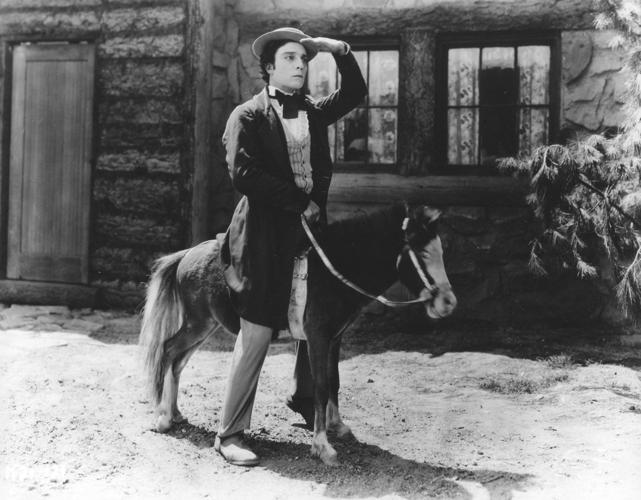
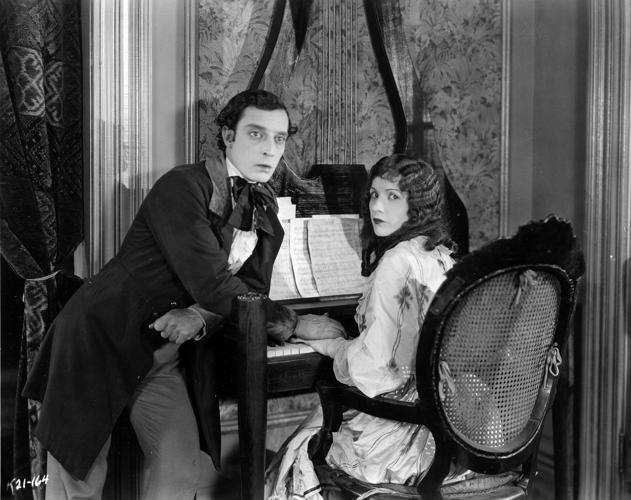
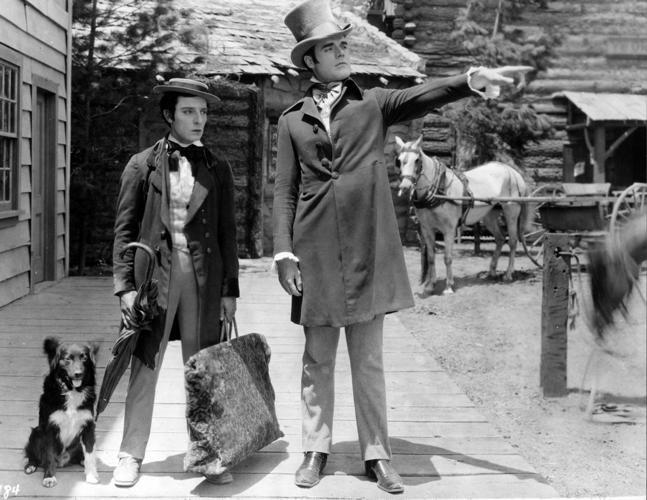
DANBURY — He never smiled on camera, earning him the nickname of "the Great Stone Face," but Buster Keaton's comedies rocked Hollywood's silent era with laughter throughout the 1920s, and remain crowd-pleasers today.
See for yourself with a screening of "Our Hospitality" (1923), one of Keaton's landmark features, on Saturday, March 23, at 7 p.m. at the Blazing Star Grange Hall, 15 North Road, Danbury.
The show is open to the public with suggested $5 donation.
The screening will feature live accompaniment by Jeff Rapsis, a New Hampshire-based composer who specializes in creating scores for silent films.
"Our Hospitality" is a period comedy, set in the 1830s, and tells the story of a young man (Keaton) raised in New York City but unknowingly at the center of a long-running backwoods family feud.
Highlights of the picture include Keaton's extended journey on a vintage train of the era, as well as a dramatic river rescue scene that climaxes the film.
The film stars Keaton's then-wife, Natalie Talmadge, as his on-screen love interest; their first child, newborn James Talmadge Keaton, makes a cameo appearance, playing Buster as an infant. Keaton's father also plays a role in the film.
The Grange's screening of "Our Hospitality" aims to show early movies as they were meant to be seen — in high-quality prints, on a large screen, with live music, and with an audience.
"All those elements are important parts of the silent film experience," said Rapsis, who will improvise a musical score for "Our Hospitality."
"Recreate those conditions, and the classics of early Hollywood leap back to life. They featured great stories with compelling characters and universal appeal, so it's no surprise that they hold up and we still respond to them."
Rapsis performs on a digital synthesizer that reproduces the texture of the full orchestra and creates a traditional "movie score" sound.
Keaton, along with Charlie Chaplin and Harold Lloyd, stands today as one of the silent screen's three great clowns. Some critics regard him as the best of all: Roger Ebert wrote in 2002 that "in an extraordinary period from 1920 to 1929, (Keaton) worked without interruption on a series of films that make him, arguably, the greatest actor-director in the history of the movies."
While making films, Keaton did not think of himself as an artist, merely an entertainer trying to use the then-new art of motion pictures to tell stories and create laughter.
As an entertainer, Keaton was uniquely suited to the demands of silent comedy. Born in 1895, he made his stage debut as a toddler, joining his family's knockabout vaudeville act and learning to take falls and do acrobatic stunts at an early age. He spent his entire childhood and adolescence on stage, attending school for exactly one day.
An entirely intuitive performer, Keaton entered films in 1917 and was quickly fascinated with them. After apprenticing with popular comedian Roscoe "Fatty" Arbuckle, Keaton went on to set up his own studio in 1920, making short comedies that established him as a one of the era's leading talents.
A remarkable pantomime artist, Keaton naturally used his whole body to communicate emotions from sadness to surprise and, in an era with no special effects, Keaton's acrobatic talents meant he performed all his own stunts.
In 1923, Keaton made the leap into full-length films with "Our Hospitality" which proved popular enough for him to continue making features for the rest of the silent era.
Although not all of Keaton's films were box office successes, critics later expressed astonishment at the sudden leap Keaton made from short comedies to the complex story and technical demands required for full-length features.


(0) comments
Welcome to the discussion.
Log In
Keep it Clean. Please avoid obscene, vulgar, lewd, racist or sexually-oriented language.
PLEASE TURN OFF YOUR CAPS LOCK.
Don't Threaten. Threats of harming another person will not be tolerated.
Be Truthful. Don't knowingly lie about anyone or anything.
Be Nice. No racism, sexism or any sort of -ism that is degrading to another person.
Be Proactive. Use the 'Report' link on each comment to let us know of abusive posts.
Share with Us. We'd love to hear eyewitness accounts, the history behind an article.