


LACONIA — The invasion force seems like something out of a science fiction movie: Hermaphrodite snails the size of golf balls, fleas with glass-like spines, underwater weeds that choke and degrade waterways.
Amy Smagula, the New Hampshire Department of Environmental Services Exotic Species Program Coordinator, is ever vigilant for non-native plants and animals.
She spoke to The Daily Sun Wednesday after sampling Lake Winnipesaukee for the spiny water flea.
“It is in Lake Champlain, Vermont, and Lake George, New York,” Smagula said. “It’s a microscopic animal with a long glassy spine that eats native plankton, disrupts the food web, gets stuck in the digestive tract of fish, causing stunted growth and mortality.”
Vegetative invaders keep her busy as well.
Variable milfoil
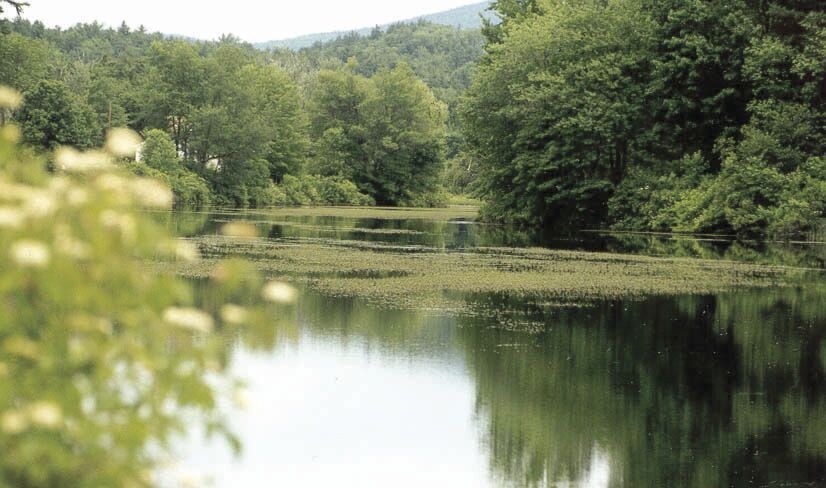
New Hampshire has 78 infested lakes and 11 infested rivers, most containing variable milfoil as the primary invasive plant, while others have fanwort, Eurasian water milfoil and water chestnut.
That represents about 7 percent of the state’s 950 lakes and ponds.
“But even though the percentage is small, the visibility is large,” Smagula said. “It’s the big ones like Winnipesaukee, Winnisquam, Newfound.”
Variable milfoil can become so thick that there have been instances in other states where people have become entangled and have drowned.
"It can change the water chemistry and biology," she said. "It holds a lot of heat, make the water warmer, and that could make it possible for algae blooms. Also it has a lot of biomass. As it decomposes, it releases a lot of nutrients that can change the pH of the water and the oxygen concentration in the water."
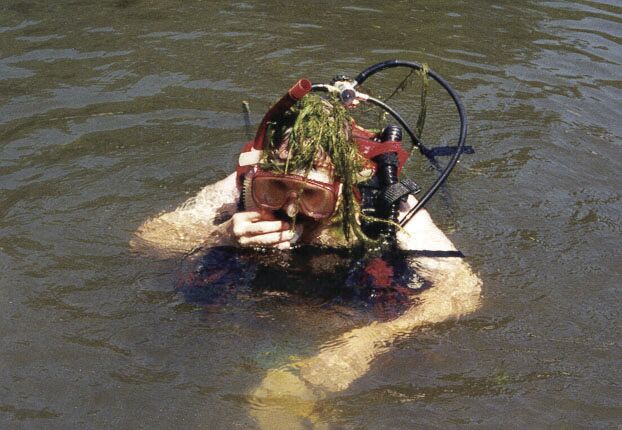
Biologists are getting better at detecting and managing invasive plant species, including removal by divers, but animal invaders are much more difficult to control.
One example is the Chinese mystery snail, which has been spotted in Lake Wicwas and elsewhere.
“That’s a tricky one,” Smagula said. “It is a hermaphrodite. In one shell it has male and female parts, so it doesn’t need to mate. Introduce one and it starts a new population.”
Smagula said the snail also has a smelly funk to it.
Hitching a ride
Some of the invasive species of plants and animals may have originally reached the waters of New Hampshire by someone dumping an aquarium, but the biggest problems are those that hitch a ride on boats.
“Animals are going to be very problematic,” Smagula said. “They get trapped in bait buckets and in the ballast water of boats, particularly the wakeboarding and wakesurfing boats.
“They have hard and soft tanks that can be filled and drained. A lot of them don't have the capacity to drain fully. They suck in and discharge water that can be from a number of lakes.”
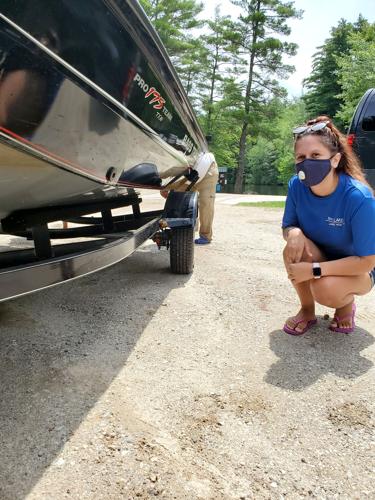
The state urges boaters to clean, drain and dry their vessels to prevent transporting plants and animals from lake to lake.
It doesn’t take much for an invader to hitchhike on a boat.
“For most of the plants, all it takes is a couple inches of viable stem materials,” Smagula said. “For microscopic animals, it could be just a drop of water.”
Lake to lake
Many local boaters keep their vessels in the water all season, but visitors bring their boats in from all over the region.
“This year, with the pandemic, there's been a tremendous increase in the use of our surface waters,” Smagula said. “Several thousand more boat registrations have been issued than in prior use.
“There’s been a lot of day use or week use of our surface waters. People have been coming all season and even a swim tube, a live well, a bait bucket can carry invasive species.
“I worry less about people fixed on a lake all season than the more transient boater who is in one lake one day and is in another the next.”
Raising awareness
New Hampton boating enthusiast Dave Katz keeps his pontoon boat at dock during the season for outings on Squam Lake.
He credits the Lake Host Program with boosting awareness of the problem of invasive species. Volunteers in the program do boat inspections through a collaborative effort with the DES, boat ramp owners and other local partners.
Educational poster boards are placed at boat launches.
“The natural resources are one of the biggest treasures that we have here,” said Katz, who also conducts boat tours for Squam Lakes Natural Science Center. “They do a lot of good work trying to maintain that.”
The course for a state boating certificate touches on best practices to avoid spreading invasive species, but Katz said he observes boaters don’t always comply with course tenets.
“In my opinion, the certificate is a one and done deal,” he said. “You get it once and don’t have to get it refreshed.
“I spend a lot of time on the water,” he said. “Sometimes I could sell tickets for the entertainment value of what goes on out there. People have just completely forgotten everything they were taught.”
DES-recommended precautions
Before leaving any boat launch area —
CLEAN: Clean off all mud, plants, animals, and debris from your boat, trailer, and equipment. Clean off anchors and anchor lines, water intake grates on jet-powered craft, kayak and canoe cockpits, storage compartments, and paddles, too. Dispose of all material away from the waterbody where it won’t wash back into the water.
DRAIN: Drain the motor, bilge, live wells, ballast tanks, storage compartments, and gear. Blow out water in jet-powered craft and tip paddle craft and motors to let out water. Drain all equipment away from the water where runoff won’t flow back into the water. Open/remove drain plugs and keep out/open while trailering. You may need a wrench to remove plugs.
DRY: Dry off everything that came into contact with the water. If launching your boat again within 5 days, thoroughly rinse with clean water somewhere runoff won’t flow back into the water, and towel dry — rinsing with high pressure, hot water between waterbodies is the best practice.
Between visiting waterbodies —
RINSE: Rinse boat hull and trailer with clean water. Flush motor, bilge, live wells, ballast tanks, and storage compartments with clean water per boat manufacturer instructions. It is best to visit a car wash before launching again, especially if the boat has been in a waterbody containing an invasive species infestation.





(0) comments
Welcome to the discussion.
Log In
Keep it Clean. Please avoid obscene, vulgar, lewd, racist or sexually-oriented language.
PLEASE TURN OFF YOUR CAPS LOCK.
Don't Threaten. Threats of harming another person will not be tolerated.
Be Truthful. Don't knowingly lie about anyone or anything.
Be Nice. No racism, sexism or any sort of -ism that is degrading to another person.
Be Proactive. Use the 'Report' link on each comment to let us know of abusive posts.
Share with Us. We'd love to hear eyewitness accounts, the history behind an article.