




The Microsoft Security advantage: Eliminating data leaks in the age of generative AI
For IT directors and security executives, the risk calculation for workplace automation has changed. The primary threat to corporate integrity is no longer a slow rollout; it is “privilege creep”—the over-permissioning of agents already live within the enterprise stack. The statistics are stark. According to the Cloud Security Alliance (CSA), 74% of organizations grant AI agents broader permissions than their specific functions require, while a mere 22% consistently enforce access-control frameworks.
This technical gap provides the oxygen for "shadow AI" to proliferate. When employees bypass official guardrails to use unauthorized automated tools, proprietary data is left susceptible to exfiltration. Consequently, securing the modern workplace requires a structural shift: a cross-departmental framework that aligns IT security protocols with HR-defined acceptable use policies.
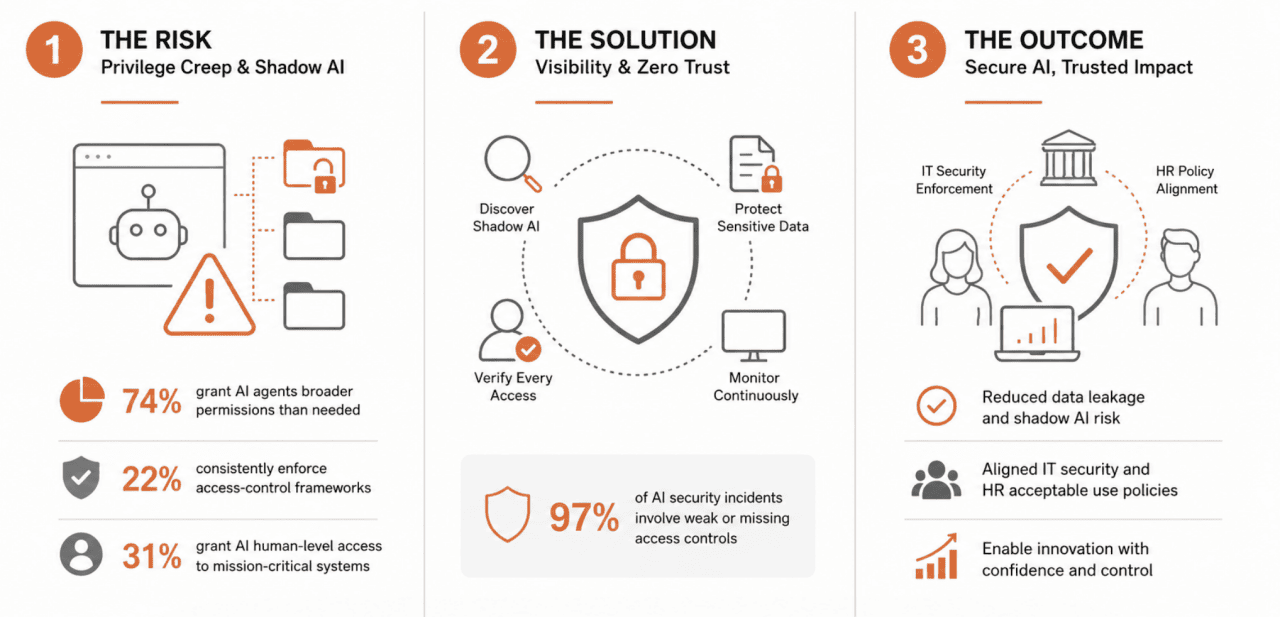
Quantifying the Privilege Separation Gap
The lack of consistent access management has led to a documented erosion of the "least-privilege" principle within agentic systems. In the CSA report, researchers found that 31% of organizations grant AI the equivalent of human-level access to mission-critical internal systems.
Identities are often tied to authenticated human users rather than restricted service-level accounts. This lack of privilege separation makes it nearly impossible for traditional monitoring tools to distinguish between a legitimate user action and a malicious prompt injection.
According to Terminal B, an IT support and managed services provider, companies that allow these architectural gaps to go unaddressed remain exposed to the pervasive risks of shadow AI. Beyond the immediate threat of a data breach, organizations risk their authorized tools falling short of security benchmarks, ultimately exposing internal systems to unfettered third-party platforms.
The Upsides of Integrated Visibility
Shadow AI can perpetuate in environments where employees feel that sanctioned tools are too restrictive or slow. However, the cost of this convenience is often the inadvertent submission of proprietary information to external models for training. When this occurs, the data is essentially lost to the public domain, making it a permanent liability for the firm.


Microsoft Defender for Cloud Apps is a primary tool for detecting these unsanctioned applications. Identifying where data is being sent means IT departments can move from a reactive posture to a proactive one. This transition is supported by the fact that 97% of organizations reporting AI security incidents lacked proper AI access controls, according to an IBM report.
The alignment of HR and IT is critical here because the solution is rarely purely technical. While IT can block a website, HR defines the acceptable use policies that govern employee behavior. This partnership ensures that when an unsanctioned tool is flagged, the response is rooted in a clear understanding of both security requirements and operational needs.
Delivering Data Protection via Zero Trust Architecture
A significant shift in how security is perceived involves the move toward a Zero Trust model. In this framework, no user or application is trusted by default, regardless of their position within the network. This is particularly relevant for AI, as these models often require broad access to internal databases to function effectively.
Research into the use of Microsoft Copilot in government and enterprise settings shows that these tools are designed to work within specific risk frameworks. Microsoft Purview enables organizations to implement data loss prevention (DLP) policies that automatically identify and protect sensitive information before it reaches an AI interface.
For observers in the security space, the capability-damage bundling effect is a primary deterrent to unmanaged AI growth. The goal for modern enterprises is to decouple the intelligence of the AI from the potential damage of a breach by ensuring that the AI only has access to the specific data points required for a task, rather than the entire corporate library.
Governing the Future of Synthetic Intelligence
The establishment of AI Governance Steering Committees is expected to become a standard corporate practice given the concerns we’ve explored. These committees combine technical execution and high-level policy. Centering the conversation on data integrity rather than just technological capability lets firms avoid the pitfalls of governance drift.
The shift toward these structured environments based on Microsoft Security suggests a potential increase in the stability of AI-driven workplaces. When IT and HR are aligned through a centralized security provider, the risk of hallucination-driven decision errors and data leakage is significantly reduced. Such a systematic approach enables the benefits of generative AI to be realized without compromising the organization's foundational security.
This story was produced by Terminal B and reviewed and distributed by Stacker.


(0) comments
Welcome to the discussion.
Log In
Keep it Clean. Please avoid obscene, vulgar, lewd, racist or sexually-oriented language.
PLEASE TURN OFF YOUR CAPS LOCK.
Don't Threaten. Threats of harming another person will not be tolerated.
Be Truthful. Don't knowingly lie about anyone or anything.
Be Nice. No racism, sexism or any sort of -ism that is degrading to another person.
Be Proactive. Use the 'Report' link on each comment to let us know of abusive posts.
Share with Us. We'd love to hear eyewitness accounts, the history behind an article.