



(Photo by ClickerHappy via Pexels)
By Stephen Beech
Older aircraft passengers should be evenly distributed throughout the cabin to allow for a safe evacuation in an emergency, according to new research.
Older travelers, who may be limited in their dexterity, should be spread out onboard for everyone's safety, scientists say.
The Federal Aviation Administration requires aircraft to be able to evacuate within 90 seconds in case of an emergency. But as the average age of the global population increases, experts say the growing number of elderly airline passengers poses new challenges in emergency situations.
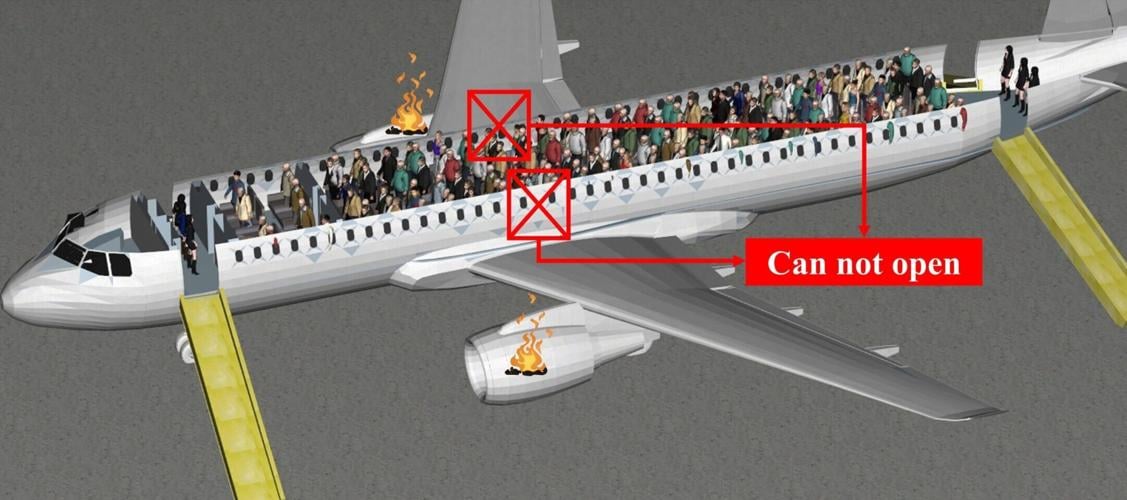
An international team of researchers simulated 27 different evacuation scenarios in case of a dual-engine fire on an Airbus A320, one of the most common narrow-body aircraft in the world.
The team compared three different cabin layouts with three different ratios of passengers over the age of 60 and three different distributions of those passengers for the study.
Study co-author Dr. Chenyang Zhang said, "While a dual-engine fire scenario is statistically rare, it falls under the broader category of dual-engine failures and critical emergencies in aviation. History has shown that dual-engine failures and emergencies, such as the famous ‘Miracle on the Hudson’ involving Captain Sullenberger, can happen and lead to severe consequences.'

A visualization of the constructed cabin model the researchers used to simulate evacuation scenarios. (Zhao et al. via SWNS)


"Our study focuses on these low-probability but high-impact events to ensure the highest safety standards."
In seeking the most efficient combination of factors, the research team created full-scale computer-aided design models of the A320 cabin and used Pathfinder—the industry-standard software for evacuation modeling—to simulate passengers’ behavior.
The findings, published in the journal AIP Advances, showed that the proportion and location of elderly passengers had the largest effect on evacuation time.
The fastest option—a layout that accommodates a total of 152 passengers with two rows of first-class seats at the front, and 30 elderly passengers evenly distributed throughout the cabin—still required 141 seconds for all the passengers to reach the ground, much longer than current FAA mandates.

(Photo by Amani Allan via Pexels)
Previous studies have shown that cognitive decline in elderly people can affect situational awareness and delay decision-making, and that reduced dexterity can be exacerbated during high-stress situations.
The research team hopes that incorporating that information into its findings—for example, by offering additional safety briefings to elderly passengers—will help further accelerate the deboarding process.
Children, babies and pregnant women also introduce unique physical capabilities and behaviors that add another vital layer to evacuation modeling, which the group plans to investigate in future work.
Zhang, of the University of Calgary in Canada, added, "We hope these findings help airlines proactively mitigate risks. By understanding how passenger distribution affects evacuation, airlines could potentially implement more strategic seating arrangements to optimize safety without compromising operational efficiency."





(0) comments
Welcome to the discussion.
Log In
Keep it Clean. Please avoid obscene, vulgar, lewd, racist or sexually-oriented language.
PLEASE TURN OFF YOUR CAPS LOCK.
Don't Threaten. Threats of harming another person will not be tolerated.
Be Truthful. Don't knowingly lie about anyone or anything.
Be Nice. No racism, sexism or any sort of -ism that is degrading to another person.
Be Proactive. Use the 'Report' link on each comment to let us know of abusive posts.
Share with Us. We'd love to hear eyewitness accounts, the history behind an article.