


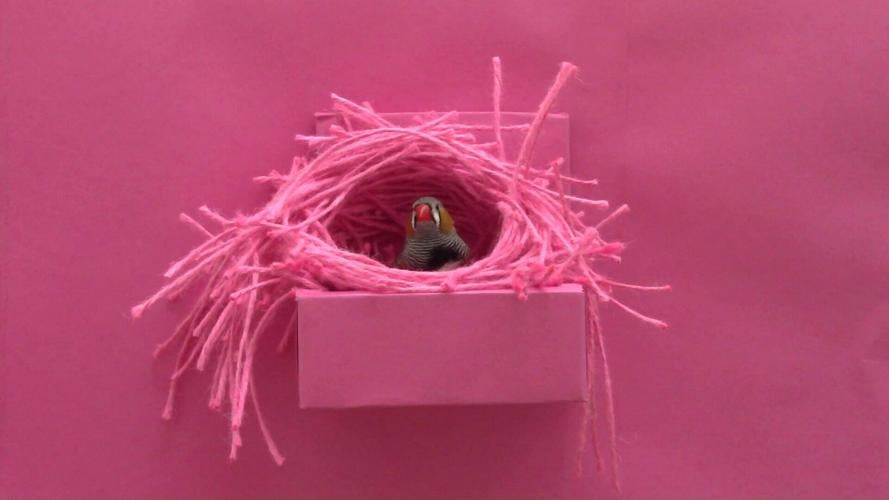
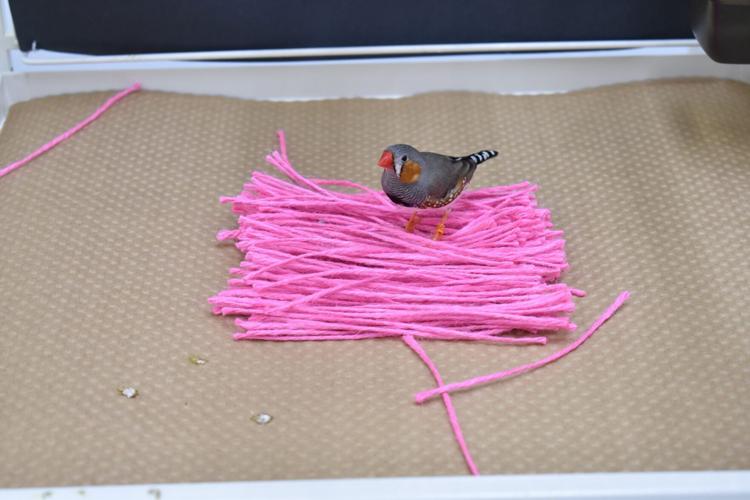
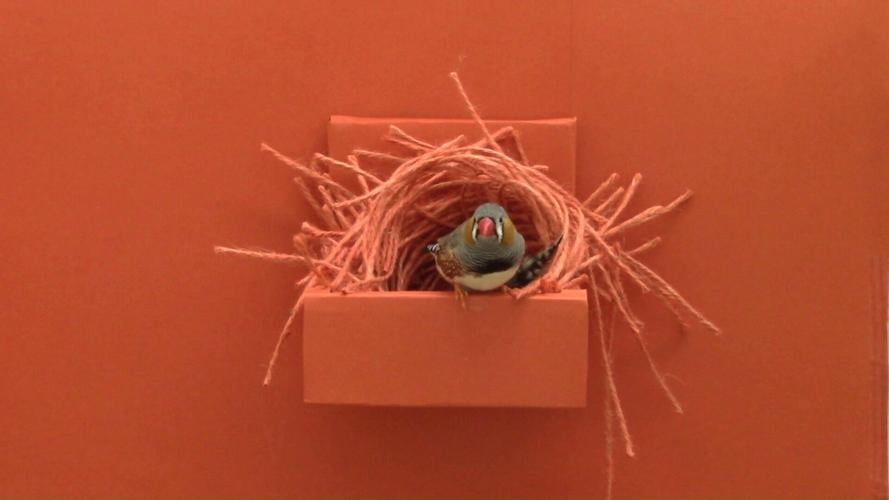

Male zebra finch depositing colored sting into a nests built in the laboratory. (Animal Cognition Research Group via SWNS)
By Dean Murray
Some birds want pink nests, according to new research.
A new study found that birds with strong color preferences for nest-building material were less likely to copy others, instead relying on their own established bias.
Researchers in the Department of Psychology at the University of Alberta have revealed that individual preferences influence how animals use social information.
Working with zebra finches, a small songbird, lead author Julia Self found that if a bird favours a color, it wouldn’t follow what its contemporaries were doing.

(Animal Cognition Research Group via SWNS)
In controlled experiments, zebra finch males — the nest builders in this species — first demonstrated individual color preferences, with some choosing pink string exclusively as building material.


When given the opportunity to observe other birds building nests with different materials, individuals with weaker preferences were more likely to incorporate social information.
In contrast, birds with strong pre-existing preferences tended to ignore demonstrators and build according to their own bias.
“These results are exciting because they show that birds integrate social information with their own preferences when making nest-building decisions,” said Julia Self. “The stronger a bird’s pre-existing preference, the less likely they are to copy others, shaping whether or not behavioral traditions spread and persist over time.”

(Animal Cognition Research Group via SWNS)
The researchers explain that cognitive biases are difficult to manipulate experimentally in humans, so zebra finches offer a powerful model for understanding the biological roots of decision-making.
The study, conducted in the Animal Cognition Research Group led by Dr. Lauren Guillette, advances research in animal cognition, cultural evolution and comparative psychology by revealing how individual differences shape the spread of information in social groups.
However, there is one factor that picky male finches contend with: females will also have a say in how the nest is arranged.
The researchers add: “In this study, we focused on the male’s preferences because he collects and deposits the material. But females are not passive observers. They rearrange material, and sometimes even eject it from the nest. We are currently exploring how female biases might further shape nest-building outcomes.”


(0) comments
Welcome to the discussion.
Log In
Keep it Clean. Please avoid obscene, vulgar, lewd, racist or sexually-oriented language.
PLEASE TURN OFF YOUR CAPS LOCK.
Don't Threaten. Threats of harming another person will not be tolerated.
Be Truthful. Don't knowingly lie about anyone or anything.
Be Nice. No racism, sexism or any sort of -ism that is degrading to another person.
Be Proactive. Use the 'Report' link on each comment to let us know of abusive posts.
Share with Us. We'd love to hear eyewitness accounts, the history behind an article.