


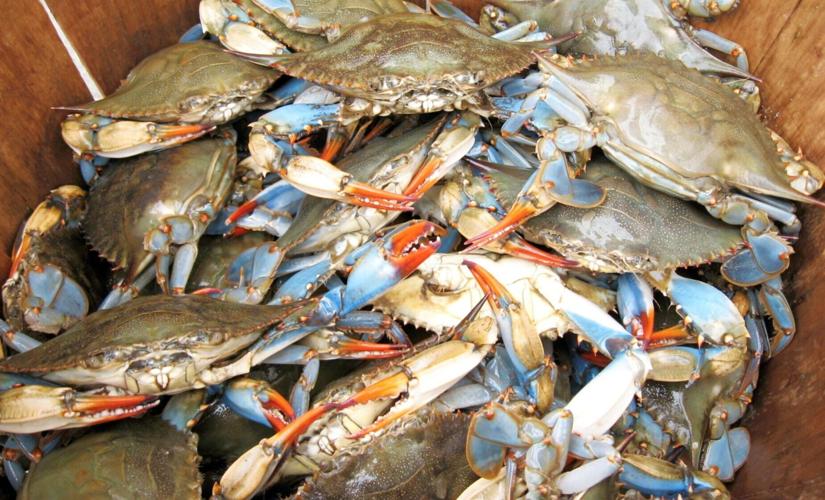

A basket of blue crabs caught during a survey by the Smithsonian Environmental Resarch Center. (Smithsonian ERC via SWNS)
By Stephen Beech
Young blue crabs hide in the shallows to avoid being eaten by their cannibal cousins, reveals new research.
Juvenile crabs rely on shrinking shallow-water habitats as a refuge to escape cannibalism by adults, say American scientists.
Cannibalism is the No. 1 killer of juvenile blue crabs in mid-salinity waters where they are known to congregate in Chesapeake Bay, according to the study published in the journal Proceedings of the National Academy of Science (PNAS).
After spending around two months as larvae in the ocean, young blue crabs are swept back into the lower bay to morph into juvenile crabs.
The research team found that, there, the juveniles rely on seagrass to provide partial refuge from predatory fish such as striped bass. But after they grow to about 1 inch, many of them migrate up the bay to mid-salinities, where fish and seagrasses are scarcer. There they face another enemy: larger blue crabs.

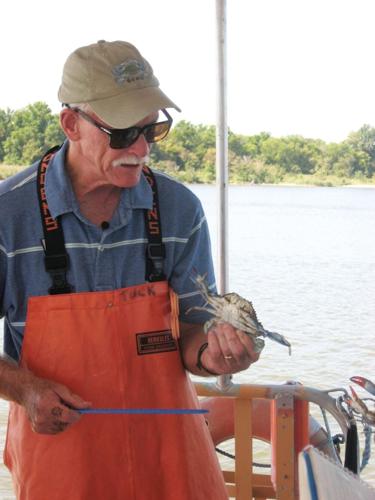
Tuck Hines, lead author of the study and director emeritus of the Smithsonian Environmental Research Center, measures a blue crab on a survey. (Smithsonian ERC via SWNS)
Study leader Dr. Tuck Hines, of the Smithsonian Environmental Research Center (SERC), said: “Blue crabs are notoriously cannibalistic.
”But although cannibalism is common throughout aquatic ecosystems, long-term studies attempting to quantify it are rare.
"And the data could make a difference for managers trying to keep the blue crab fishery sustainable."
Marine biologist Dr. Hines and his team sought to find out what is eating young blue crabs and what makes them less vulnerable over 37 years.
The field study began in 1989, when Dr. Hines headed SERC’s Fish and Invertebrate Ecology Lab.
It took place in the Rhode River, a mid-salinity tributary of Chesapeake Bay located at SERC’s campus in Edgewater, Maryland.
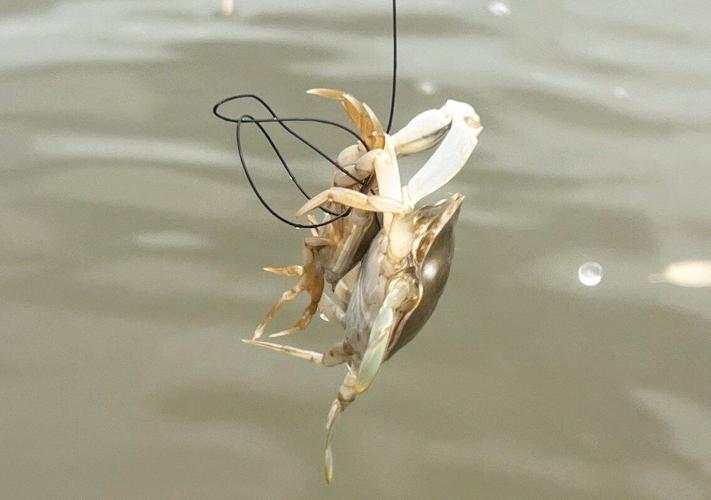
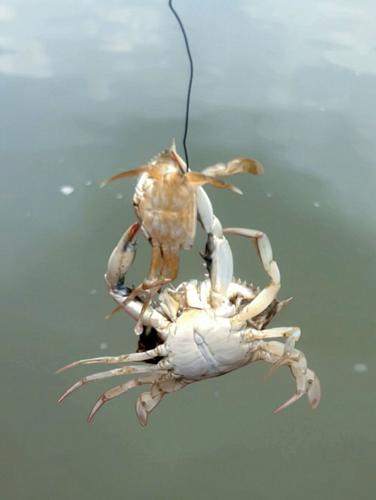
The team conducted the study by attaching juvenile crabs to small metallic spikes in the water, with a one-meter tether that allowed the crabs to move around.

An adult male blue crab attempts to cannibalize a smaller blue crab on a tether. (Smithsonian ERC via SWNS)
Tethering allows juvenile crabs to spend much of their time buried in the sediment, avoiding predatory fish that hunt by sight.
But buried juveniles are still vulnerable to large crabs that use chemical and tactile cues to detect buried prey.
After 24 hours, the researchers returned to the sites to see how the crabs had fared.
Around 74%of the crabs in the study survived, while over half remained unscathed and were released back into the bay.


The biologists detected hallmarks of cannibalism on 42% of the crabs - either alive with injuries or killed with some remains left behind.
The team found no evidence of fish predators in the study, suggesting that mid-salinity rivers do offer a refuge from some predators.
Dr. Hines said: “We were amazed to find that over our 37-year study, cannibalism accounted for all of the predation, and we found no fish predation on tethered crabs."
Study co-author Dr. Matt Ogburn, a research ecologist at SERC, said: “We’ve recorded a few of the tethering experiments with a high-resolution sonar.

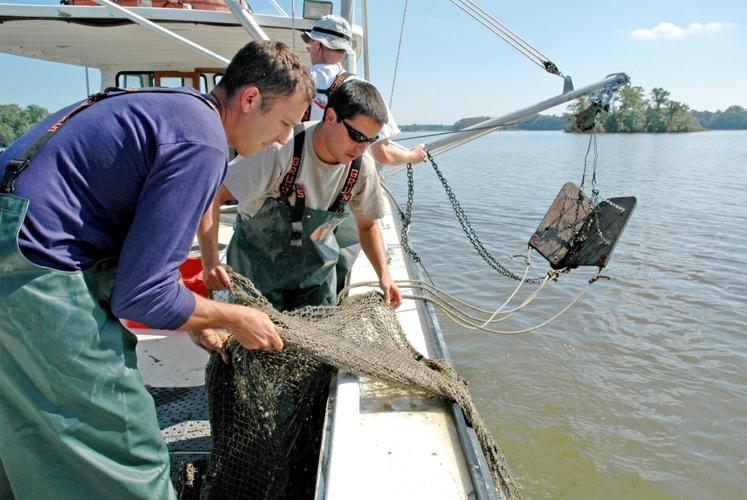
Scientists Eric Johnson (left) and Rob Aguilar pull in a net during a survey for fish, crabs and other aquatic life. (Smithsonian ERC via SWNS)
“In the sonar videos, most fish didn’t show any interest in the tethered crabs, and only adult crabs attacked them.”
The researchers found that the smallest crabs were the most vulnerable, and more than twice as likely to get eaten compared to medium or large juveniles.
But in shallow waters they were far safer.
In the experiment, a small juvenile crab was 60% to 80% likely to get eaten in deeper waters of 1.3ft to 2.5ft depth.
But in the shallowest zones less than six inches deep , they were only about 30% likely to be cannibalised.
The rule of safety in the shallows held true for larger juveniles as well.
Scientists are working on a new stock-assessment model for blue crabs in the Chesapeake that is expected to come out later this year.

An adult male blue crab attempts to cannibalize a smaller blue crab on a tether. (Smithsonian ERC via SWNS)
They say the long-term data from the study can help make the new model more accurate - especially the discovery that most cannibalism is focused on smaller juvenile crabs.
Dr. Ogburn said: ”Knowing that juveniles become less susceptible to cannibalism as they grow is important for getting the new model right."
But the shallow-water sanctuaries are at risk as seawalls, riprap - a layer of large stones to protect soil from erosion, and other shoreline-hardening projects are shrinking the nearshore territory where young blue crabs can escape.
Invasions by non-native species - especially blue catfish - may also impact blue crabs and further diminish the shallow refuge areas, according to the the study.
Dr. Hines added: “The nearshore shallows of the mid-salinity zone provide juvenile crabs with a crucial refuge habitat from cannibalism by large crabs.
"With cannibalism so intense and predators in every region of the bay, protecting these nearshore habitats - and restoring them where they have been lost - is critical for stabilising blue crab numbers and protecting the blue crab fishery as a whole."


(0) comments
Welcome to the discussion.
Log In
Keep it Clean. Please avoid obscene, vulgar, lewd, racist or sexually-oriented language.
PLEASE TURN OFF YOUR CAPS LOCK.
Don't Threaten. Threats of harming another person will not be tolerated.
Be Truthful. Don't knowingly lie about anyone or anything.
Be Nice. No racism, sexism or any sort of -ism that is degrading to another person.
Be Proactive. Use the 'Report' link on each comment to let us know of abusive posts.
Share with Us. We'd love to hear eyewitness accounts, the history behind an article.