


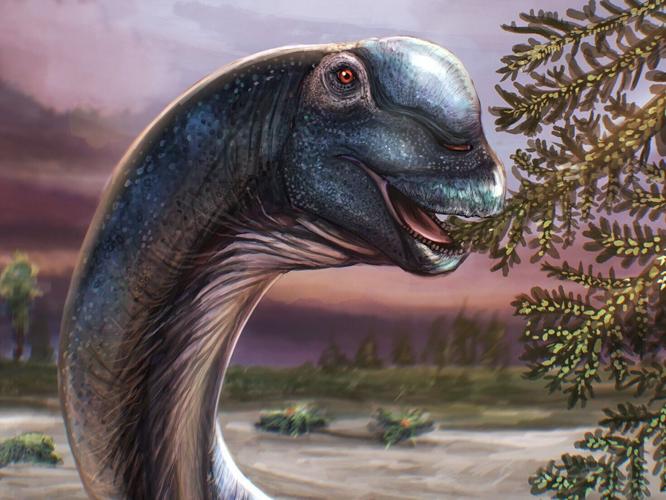
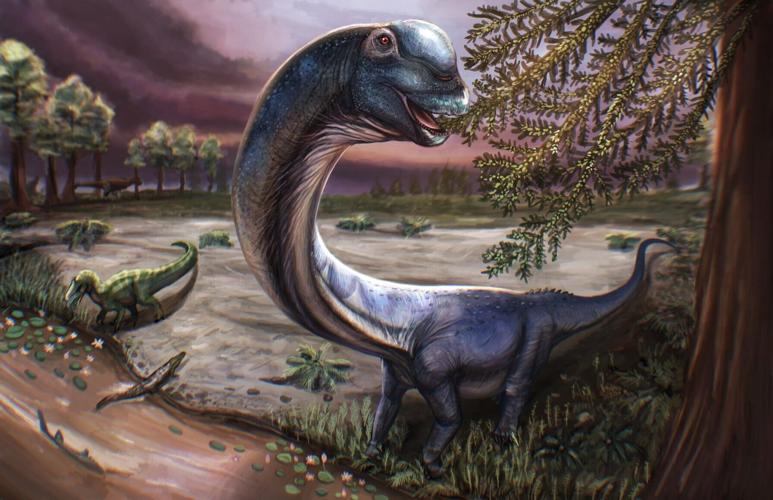
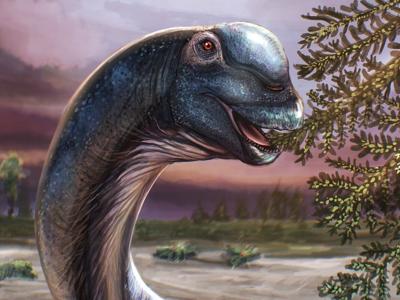

Artistic illustration of the Nagatitan. (Patchanop Boonsai via SWNS)
By Stephen Beech
A newly identified giant long-necked dinosaur weighed the same as nine adult elephants and was as long as three city buses, according to new research.
Bones found at the edge of a pond in Thailand 10 years ago come from the largest dinosaur ever found in Southeast Asia, say scientists.
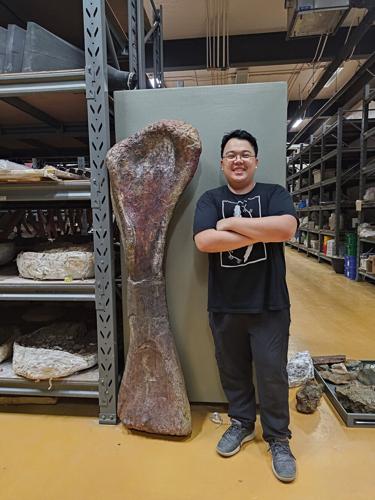
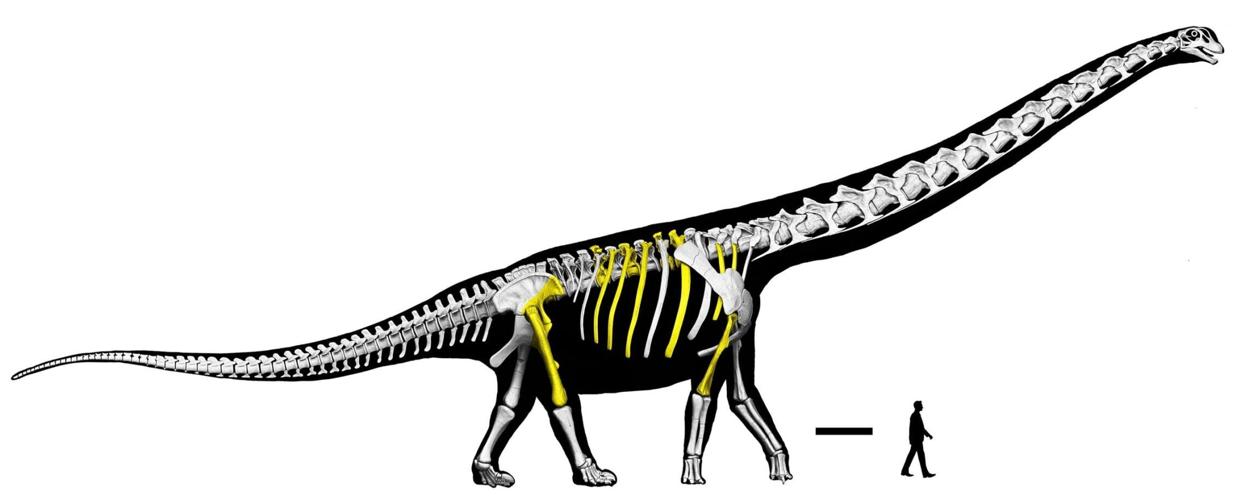
Analysis of spine, rib, pelvis and leg remains, including a front leg bone 1.78 meters (5.8 feet) long, suggests it weighed 27 tons — about the same as nine adult Asian elephants — and measured 27 meters (88.5 feet) in length.
It has been named Nagatitan chaiyaphumensis, with "Naga" referring to a mythological aquatic serpent in Thai folklore, "Titan" referring to the giants of Greek mythology, and chaiyaphumensis meaning "from Chaiyaphum" — the Thai province where the fossils were discovered.
The study, published in the journal Scientific Reports, was led by researchers from University College London (UCL), Mahasarakham University, Suranaree University of Technology and Sirindhorn Museum, Thailand.
They say the giant plant-eater belonged to the sauropod family of dinosaurs — which include Diplodocus and Brontosaurus — and lived in the Early Cretaceous period between 100 and 120 million years ago.
Lead author Thitiwoot Sethapanichsakul, a Ph.D. student at UCL, said: "Our dinosaur is big by most people's standards.

Thitiwoot Sethapanichsakul and the front leg bone (humerus) of a newly identified giant long-necked dinosaur. (Thitiwoot Sethapanichsakul via SWNS)
"It likely weighed at least 10 tons more than Dippy the Diplodocus. However, it is still dwarfed by sauropods like Patagotitan (60 tons) or Ruyangosaurus (50 tons).
"We refer to Nagatitan as 'the last titan' of Thailand. That is because it was discovered in Thailand's youngest dinosaur-bearing rock formation.
"Younger rocks laid down towards the end of the time of the dinosaurs are unlikely to contain dinosaur remains because the region by then had become a shallow sea.
"So this may be the last or most recent large sauropod we will find in Southeast Asia."
He explained that during the Early Cretaceous the environment would have been arid to semi-arid — a preferred habitat for sauropods who appeared to thrive in such environments, relying on the surface area of their long necks and tails to shed heat and regulate their body temperature.
The area where the specimens were found also appeared to be part of a meandering river system, which would have been home to fish, freshwater sharks and crocodiles.
Nagatitan would have lived alongside smaller plant-eating dinosaurs such as iguanodontians and early branching ceratopsians, as well as big meat-eaters including carcharodontosaurians and spinosaurids, and flying reptiles called pterosaurs eating fish from the river.
The researchers say Nagatitan was a somphospondylan sauropod — a subgroup of sauropod that became widespread about 120 million years ago.


They explained that it specifically belonged to a narrower group within the somphospondylans called Euhelopodidae, which represents a group of somphospondylan sauropods only found in Asia.
But Nagatitan is distinct from other species due to a combination of unique features on its spine, pelvis and legs.
Sethapanichsakul said: "My dream is to continue pushing to get Southeast Asian dinosaurs recognized internationally.

Skeletal reconstruction with specimens highlighted in yellow. (Thitiwoot Sethapanichsakul via SWNS)
"More international collaborations between Thailand and other institutions like UCL can further our understanding of the region's paleobiology and apply it to a global context.
"This all starts with identifying and describing the specimens we have found first.
"We have a large collection of sauropod fossils that have not yet been formally described — these may include a number of new species."
He added: "I've always been a dinosaur kid.
"This study doesn't just establish a new species, but also fulfills a childhood promise of naming a dinosaur."
Co-author Paul Upchurch, of UCL Earth Sciences, said: "The material was studied both in Thailand and at UCL — 3D scanning and printing has meant that we can study the specimen and collect data without having to travel: good for reducing carbon footprint."
He added: "We have had a long-standing interest in the evolution of these gigantic plant eaters and have good collaborative links with researchers around the world.
"It is great to work with Thai colleagues and start to get insights into what was happening in Southeast Asia during the Jurassic and Cretaceous."
A team of five academics work on different aspects of dinosaur evolution at UCL, with strong collaborative links to the Natural History Museum.
The extended research group comprises four research fellows and postdoc researchers, and more than 10 Ph.D. students.
At least four of the Ph.D. students are working on dinosaur evolution, with the others looking at a range of other evolutionary questions relating to vertebrates, including crocodiles and birds.
Project leader Sita Manitkoon, of Mahasarakham University, said: "Although Thailand is a small country within Asia, we have a very high diversity in dinosaur fossils, possibly the third most abundant in Asia in terms of dinosaur remains."
Manitkoon added: "We've only really been studying dinosaurs in Thailand about 40 years, since the first dinosaur was named in 1986, and already we have a surge of younger generation paleontologists, who are actively undertaking research and promoting paleontology and its importance within the country."
A life-size reconstruction of the dinosaur is now on display at the Thainosaur Museum at Asiatique in Bangkok.


(0) comments
Welcome to the discussion.
Log In
Keep it Clean. Please avoid obscene, vulgar, lewd, racist or sexually-oriented language.
PLEASE TURN OFF YOUR CAPS LOCK.
Don't Threaten. Threats of harming another person will not be tolerated.
Be Truthful. Don't knowingly lie about anyone or anything.
Be Nice. No racism, sexism or any sort of -ism that is degrading to another person.
Be Proactive. Use the 'Report' link on each comment to let us know of abusive posts.
Share with Us. We'd love to hear eyewitness accounts, the history behind an article.