




(Photo by Look Studio via Unsplash)
According to a new study, 43% of Americans have felt duped by AI ads before.
The poll of 2,000 U.S. adults found that 44% frequently see products advertised using some form of AI. On average, they question whether the ads they see online feature real or AI-generated products four times a week.
More than half said they do not trust products advertised with AI to match their descriptions.
Commissioned by Auros and conducted by Talker Research, the study found that 61% believe at least one type of brand would be likely to use misleading or AI-focused marketing.
The biggest offenders, according to them, are clothing brands (16%), beauty and cosmetic brands (16%), electronics (14%), luxury goods (11%) and food and beverage brands (11%).
Respondents believe major retailers including Walmart (27%) and Amazon (26%) are most likely to use AI marketing for products, followed by social media sites like TikTok, Instagram, and Facebook (24%).
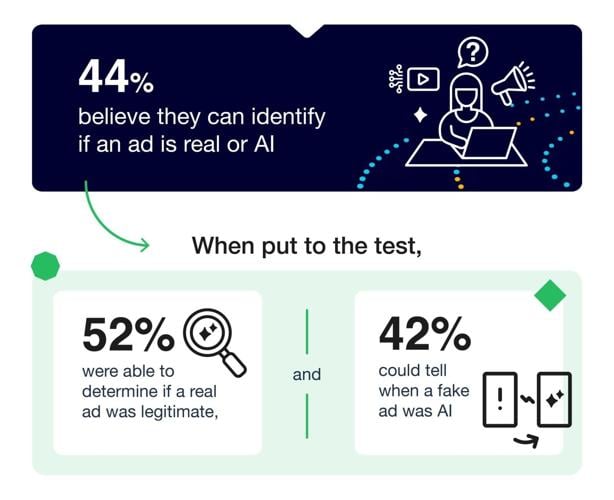
When asked how confident they were in identifying whether an ad featured a real or AI product, 44% said they felt confident, while 22% said they did not.
This was then put to the test, as respondents were tasked to determine if ads shown to them were real or AI.
When shown real products, an average 52% were able to correctly identify them. A third (31%) thought what they saw was AI, and 18% believed they saw a real product, but enhanced with AI.
When shown fake products, an average 42% correctly knew what they saw was just AI. Thirty-four percent thought what they saw was real, and 24% thought the products were real, but AI-enhanced.

(Talker Research)


Images of real products enhanced with AI appeared to cause the most confusion. Only 20% correctly identified these as real products with AI-enhanced features or surroundings. A majority (60%, on average) thought the products were AI, and 21% thought they were real.
Whether AI was used in an ad seemed to shape consumers’ perceptions. A third (36%) believe that a product is lower quality if AI is used in its marketing, while only 17% believe that it’s higher quality if AI is used in its marketing.
“There’s a fascinating trust divide emerging around AI in commerce," says Bobby Meixner, vice president of solution marketing at Auros. "Consumers are skeptical when AI is being used to persuade them, but much more receptive when they’re the ones using AI to make a better decision. People aren’t necessarily rejecting AI in shopping. They’re rejecting the feeling that AI is being used on them rather than for them.”
While many respondents viewed AI negatively when used in advertising, they had a more favorable view of using AI as a shopping tool. Over half (53%) of Americans surveyed said AI has been helpful to them while shopping.
According to them, AI is best at finding the most affordable price possible (24%), finding alternatives to what they were looking for (22%) and finding product reviews (22%). Others have also found it useful to show use cases for products (19%) and reminders for when a product is in stock (17%).
Similarly, 54% plan to use AI for some part of their holiday shopping this year. Many believe they'll use the technology to help them find the best prices (21%), suggest gift ideas (17%), compare product reviews across sites (16%), find deals (15%) and track packages (15%).
Given the amount of time they spend shopping for others during the season, 37% believe AI will make it easier to find gifts.
On average, holiday shoppers spend the most time shopping for their significant other and children, at four hours each, and least amount of time shopping for coworkers, at two hours.
“AI could be the biggest change to e-commerce since e-commerce itself. Online shopping has always been an experience designed by the retailer," continued Bobby. "AI flips that model: the shopper can now have an experience assembled around them, using information from across the internet rather than from one retailer alone. That could solve personalization at a scale retailers never could, but it also fundamentally changes who controls the shopping journey.”
Research methodology:
Talker Research surveyed 2,000 general population Americans who have access to the internet; the survey was commissioned by Auros and administered and conducted online by Talker Research between Aug. 26 to Sept. 1, 2026. A link to the questionnaire can be found here.
To view the complete methodology as part of AAPOR’s Transparency Initiative, please visit the Talker Research Process and Methodology page.


(0) comments
Welcome to the discussion.
Log In
Keep it Clean. Please avoid obscene, vulgar, lewd, racist or sexually-oriented language.
PLEASE TURN OFF YOUR CAPS LOCK.
Don't Threaten. Threats of harming another person will not be tolerated.
Be Truthful. Don't knowingly lie about anyone or anything.
Be Nice. No racism, sexism or any sort of -ism that is degrading to another person.
Be Proactive. Use the 'Report' link on each comment to let us know of abusive posts.
Share with Us. We'd love to hear eyewitness accounts, the history behind an article.