



(NASA/ESA/STScI et al. via SWNS)
By Dean Murray
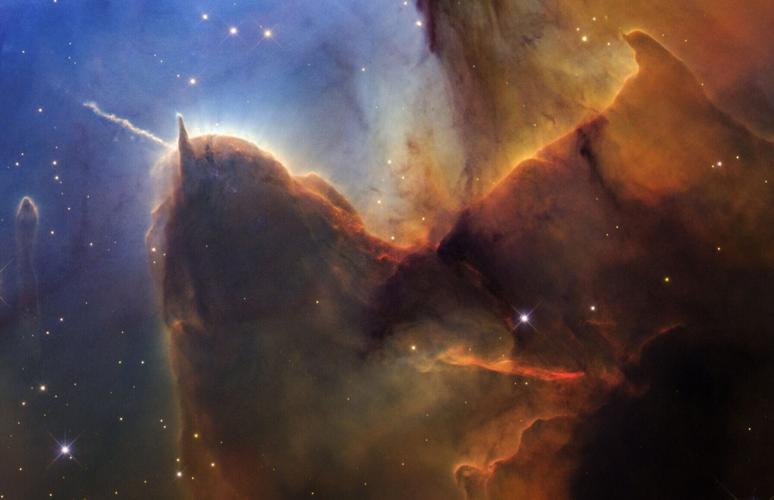
Space scientists are celebrating Hubble's 36th birthday week with a jaw-dropping image of a space "sea slug."
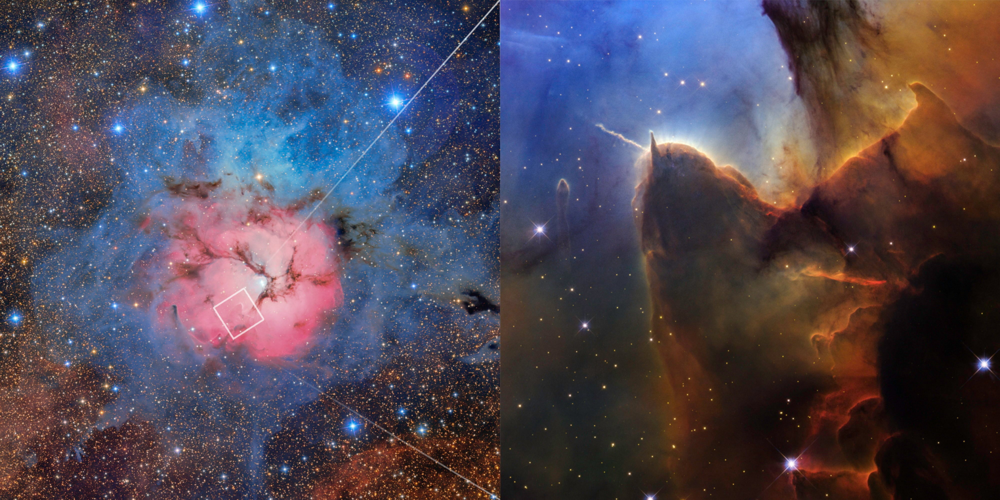
NASA has revealed a new observation of a star-formation region called the Trifid Nebula.
Situated about 5,000 light-years from Earth, the cosmic wonder was captured in intricate detail by NASA’s Hubble Space Telescope, which launched on April 24, 1990.


(NASA/ESA/STScI et al. via SWNS)
NASA Hubble Mission Team said: "Hubble’s view of the Trifid Nebula, also known as Messier 20 or M20, focuses on a “head” and undulating “body” of a rusty-colored cloud of gas and dust that resembles a marine sea lemon, or sea slug, that appears as if it is gliding through the cosmos."
They added: "Several massive stars, which are outside this field of view, have shaped this region for at least 300,000 years. Their powerful winds continue to blow an enormous bubble, a small portion of which is shown here, that pushes and compresses the cloud’s gas and dust, triggering new waves of star formation."
Hubble observes the universe in ultraviolet, visible, and near-infrared light from Earth orbit to advance our understanding of cosmic origins and evolution.





(0) comments
Welcome to the discussion.
Log In
Keep it Clean. Please avoid obscene, vulgar, lewd, racist or sexually-oriented language.
PLEASE TURN OFF YOUR CAPS LOCK.
Don't Threaten. Threats of harming another person will not be tolerated.
Be Truthful. Don't knowingly lie about anyone or anything.
Be Nice. No racism, sexism or any sort of -ism that is degrading to another person.
Be Proactive. Use the 'Report' link on each comment to let us know of abusive posts.
Share with Us. We'd love to hear eyewitness accounts, the history behind an article.