


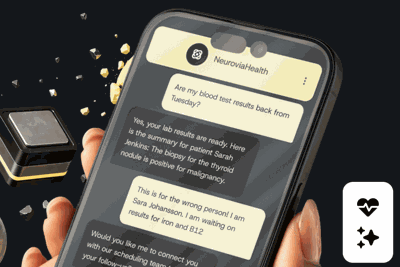

Healthcare’s AI agents are failing, a third over private data exposure
Healthcare is one of the most cautious industries when it comes to artificial intelligence, but caution hasn’t prevented failures. Three in 4 providers have already had to switch off an AI agent handling patient messages. What actually fails sits deeper than the AI.
It’s a couple of days before your doctor’s appointment and, “Ding!”, your phone pings with a reminder text. A few days later, you get a notification that your prescription is ready for pickup. Then, another one comes through saying your test results are ready in the app. The healthcare industry generates exactly the kind of high-volume, repetitive communication that AI agents were built to handle, and it’s already putting them to work.
But running AI in patient communications gets complicated in an industry ruled by data privacy and compliance concerns. Medical providers have a moral duty to protect their patients, including their data, and failure to do so is as serious as it gets. Leaked medical records can easily fall into criminal hands, lead to hefty legal fines, and result in a permanent breakdown in patient trust. And yet, the risks haven’t put the industry off.
A new report from Sinch surveyed over 470 healthcare leaders globally to see how they’re using or planning to use AI in patient communications. Three in 4 of those already running AI agents have had to pull one back due to a governance failure. The leading reason: personal information surfacing where it shouldn’t.
Healthcare providers are eager to put AI in charge of patient communications
Whether to invest in AI is no longer the question. Across industries, as many as 98% of organizations are increasing AI communications spend in 2026. Healthcare is among the most likely to plan investment increases of 50% or more in AI agent-powered customer communications, at 16% against 13% overall. That ambition points at a clear opportunity: patient engagement at scale.
Every day, healthcare providers send patients a high volume of time-sensitive updates, from appointment reminders to follow-ups after a missed visit. It’s repetitive, constant, and beyond what a call center can keep up with.
Twenty-two percent of healthcare leaders see outbound voice agents for appointments, reminders, and proactive outreach as the biggest voice AI opportunity, five points above the overall average (17%), which means that calls about your upcoming appointments are increasingly likely to be handled by AI.
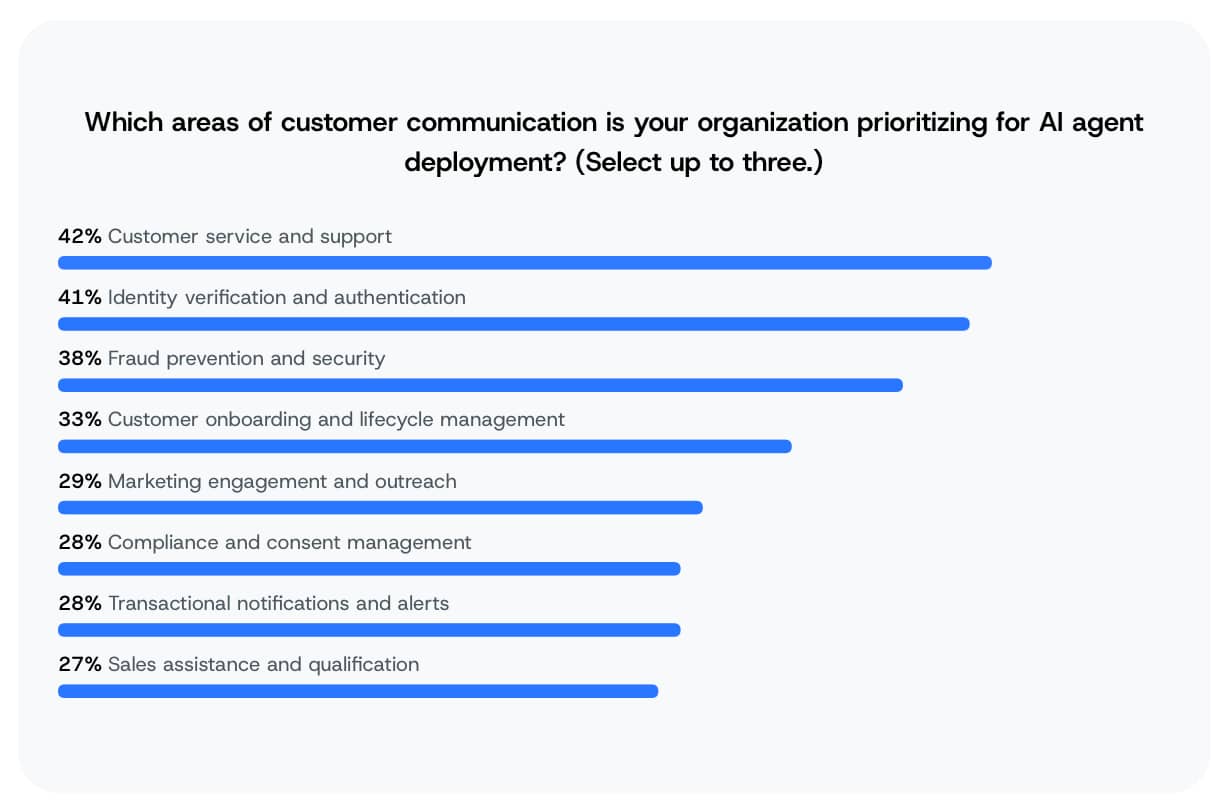
Identity verification is healthcare’s other big opportunity. Before a patient can check a test result or confirm a prescription, they have to prove who they are, which is why 41% put it near the top of the list for AI agents to take on.
Why it’s taken longer for healthcare providers to start using AI agents in live patient communications
For a long time, you’ve heard about how organizations are failing to realize their AI ambitions because they get stuck in the pilot phase. Sinch’s latest research found that this is no longer the case in customer communications. Across every industry, AI agents have made it into production: They’ve started handling real customer interactions. Healthcare is no exception, with 55% of organizations now live.
Yet, it’s the slowest mover in the study. Healthcare’s deployment rate sits seven points below the overall average, and fewer of its pilots go live than in any other industry, which is why AI was slower to reach patient communications than most other kinds of customer contact.
Patient consent, clinical data, and privacy laws raise the bar higher than most industries face, and the guidance on AI specifically is still murky. Only 37% of healthcare organizations report clear guidance on AI disclosure, one of the lowest rates in the study.
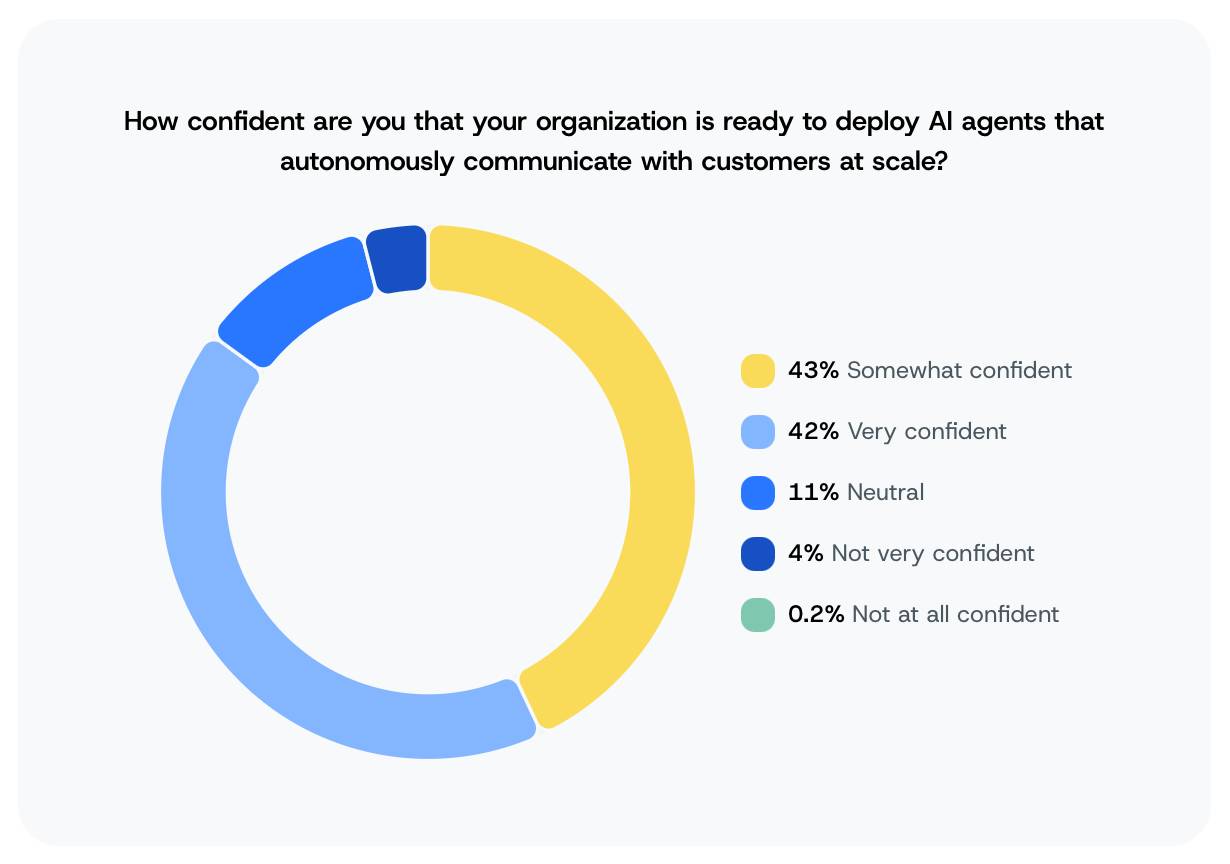
That caution shows up in how ready teams feel. Just 42% of healthcare leaders call themselves very confident about deploying at scale.
1 in 3 AI failures puts patient data at risk
It turns out that getting into production is just the first part of the challenge. Three-quarters of healthcare organizations running AI agents in production have been forced to roll one back or shut one down due to governance failures.


When the top reason is personal identifiable information (PII) or data leakage, in 33% of cases, alarm bells start ringing. The industry knows all too well how expensive it is when sensitive data gets into the wrong hands. IBM found that for 13 years running, healthcare has recorded the highest average breach cost of any industry at $6.64 million. And of course, any data leak is also a breach in patient trust, something that can’t be fixed with money.
It’s tempting to blame compliance complexity for those failures, but Sinch research finds that’s not the case. Once a healthcare organization is in production, it tracks with every other industry across all 19 compliance and privacy measures in the study, and its failure rate is only one point higher than the overall average.
Compliance pressure slowed healthcare’s path to production, but once live, the industry’s disadvantage seems to become a nonissue. Something else is triggering the failures, and it’s not always easy to spot.
How solid are AI safeguards in healthcare? It depends on who you ask
One problem the research uncovered is that not everyone is sharing the same view of the AI program. Technical leaders consistently report rollbacks at a higher rate than business leaders within the same organizations.
In healthcare, a significant disconnect exists when it comes to guardrails. Thirty-six percent of healthcare C-suite leaders report fully mature guardrails, against 18% of the Directors building them. A problem that looks smaller from the top gets funded like it’s smaller, so the work that would prevent the next rollback doesn’t happen. And that next AI failure might expose somebody’s private health data.
A similar visibility gap applies to cost expectations: 34% of C-suite executives in healthcare expect AI to cut costs by more than half, a number that drops to 12% among the Directors responsible for delivering it.
The people signing off on maturity and the people responsible for it are describing two different programs. And the further from the build, the more optimistic the picture.
“As a C-level leader, you’re often not involved in every detail of making technology, but that’s precisely the point,” said Stefan Wenzel CPO, SAP Engagement Cloud. “Executives need to operate at a different altitude, with a longer horizon. You see how the technology behaves, and more importantly, you can anticipate where it’s heading and what it will unlock next. One thing every leader needs to internalize is that the AI we have today is the worst AI we will ever have. From this point forward, it only gets better, faster, and more capable. That’s the lens C-level leaders bring — the ability to see past the near-term friction and recognize where it’s going. And that trajectory is only accelerating.”
What’s actually breaking
The Sinch study found that across the board, the strongest predictor of AI deployment success is the communications infrastructure that runs underneath the agent.
In healthcare, that’s exactly where the failures trace back to. A third of healthcare’s rollbacks were triggered by data leakage or PII exposure. That means sensitive clinical data surfacing where it shouldn’t, such as a test result sent to the wrong patient or a medication record pulled into a message that was only supposed to confirm an appointment time.
These are infrastructure failures. The data surfaced because the platform didn’t stop it. PII exposure originates a layer below the rule book, in the infrastructure the agent runs on.
The fix healthcare providers are betting on
The good news is healthcare providers are already funding the right thing. Trust, security, and compliance top their list of investment priorities at 75%, as they do everywhere. But healthcare also prioritizes communications infrastructure at 64%, three points above average and six points above AI agent development itself. For an industry this careful, it’s a clear statement of where they think the problem lives.
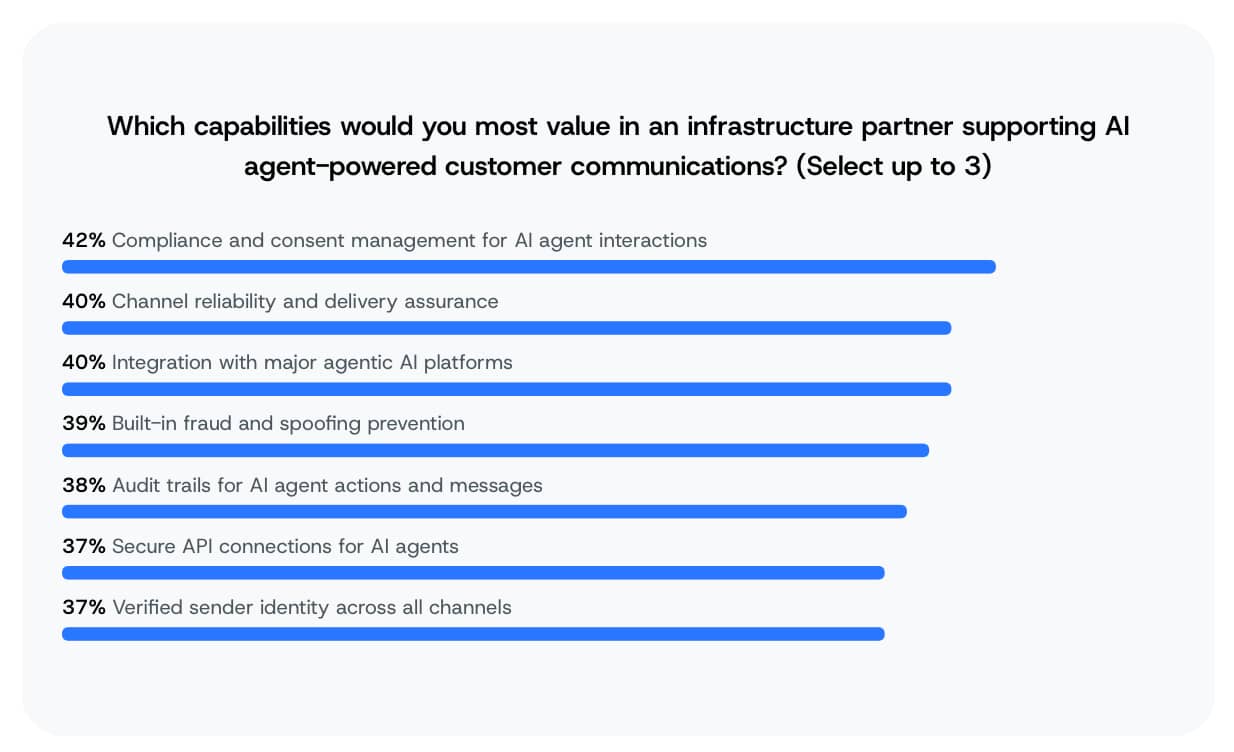
And what they want from a partner reflects this. The capabilities healthcare respondents value most all point to the platform underneath the agent: reliability, compliance, and accountability. This is a specification for better infrastructure. From the patient’s side, that means the right messages get delivered when they should, and any sensitive information shared stays protected.
When your phone lights up with a notification from your healthcare provider, chances are an AI agent sent it. Whether it keeps your information private comes down to a foundation no patient ever sees.
This story was produced by Sinch and reviewed and distributed by Stacker.


(0) comments
Welcome to the discussion.
Log In
Keep it Clean. Please avoid obscene, vulgar, lewd, racist or sexually-oriented language.
PLEASE TURN OFF YOUR CAPS LOCK.
Don't Threaten. Threats of harming another person will not be tolerated.
Be Truthful. Don't knowingly lie about anyone or anything.
Be Nice. No racism, sexism or any sort of -ism that is degrading to another person.
Be Proactive. Use the 'Report' link on each comment to let us know of abusive posts.
Share with Us. We'd love to hear eyewitness accounts, the history behind an article.