


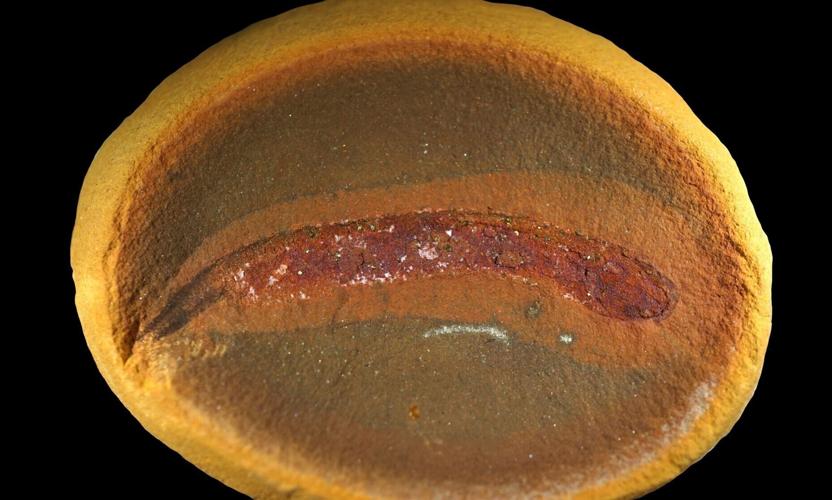
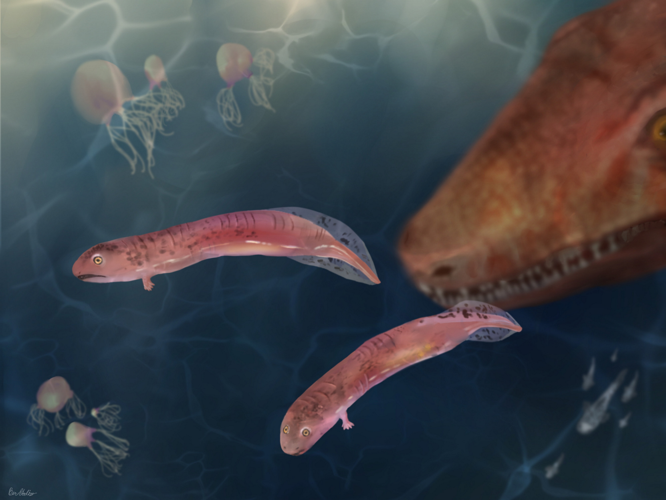
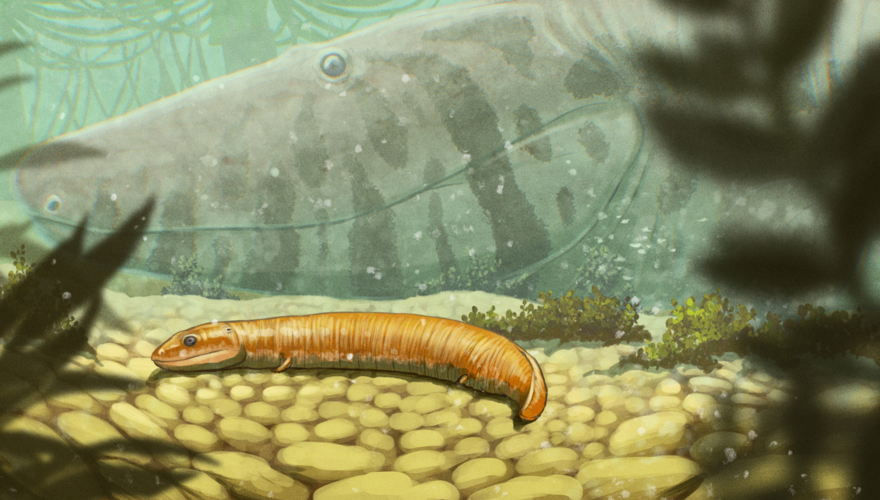

Fossil baby embolomere, showing that young embolomeres did not undergo a full amphibian-like metamorphosis. (Arjan Mann via SWNS)
By Stephen Beech
Fossilized babies of ancient crocodile-like predators have led to a "monumental" change in understanding of how animals first adapted to life on land.
Young fossilized tetrapods show that the common ancestors of amphibians, reptiles, and mammals didn't evolve from species with amphibian-like tadpoles after all, say scientists.
They explained that life on Earth began in water before, eventually, one branch of the fish family tree developed legs and came up on land.
The early four-legged animals, the tetrapods, were the forebears of today’s mammals, birds, reptiles, and amphibians.
Researchers have long believed that the earliest of the occasional-land-dwellers were like modern amphibians, in that they hatched from eggs, underwent a tadpole phase, and then transformed into their adult bodies.
But American scientists have now discovered fossilized baby early tetrapods, which skipped the tadpole metamorphosis they had expected to see.
Their findings, published in the journal Science, mean that the first land-dwelling vertebrates were less like modern amphibians than had previously been thought, rewriting scientists’ understanding of how animals conquered the land.
Study co-lead author Dr. Jason Pardo, of the Field Museum in Chicago, said: “When a lot of us were in high school, we were taught this simplified story of evolution: that some fish evolved into amphibians, and some of those amphibians evolved into reptiles, and some of those reptiles evolved into mammals.
"And our study shows that this basic underlying premise, that the first four-legged vertebrates grew up like amphibians, is wrong."
The research made use of dozens of fossils discovered at the Mazon Creek fossil deposit in Illinois.

The early four-legged animals, the tetrapods, were the forebears of today’s mammals, birds, reptiles, and amphibians. (Gabriel Ugueto via SWNS)
The team explained that the fossils represent the evolutionary transition between fish and four-legged animals, or tetrapods, but two “centerpiece” fossils are babies of an animal called an embolomere.
Embolomeres were crocodile-like early tetrapods that were among the top predators in rivers, lakes, and swamps from 350 to 280 million years ago.
As adults, they could reach lengths of over 10 feet (3 meters), but the specimens found at Mazon Creek are babies that were just a few centimeters long.
Study co-lead author Dr. Arjan Mann, the Field Museum’s assistant curator of early tetrapods, said: "This is the first time we’ve had these early, early hatchling animals.
"This discovery is really a testament to the power of Mazon Creek, the site where these fossils came from.
“It’s an hour’s drive southwest of Chicago, and it’s one of the best fossil sites in the world, especially for soft tissues and delicate little fossils like these baby tetrapods.
"Mazon Creek fossils are time capsules that capture the impossible.
“I first saw the baby embolomere fossil about 10 years ago, when I was working on my PhD.
“It’s in the collections at the Field Museum, and the curator of tetrapods at the time, John Bolt, pulled it out of a drawer and showed it to me when I was visiting.


"At the time, it hadn’t yet been identified as an embolomere, but I was really drawn to it, and John loaned me the fossil to study.”
Mann and Pardo, who were both PhD students in Canada at the time, spent years puzzling over the strange fossil.
Mann said: "We had so many conversations over the past decade about what the heck this thing was.
“Every night, we’d go back and forth saying, what’s this feature? What could this thing be?”
Eventually, analysis with scanning electron microscopy at the Canadian Museum of Nature confirmed the fossil’s identity as an embolomere.
But that led to more questions as the baby embolomere, despite being an early tetrapod, didn’t show the amphibian-like tadpole features that scientists assumed an early tetrapod tadpole would have.

While the juvenile tetrapod did grow limbs over the course of its development, it was missing key amphibian tadpole traits such as frilly external gills.
The same held true for another smaller embolomere that the team analyzed, as well as for other species of fossil baby tetrapod relatives.
Even when the larval stages did undergo big changes on their way to adulthood, they didn't show signs of true amphibian metamorphosis.
Pardo said: "We looked at a number of different species that represent different lineages in the transition from fish to tetrapods, and what we found is that none of them have anything that looks remotely like a tadpole.
"And if you don't have a tadpole, then you don't have a metamorphosis.
“These early tetrapods’ life cycles are more like ours, or like those of fish, than they are like amphibians.”
Pardo explained that if species like the embolomere didn’t have a tadpole form or a true amphibian metamorphosis, that means that the widely accepted hypothesis that reptiles and mammals evolved from amphibian-like animals is incorrect.
He added: “The story was that metamorphosis is the tool by which animals made the transition from fossil to land.
"That story doesn’t work anymore, it’s dust in the wind."
Mann noted that this discovery, which rewrites decades of scientific understanding of early tetrapod evolution, wouldn't have been possible without the collaboration of many people.
He said: “Every single specimen in this paper was a joint effort with the Earth Science Club of Northern Illinois, the Lauer Foundation for Paleontology, Science and Education, and the Field Museum.
"We could not have done this without the help of lots of scientists, including citizen scientists and volunteers.
“People like Paul Demkovich, Ben Riegler, Rich Rock, and Tom Testa allowed us to study specimens that they found, and these specimens have changed the course of our understanding of how tetrapods evolved."
He added: "This is a monumental discovery, and it could not have happened without citizen science.”


(0) comments
Welcome to the discussion.
Log In
Keep it Clean. Please avoid obscene, vulgar, lewd, racist or sexually-oriented language.
PLEASE TURN OFF YOUR CAPS LOCK.
Don't Threaten. Threats of harming another person will not be tolerated.
Be Truthful. Don't knowingly lie about anyone or anything.
Be Nice. No racism, sexism or any sort of -ism that is degrading to another person.
Be Proactive. Use the 'Report' link on each comment to let us know of abusive posts.
Share with Us. We'd love to hear eyewitness accounts, the history behind an article.