





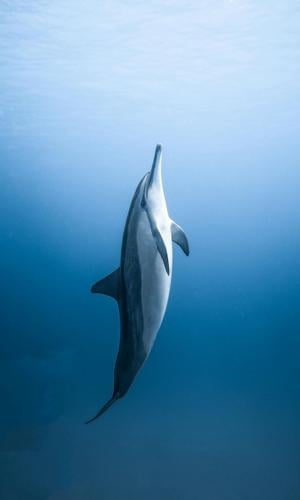

(Photo by Magda Ehlers via Pexels)
By Stephen Beech
Dolphins "speak" more when they're learning new skills, reveals research.
Captive bottlenose dolphins vary their vocalizations during "enrichment" activities, say Italian scientists.
They believe their findings can improve the future welfare of the iconic mammals when held in captivity.
Previous research has shown that dolphins produce a range of vocalisations used for echolocation and communication.
Study leader Dr Francesco Di Nardo, of Marche Polytechnic University, Ancona, said: "These vocalizations vary with social context, environmental conditions, external stimuli, and communication, reflecting their cognitive and behavioral complexity."
He said the new findings, published in the journal PLOS One, suggest that the frequency and duration of captive dolphin vocalizations may indicate engagement with structured activities.
Dr. Di Nardo said: "Captive dolphins require enrichment activities, such as training sessions and play interactions.

Positioning of the recording device (red circle) in the Laguna dei delfini pool. (Screpanti et al., 2025, PLOS One via SWNS)
"However, best practices for managing captive dolphin environments and optimising welfare practices could be improved with a more detailed understanding of what activities motivate and engage them."
To better understand the relationship between vocal behaviour and different kinds of structured activities, Dr. Di Nardo and his colleagues conducted acoustic analysis of seven bottlenose dolphins at Oltremare Marine Park in Riccione, Italy.


The team recorded the vocalisations of two males and five females over a 24-hour period in 2021 while monitoring the dolphins’ environment and activities, including feeding sessions and trainer-led exercises.
They then analyzed the recordings to classify vocalizations as whistles and pulses, quantified their diversity, number, and duration, and compared periods of organized activity with periods of no organized activity.
The researchers discovered that organised activities influenced all vocalisations, reflecting increased motivation, social coordination, and negotiation with fellow dolphins, as well as engagement with human trainers.

(Photo by Daniel Torobekov via Pexels)
Dr. Di Nardo said: "Our findings show that dolphins tend to ‘speak’ much more during structured moments like training, feeding, or play, revealing how closely their vocal activity reflects their social and emotional engagement.
"This work also illustrates how detailed acoustic datasets can deepen our understanding of dolphin communication and support better welfare and conservation practices.
“Understanding the relationship between vocalisation patterns and activity types has direct implications for dolphin welfare.
"Our study can improve the design of enrichment programmes to ensure that dolphins in human care maintain a healthy and dynamic acoustic repertoire.”
He added: "Alongside the scientific analysis, indeed, this study also releases the full database of dolphin vocalizations in the hope that it will support and inspire further research.
"Working with these highly social animals is truly inspiring; they remind us how much we can learn about the marine environment and the relationships among its inhabitants.”
Dr. Di Nardo says the study was limited by its small sample size of seven dolphins and short duration.
But he said future research focusing on comparisons between different types of activities and environments, rather than comparing activity to periods of no activity, could yield further insights.


(0) comments
Welcome to the discussion.
Log In
Keep it Clean. Please avoid obscene, vulgar, lewd, racist or sexually-oriented language.
PLEASE TURN OFF YOUR CAPS LOCK.
Don't Threaten. Threats of harming another person will not be tolerated.
Be Truthful. Don't knowingly lie about anyone or anything.
Be Nice. No racism, sexism or any sort of -ism that is degrading to another person.
Be Proactive. Use the 'Report' link on each comment to let us know of abusive posts.
Share with Us. We'd love to hear eyewitness accounts, the history behind an article.