


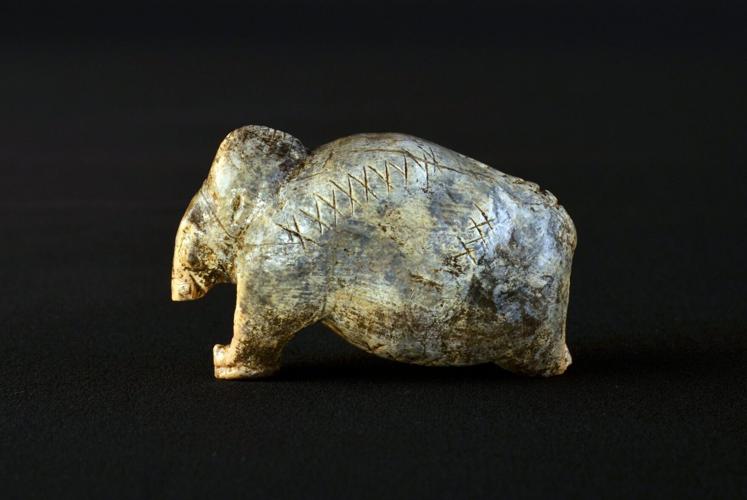



The mammoth figurine from Vogelherd Cave, approximately 40,000 years old, bears multiple sequences of crosses and dots on its surface. (Universität Tübingen / Hildegard Jensen via SWNS)
By Stephen Beech
Carvings made on tools and sculptures over 40,000 years ago were a "precursor" to written language, suggests new research.
Stone Age sign sequences have the same level of complexity and information density as the earliest proto-cuneiform script that emerged tens of thousands of years later around 3,000BC, say scientists.
Using a computational approach, German researchers examined more than 3,000 signs found on 260 objects to reveal insights on the origins of writing.
The findings, published in the journal Proceedings of the National Academy of Sciences (PNAS), surprised even the researchers.
The team explained that palaeolithic objects dating back between 34,000 and 45,000 years bear mysterious sign sequences – often repeated lines, notches, dots and crosses.
Many of the artefacts were discovered in caves in the Swabian Jura mountain range in southern Germany, including a small mammoth found in the Vogelherd Cave.
A Stone Age human carved the mammoth figurine out of a mammoth tusk and carefully engraved it with rows of crosses and dots.
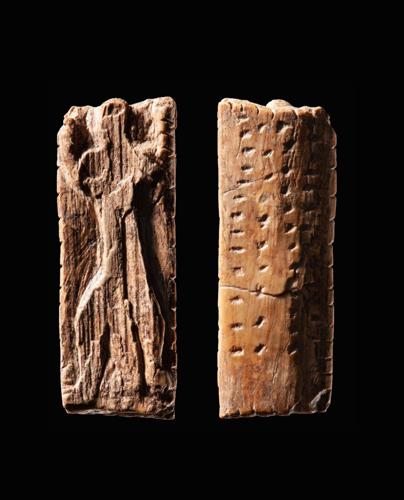
Other artefacts found in the Swabian Jura are also etched with signs, including the 'Adorant' - a mammoth ivory plate uncovered in a cave in the Ach Valley that depicts a hybrid lion-human creature.

The new analysis isby linguist Christian Bentz (photo) at Saarland University and archaeologist Ewa Dutkiewicz at the Museum für Vor- und Frühgeschichte (Museum of Prehistory and Early History) in Berlin.
It is also adorned with rows of dots and notches.
Another mythical depiction of a human-lion hybrid, the Lion Human from the Hohlenstein-Stadel Cave in the Lone Valley, reveals notches placed at regular intervals along the arm.
The new research show that the marks are there because Stone Age humans used them to convey information and to record their thoughts.
Co-author Professor Christian Bentz said: "Our research is helping us uncover the unique statistical properties – or statistical fingerprint – of these sign systems, which are an early predecessor to writing."
Co-author Dr. Ewa Dutkiewicz said: "The Swabian Jura is one of the regions where objects with this type of sign have been found most frequently, but there are, of course, other important regions.
"Countless tools and sculptures from the Palaeolithic, or the Old Stone Age, bear intentional sign sequences."
The researchers travel together throughout Europe, visiting museums and archaeological sites to find new Stone Age signs.
Dr. Dutkiewicz, from the Museum of Prehistory and Early History in Berlin, said: "There are many sign sequences to be found on artefacts.
"We've only just scratched the surface.
"The artefacts date back to tens of thousands of years before the first writing systems, to the time when Homo sapiens left Africa, settled in Europe and encountered Neanderthals."

The Adorant figurine from Geißenklösterle Cave, approximately 38,000 years old, consists of a small ivory plate bearing an anthropomorphic figure and multiple sequences of notches and dots. (Landesmuseum Württemberg / Hendrik Zwietasch via SWNS)
The researchers said the aim of the analysis was not to uncover the concrete meaning of the signs, which have not been deciphered.
Bentz, a linguist at Saarland University, Saarbrücken, said: "There are plenty of theories, but until now there has been very little empirical work carried out on the basic, measurable characteristics of the signs."
His research deals with frequency trends and measurable aspects of the signs.
He explained that allows him to see what the sign systems have in common with later systems – and how they differ.
Bentz said: "Our analyses demonstrate that these sign sequences have nothing to do with the writing systems of today, which represent spoken languages and are characterised by high information density.


"In contrast, the signs on the archaeological objects are frequently repeated – cross, cross, cross, line, line, line.
"This type of repetition is not a feature found in spoken language.
"However, our findings also show that Palaeolithic hunter-gatherers developed a system of symbols that has an information density that is statistically comparable to the earliest proto-cuneiform tablets from ancient Mesopotamia, which came 40,000 years later.
"Sign sequences in proto-cuneiform script are also repetitive and the individual signs are repeated at a similar rate.
"In terms of complexity, the sign sequences are comparable."

Archaeologist Ewa Dutkiewicz (photo) at the Museum für Vor- und Frühgeschichte (Museum of Prehistory and Early History) in Berlin. (Staatliche Museen zu Berlin / Juliane Eirich via SWNS)
Dr. Dutkiewicz added: "Figurines exhibit higher informational density than do tools."
The researchers were particularly surprised by how the sign systems measured up to proto-cuneiform.
Bentz said: "We hypothesized that the early proto-cuneiform script would be more similar to the writing systems of today, especially due to their relative proximity in time.
"Yet the more we studied them, the clearer it became that the early proto-cuneiform script is very similar to the much older Palaeolithic sign sequences."
He says that also means that little changed between the Old Stone Age and the emergence of the first proto-cuneiform scripts.
Bentz said: "Then, about 5,000 years ago, a new system emerged relatively suddenly that represents spoken language.
"The new system therefore has completely different statistical characteristics."
The team digitalised sign sequences on archaeological objects in a database, which they then use to assess statistical properties in the Stone Age sign inventories.
Bentz said: "Because of the high rate of repetitions and the high predictability of the next sign, we were able to show that the entropy – a measure of information density – is comparable to that of proto-cuneiform, which came much later."
He added: "The human ability to encode information in signs and symbols was developed over many thousands of years.
"Writing is only one specific form in a long series of sign systems.
"We continue to develop new systems for encoding information.
"Encoding is also the basis of computer systems."
The study does not reveal what the Stone Age humans were trying to record with the signs.
But Dr. Dutkiewicz said: "The findings can help us to narrow down potential interpretations."
She says the ability to record and convey information to others was extremely important for Palaeolithic humans as it may have allowed them to coordinate groups or even helped them survive.
Dr. Dutkiewicz added: "They were highly skilled craftspeople.
"You are able to see that they carried the objects with them.
"A lot of the objects fit right in the palm of your hand.
"That is another way in which the objects are similar to proto-cuneiform tablets."


(0) comments
Welcome to the discussion.
Log In
Keep it Clean. Please avoid obscene, vulgar, lewd, racist or sexually-oriented language.
PLEASE TURN OFF YOUR CAPS LOCK.
Don't Threaten. Threats of harming another person will not be tolerated.
Be Truthful. Don't knowingly lie about anyone or anything.
Be Nice. No racism, sexism or any sort of -ism that is degrading to another person.
Be Proactive. Use the 'Report' link on each comment to let us know of abusive posts.
Share with Us. We'd love to hear eyewitness accounts, the history behind an article.