



(University of Alicante via SWNS)
By Stephen Beech
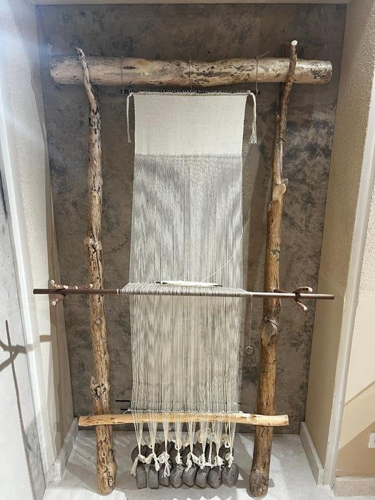
A wooden loom that survived a devastating fire 3,500 years ago has revealed key aspects of the Bronze Age textile revolution.
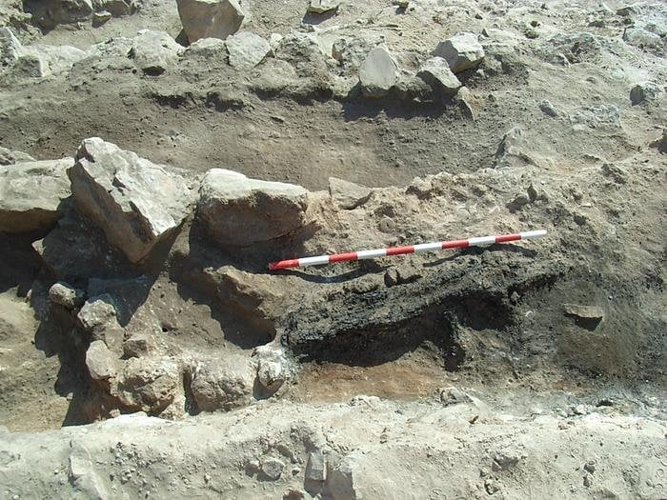
Most of the weights as well as components made from wood and plant fibers, remained remarkably intact despite the blaze that burned down a settlement near Villena in present-day Spain.
Scientists explained that the same inferno that destroyed part of the ancient village of Cabezo Redondo also helped preserve the loom that they say is "incredibly hard" to document in archaeology.
The discovery by a team of Spanish researchers, described in the journal Antiquity, is one of just a few known cases in which both the set of loom weights and components have been preserved.
The team says that Cabezo Redondo was a major Bronze Age settlement occupied between around 2100 BC and 1250 BC.
The dwellings, built on a series of terraces on the slope of the hill, had workbenches, fireplaces, silos and receptacles for storage.
Analysis of plant and animal remains indicates that the economy was based on intensive farming.
The discovery of gold, silver and ivory ornaments, glass and seashell beads proved that the settlement was part of large exchange networks that connected it with other areas of the Iberian Peninsula, the Eastern Mediterranean and even Central Europe.
Study co-author Professor Gabriel García Atiénzar, of the University of Alicante, explained that the fire generated a very specific archaeological context.

(University of Alicante via SWNS)
He said: "The collapse of the ceiling was crucial - resulting in a sealed space in which the area was suddenly destroyed and immediately buried, enabling its preservation."
Atiénzar says the loom components – including charred timbers, clay weights and esparto ropes – were trapped beneath the remains of the collapsed ceiling.
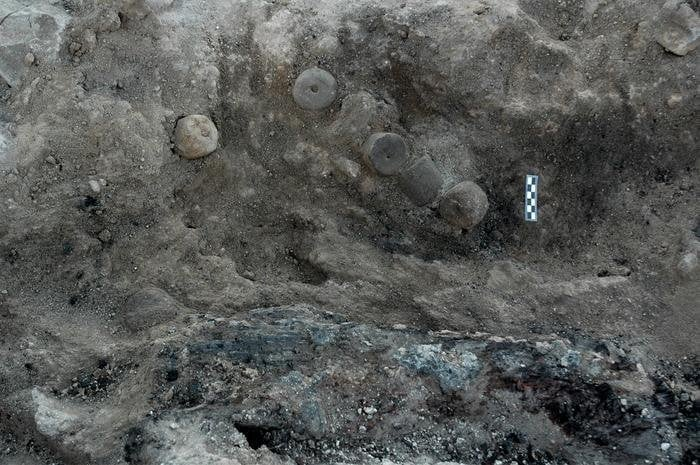
The loom appeared during the excavation of a circulation area on the western slope of the settlement, where the researchers found a raised platform with a dense concentration of clay weights.
Ricardo Basso Rial, a predoctoral researcher at the University of Granada, says the evidence allowed the team to identify the device with a high degree of certainty.
He said: "Although the loom was recovered from a collapsed area and some pieces were missing, the compact set of 44 cylindrical weights with a central perforation, most of them about 200 grams in weight, is characteristic of a vertical warp-weighted loom.
"Several pine timbers in a parallel arrangement were discovered alongside the weights.
"Some of the thicker timbers, with a rectangular cross-section, are probably the remains of the upright posts of the loom frame; other narrower pieces, with a rounded cross-section, supposedly constitute the horizontal posts."
The researchers also identified plaited esparto fibers associated with the structure, and even remains of small cords in the perforations of some weights, probably used to warp the threads to each loom weight.


The researchers have been able to accurately determine how the loom worked, which they say is highly unusual in prehistoric contexts.
Archaeobotanist Yolanda Carrión, from the University of Valencia, analyzed the wooden pieces.
She said: “The preservation of the organic elements was due to the fire that charred the remains and to the fact that these remains were practically unaltered later.
"Paradoxically, the fire both destroyed and preserved the site."
It was concluded from the microscopic study of the wood that the loom was made from Aleppo pine, widely found in the surrounding area.
PhD researcher Carrión said: "The observation of the growth rings suggests that the timbers came from long-lived trees that provided large-diameter pieces of wood, which indicates that the material was carefully selected."
She added: "The arrangement of wooden components of various sizes, assembled with each other and resting on a wall, and the presence of the weights allow us to develop a robust hypothesis about the morphology of the loom."
The loom was part of a wider process known as the “textile revolution” in the European Bronze Age - characterized by technological and economic changes in textile production, according to the study.
(University of Alicante via SWNS)
Basso said: "The textile revolution was the result of a combination of processes, including the expansion of livestock breeding for wool production, technical innovations in looms and spinning and weaving tools, and social changes that led to more intensive and diversified textile production."
He says new forms of lighter spindle whorls and various types of loom weights, some of them lightweight enough to allow for the production of finer, more complex fabrics, such as twills, were present at Cabezo Redondo.
But the fabrics themselves are rarely preserved in archaeological settings, so many of the deductions are based on the indirect study of tools.
For that reason, the researchers say the loom recovered from Cabezo Redondo is especially valuable.
Basso says it allows scientists to “go from interpreting isolated loom weights to documenting a working loom with extreme detail: the wooden structure, the ropes, the weights and the architectural context."
The team said the context in which the loom appeared also provides information on the social organization of work.
It was located in an outdoor space shared by several households, which suggests that production was a "cooperative" effort.
Paula Martín de la Sierra, a predoctoral researcher at the University of Alicante, said: “This indicates that different household groups may have collaborated on activities such as spinning, weaving and milling.
"Other artisanal activities in the village, such as metalwork or ivory craftsmanship, seem to have been concentrated in specialized areas."
She added: "In several graves at the site, teeth recovered from female remains have a degree of wear characteristically associated with spinning and weaving, as these women probably used their incisors to hold fibers in place or cut threads."


(0) comments
Welcome to the discussion.
Log In
Keep it Clean. Please avoid obscene, vulgar, lewd, racist or sexually-oriented language.
PLEASE TURN OFF YOUR CAPS LOCK.
Don't Threaten. Threats of harming another person will not be tolerated.
Be Truthful. Don't knowingly lie about anyone or anything.
Be Nice. No racism, sexism or any sort of -ism that is degrading to another person.
Be Proactive. Use the 'Report' link on each comment to let us know of abusive posts.
Share with Us. We'd love to hear eyewitness accounts, the history behind an article.