


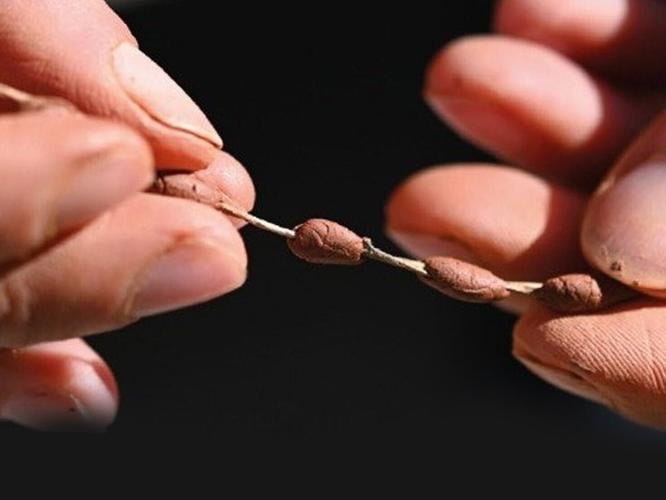
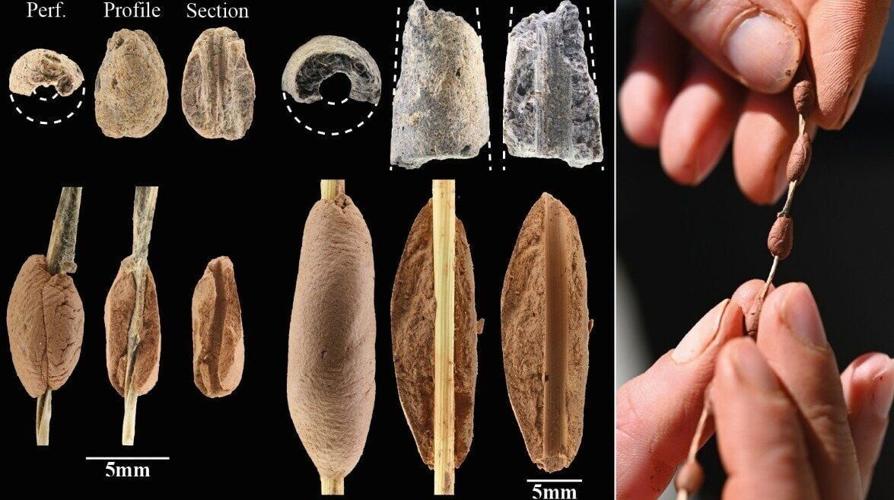
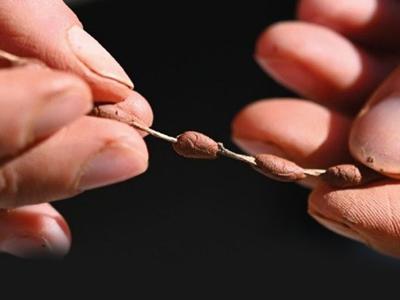

Techniques for modeling Natufian clay beads reconstructed through experimentation. Most beads were modeled directly onto plant fiber threads, while others were modeled onto wild cereal straw cores. (Laurent Davin via SWNS)
By Stephen Beech
Children were shaping clay 15,000 years ago - long before pottery became common, according to new research.
Discoveries made by archaeologists in what is now Israel suggest that the first villagers used clay not to cook, but to tell stories about who they were - thousands of years earlier than previously known.
An international team of archaeologists say their findings suggest that people in the Levant, including children, were already modeling clay with their hands, carefully, deliberately, and sometimes playfully.
They uncovered the earliest known clay ornaments in Southwest Asia, revealing a "forgotten chapter" in the story of how humans began to express identity, belonging, and meaning through material culture.
Some objects - including a tiny ring - appear to have been specifically designed for children, say scientists.
The findings, published in the journal Science Advances, push back the symbolic use of clay in the region by thousands of years.
The team said the ornaments,142 beads and pendants, were made some 15,000 years ago by Natufian hunter-gatherers.
Study leader Dr. Laurent Davin, of the Institute of Archaeology at Hebrew University of Jerusalem, says the communities were the first in the world to settle permanently in one place, thousands of years before the rise of agriculture.

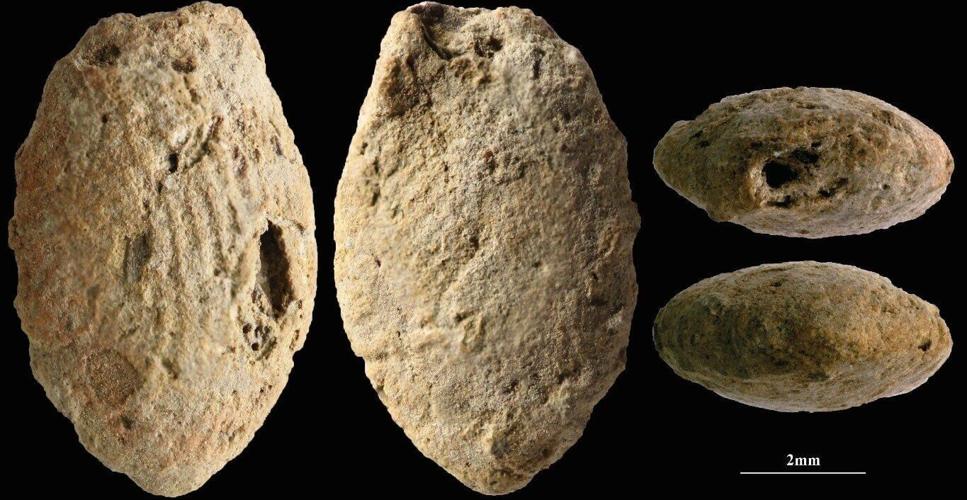
A butterfly clay bead from the Final Natufian period in Eynan-Mallaha (Upper Jordan Valley), colored red with ochre and marked with the fingerprints of the child, 10, who modeled it 12,000 years ago. Four other beads discovered in other villages were also modeled by children. The study presents the largest collection of Paleolithic fingerprints known today. (Laurent Davin via SWNS)
Until now, clay in that period was thought to play little or no ornamental role.
Only five clay beads from the era were previously known worldwide.
Dr. Davin said: “This discovery completely changes how we understand the relationship between clay, symbolism, and the emergence of settled life."
The ornaments were found at four Natufian sites - el-Wad, Nahal Oren, Hayonim, and Eynan-Mallaha - spanning more than three millennia of occupation.
Dr. Davin said: "Small enough to fit in the palm of a hand, the beads were carefully shaped from unbaked clay into cylinders, discs, and ellipses.
"Many were coated in red ochre, using a technique known as engobe, a thin layer of liquid clay smoothed onto the surface.
"This is the earliest known use of this colouring technique anywhere in the world.
"The sheer number and diversity of the beads reveal something unexpected: this was not an isolated experiment, but a sustained tradition.


"Clay, it turns out, had already become a medium for visual communication, long before it was used for bowls or jars."
A total of 19 distinct bead types were identified, many echoing the shapes of plants such as wild barley, einkorn wheat, lentils, and peas that were central to Natufian life.
Dr. Davin said: "These were the same plants the Natufians harvested, processed, and consumed intensively, plants that would later form the backbone of agriculture."
He says traces of plant fibers preserved on some beads show how they were strung and worn, offering fresh insight into organic materials that usually disappear from the archaeological record.
Dr. Davin said: "Together, the ornaments suggest that nature, especially the plant world, was not just a source of food, but a source of meaning.

"Perhaps the most striking discovery lies not in the shapes of the beads, but in their surfaces."
A total of 50 preserved fingerprints allowed the research team to identify who made them.
The prints belong to people ranging in age from children to adolescents and adults.
It is the first time archaeologists have been able to directly identify the makers of Palaeolithic ornaments, and the largest such fingerprint assemblage ever documented from the period.
Dr. Davin said: "Some objects appear to have been designed specifically for children, including a tiny clay ring just 10 millimeters wide.
"The findings suggest that making ornaments was a shared, everyday activity, one that played a role in learning, imitation, and the transmission of social values from one generation to the next."
For decades, archaeologists believed that symbolic uses of clay only emerged in the region with farming and the Neolithic way of life.
But the study along with the recent discovery of a clay figurine in Nahal Ein Gev II overturns that assumption.
Instead, the research team say it shows that a “symbolic revolution” began earlier, during the first stages of "sedentarisation" - when communities were still hunting and gathering, but beginning to live in permanent settlements.
The scientists believe that clay ornaments became a way to express identity, affiliation, and social relationships, both visually and publicly.
Dr. Davin's supervisor Professor Leore Grosman said: “These objects show that profound social and cognitive changes were already underway."
She added: “The roots of the Neolithic lie deeper than we once thought.
”By documenting one of the world’s oldest traditions of clay adornment, the study reframes the Natufians not just as forerunners of agriculture, but as innovators of symbolic culture, people who used clay to say something about who they were, and who they were becoming."


(0) comments
Welcome to the discussion.
Log In
Keep it Clean. Please avoid obscene, vulgar, lewd, racist or sexually-oriented language.
PLEASE TURN OFF YOUR CAPS LOCK.
Don't Threaten. Threats of harming another person will not be tolerated.
Be Truthful. Don't knowingly lie about anyone or anything.
Be Nice. No racism, sexism or any sort of -ism that is degrading to another person.
Be Proactive. Use the 'Report' link on each comment to let us know of abusive posts.
Share with Us. We'd love to hear eyewitness accounts, the history behind an article.