


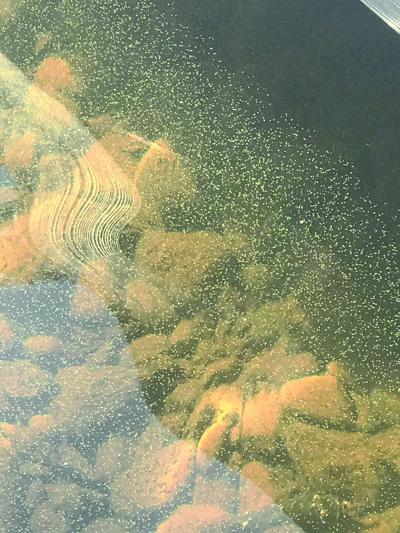
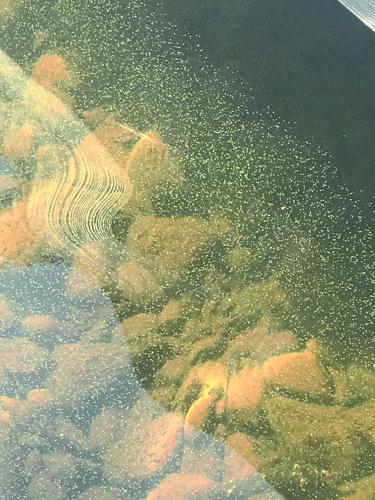
If you've been out on Lake Winnipesaukee recently, you may have noticed tiny yellow-green specks floating just below the water's surface. The first observation of Gloeotrichia (glee-oh-TRICK-ee-uh) this season was recently reported near Bear Island and appears on the New Hampshire Department of Environmental Services Healthy Swimming Mapper. While the name may sound unfamiliar, Gloeotrichia is a naturally occurring cyanobacterium that has been part of Lake Winnipesaukee's ecosystem for decades. It's important to note that this is an observation, not a warning, but it serves as a reminder to be aware of changing lake conditions throughout the summer.
Unlike the thick, paint-like blooms that often come to mind when people think of cyanobacteria, Gloeotrichia forms tiny, fuzzy colonies about the size of a pinhead. It spends much of the year growing on the lake bottom before becoming buoyant and rising through the water column during the summer. Once near the surface, wind and waves can move the colonies around the lake, concentrating them in one area while another nearby remains perfectly clear.
So, how do you know when to be concerned?
A helpful way to think about Gloeotrichia is to compare it to the night sky. If the water looks like a starry night, with just a scattering of tiny dots, the risk is generally low. But if it begins to resemble a galaxy, where the colonies are so dense they seem to blend together, we recommend staying out of the water and keeping pets away until conditions change.
Most Gloeotrichia observations do not result in a warning. However, because it is a type of cyanobacteria, it should always be treated with caution. If the water appears unusually discolored, contains dense accumulations, or simply doesn't look right, avoid contact with the water to be on the safe side. Children and pets are particularly vulnerable because they are more likely to ingest water while swimming.
The NHDES Healthy Swimming Mapper, which can be found online at des.nh.gov/water/healthy-swimming/healthy-swimming-mapper, is an excellent resource for staying informed throughout the summer. A reported observation, like the one near Bear Island, is different from a warning, but it serves as a reminder that lake conditions can change quickly.
See something? Report it.
If you see what you believe may be a cyanobacteria bloom, avoid contact with the water and keep pets away. Take a few photos and note the location. Submit a bloom report through the NHDES Bloom Report Form, found at survey123.arcgis.com/share/151c9fc3c8214c2e93325f77e0f1d578, including as much detail as possible. If the observation is on Lake Winnipesaukee, we also encourage you to notify the Lake Winnipesaukee Alliance by emailing brossiter@winnipesaukee.org. Our staff can help coordinate with NHDES, evaluate conditions, and assist with additional monitoring when appropriate. If you're unsure whether what you're seeing is Gloeotrichia, cyanobacteria, pollen, or something else, it's always better to report it than to assume.
Lake Winnipesaukee is a dynamic ecosystem, and seeing Gloeotrichia doesn't necessarily mean something is wrong. It does, however, remind us of the importance of paying attention to our surroundings and reporting anything unusual. As per NHDES guidance, “When in doubt, stay out."
•••
Bree Rossiter is the associate director of the Lake Winnipesaukee Alliance, the only nonprofit dedicated to protecting the water quality and natural resources of Lake Winnipesaukee and its watershed through science, education, advocacy, and collaborative solutions. Her work focuses on advancing long-term watershed protection initiatives and connecting science with practical solutions to help preserve the lake for future generations. To learn more, visit winnipesaukee.org.


(0) comments
Welcome to the discussion.
Log In
Keep it Clean. Please avoid obscene, vulgar, lewd, racist or sexually-oriented language.
PLEASE TURN OFF YOUR CAPS LOCK.
Don't Threaten. Threats of harming another person will not be tolerated.
Be Truthful. Don't knowingly lie about anyone or anything.
Be Nice. No racism, sexism or any sort of -ism that is degrading to another person.
Be Proactive. Use the 'Report' link on each comment to let us know of abusive posts.
Share with Us. We'd love to hear eyewitness accounts, the history behind an article.