


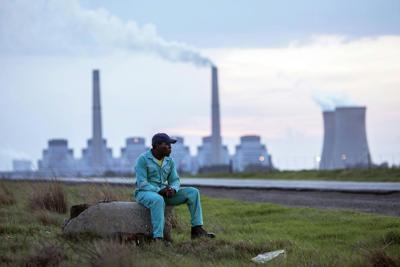
(BOULDER, CO) World leaders meeting at the annual U.N. climate summit in November 2026 are wrestling with a persistent challenge: how to get countries to follow through on their commitments to reduce greenhouse gas emissions that are warming the planet.
One of the biggest problems has long been fossil fuel power plants, but new research shows that one type of power plant in particular has been slowest to change: those owned by the very governments making the promises and writing the laws.
My colleagues and I examined carbon dioxide emissions from thousands of fossil-fueled power plants across 134 countries. What we found reveals an important hurdle to achieving the world’s goals for keeping climate change in check.
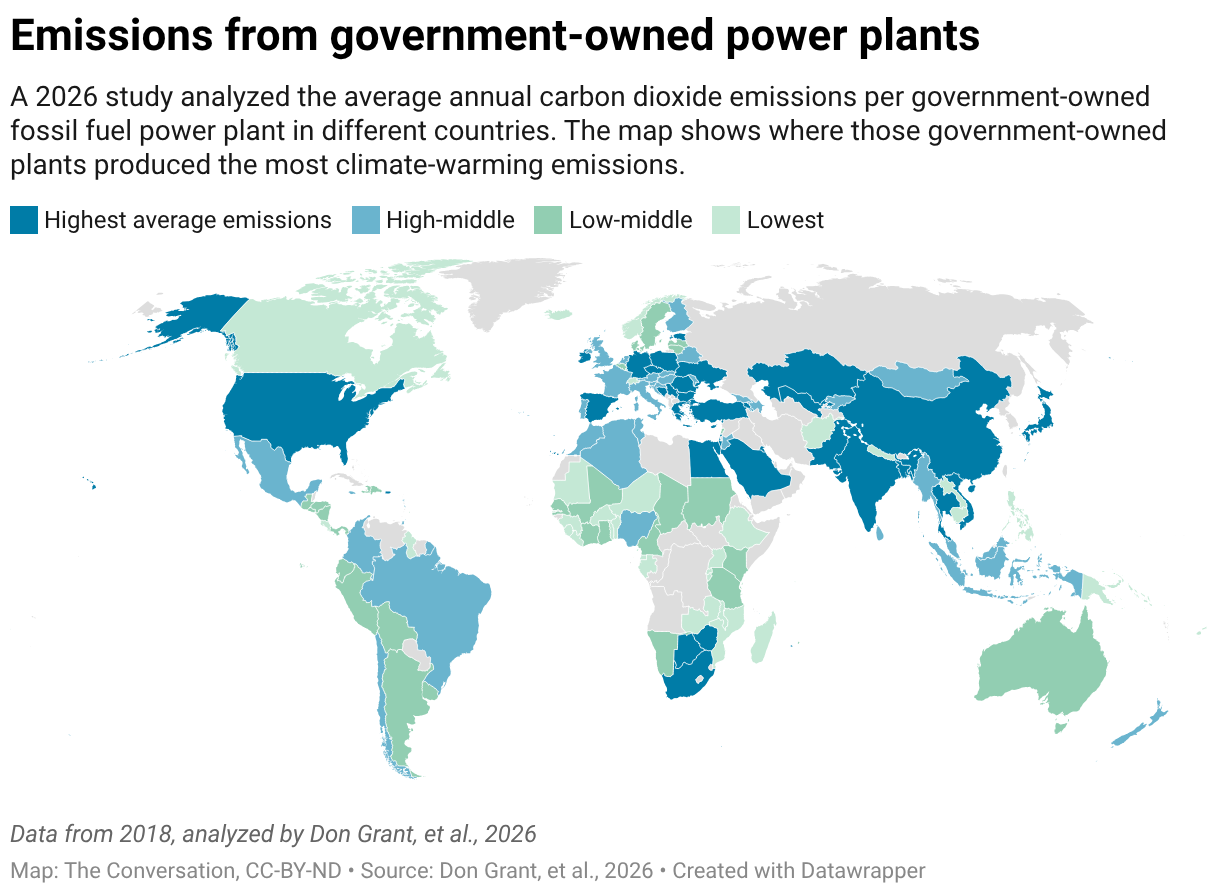
Although countries have adopted a variety of pricing, regulatory and subsidy measures designed to curb the emissions of the electricity sector, the effectiveness of these climate policies depends on utilities responding to them.
We found that power plants owned by governments had the highest emissions as a group and didn’t cut their emissions as quickly as investor-owned facilities did in response to most policies. That does not necessarily mean they are violating policy requirements, but they were slower to move.
This matters because governments control nearly two-thirds of the world’s electricity-generating capacity.
The results suggest that to limit global warming, governments need to do more than just enact climate policies – they need to ensure that all plants translate those policies into meaningful emissions cuts.
Who owns the plants matters for climate policy
Of the 13,661 power plants that my colleagues Minh Anh Ly and Musabber Ali Chisty and I studied, 5,149 were government-owned – about 38% of them.
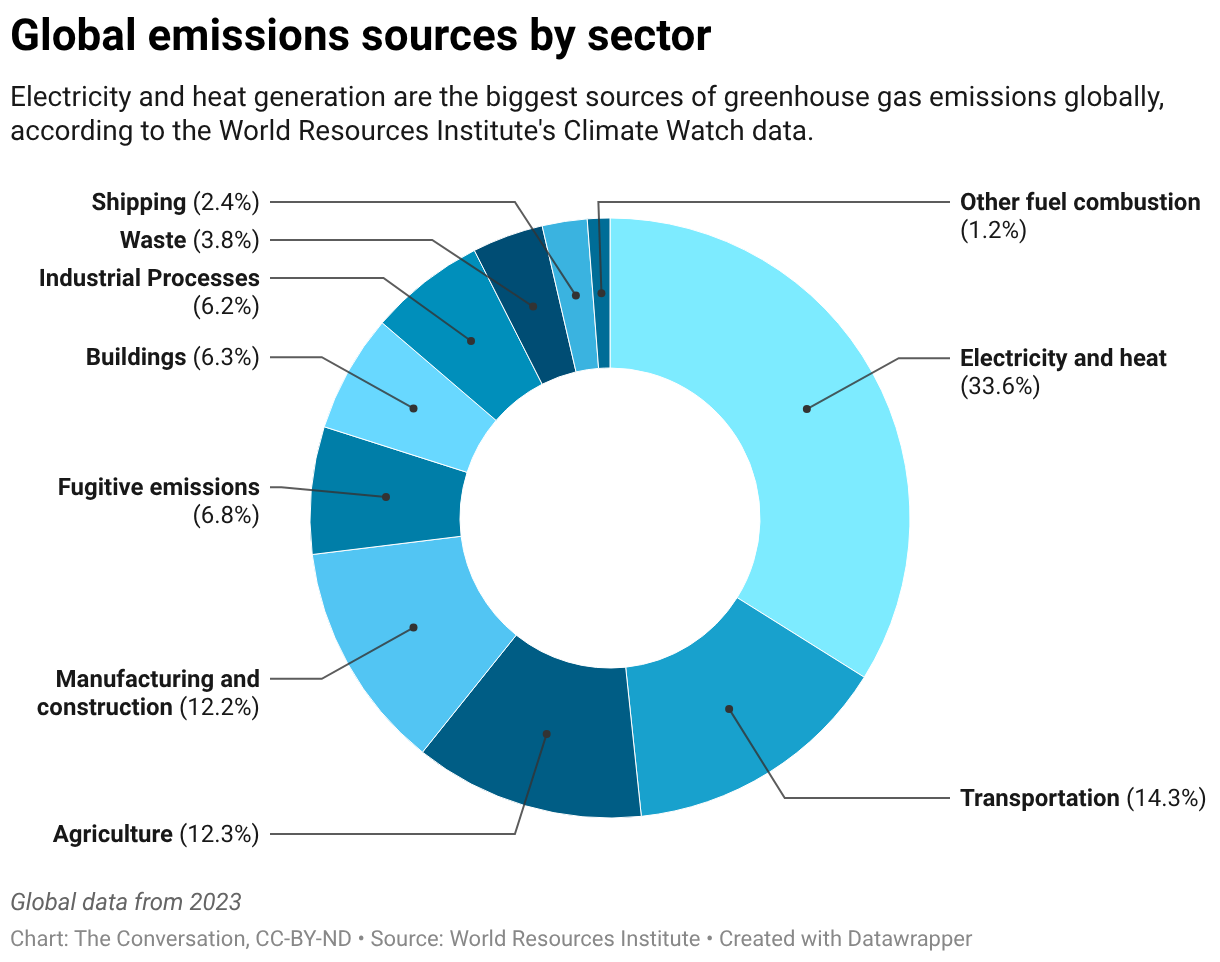
But those government-owned plants were responsible for 69% of the carbon emissions, based on the plants we reviewed. Together, power plants are the largest source of climate-warming carbon pollution globally.
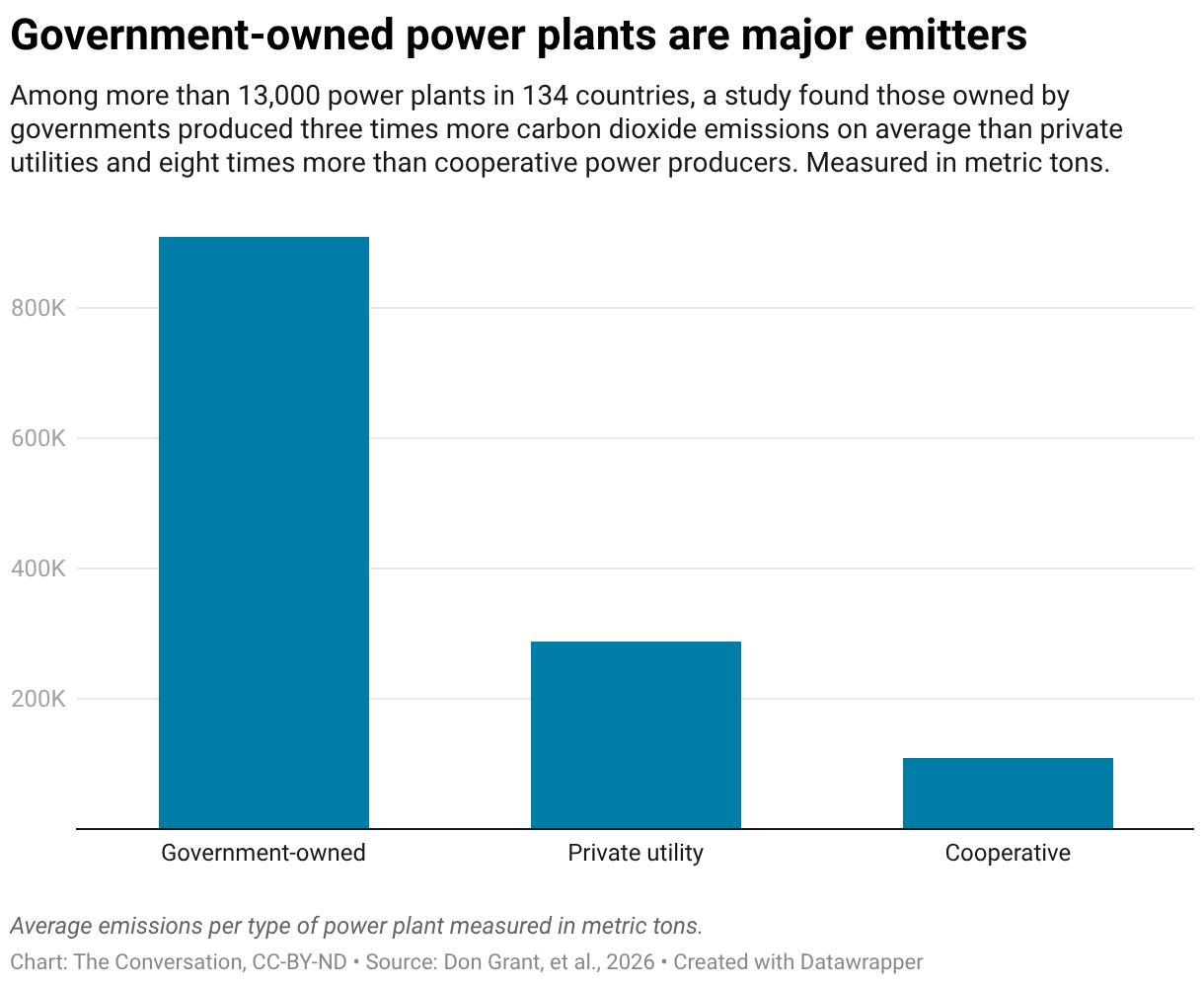
On average, we found that government-owned power plants emitted roughly 910,000 metric tons of carbon dioxide annually – three times the average of 290,000 tons for investor-owned plants and over eight times the average of 109,000 for cooperatively owned plants.
Part of the reason for the difference is that governments often invest in large power plants that burn the dirtiest fuel – coal.
However, we also compared the plants’ emissions in 2018 to their emissions a decade earlier and looked at different national policies that were applied over that time. We found some interesting results.
Several policies were statistically associated with investor-owned power plants cutting their emissions from 2009 to 2018, including:
Pricing policies such as carbon taxes that charge companies for emissions released and emission trading systems that set limits that tighten over time.
Fossil fuel subsidy reforms that cut federal support for using fossil fuels.
Regulation policies like air pollution standards and banning and phasing out coal plants.
Renewable portfolio standards that require utilities to expand their use of renewable energy.
Subsidy policies that increase renewable energy use.
But when it came to government-owned power plants, only renewable portfolio standards were associated with significant emissions cuts. The other policies had little effect on their emissions.


These differences also appeared when we examined the stringency of policies, meaning how demanding the policy is, and the amount of time utilities have had to adjust to the policies.
Why governments struggle to clean up
So, what might explain why government-owned utilities respond differently?
Government ownership creates competing pressures that other plants are less subject to. For example, state-owned utilities may be expected to provide affordable electricity, support job growth and generate tax revenue for governments. In countries dependent on payments from companies that extract fossil fuels, utilities may also face political pressure to keep coal and gas facilities operating.
South Africa’s state-owned utility, Eskom, is a prime example. It runs a fleet of aging coal-fired power plants that make it the country’s biggest polluter. But it also provides about 90% of South Africa’s power, and when the country has faced power shortages, it has at times violated emissions standards. Despite years of climate talks, Eskom’s emissions fell little in the 2010s. They have fallen about 16% since 2019, in part due to power outages and more people relying on home solar.

The extra pressure may make it harder for government-owned power plants to reduce their emissions than for private utilities that are accountable to fewer stakeholders and can respond more directly to financial incentives to shift toward cleaner production.
There is also a potential conflict when the same government both regulates and owns a utility. Officials may be reluctant to impose costs that could raise electricity prices or require public subsidies. Our study did not measure enforcement, so we couldn’t establish that publicly owned facilities receive special treatment or disregard legal requirements.
What world leaders can do differently
Our findings suggest that in addition to persuading governments to adopt and enforce more ambitious climate policies, negotiators at the U.N. climate talks will need to get governments to ensure that the power plants they own actually respond to those policies.
Here are three ways governments could do more to get their own power plants to cut emissions.
Governments could follow the example of Ireland and establish emissions-reductions targets specifically for publicly owned utilities and tie managers’ performance reviews, investment approvals and public reporting to measurable progress. Targets are more likely to get attention when managers are held accountable for meeting them. Ireland’s emissions from electricity production fell by more than a quarter from 2019, when it added emissions-reduction targets, to 2025.
They could also do more to address the financial and political constraints their utilities face. In Morocco, for example, international financing helped a state-owned agency expand solar power while limiting costs to electricity consumers. Similar measures, combined with assistance for communities affected by coal-plant closures, could make emissions reductions more feasible.
And governments could pay closer attention to emissions of individual plants as opposed to power sectors as a whole. Publishing comparable annual plant-level emissions and flagging facilities with persistently high pollution would reveal whether sector-wide gains are masking a lack of progress at specific plants.
None of this is to suggest that privatization is the answer to climate change. Government-owned power plants offer special advantages, like coordinating long-term investment and providing reliable electricity in underserved areas. The data shows, however, that for governments to meet their obligations, they need to look closely at their own plants’ emissions, as well.
This article is republished from The Conversation, a nonprofit, independent news organization bringing you facts and trustworthy analysis to help you make sense of our complex world. It was written by: Don Grant, University of Colorado Boulder
Read more:
- Pollution from coal power plants contributes to far more deaths than scientists realized, study shows
- EPA’s new way of evaluating pollution rules hands deregulators a sledgehammer and license to ignore public health
- EPA says repealing power plant emissions rules will save billions – but its estimate leaves out health and climate costs
Don Grant received funding from the National Science Foundation (award # 1824106).


(0) comments
Welcome to the discussion.
Log In
Keep it Clean. Please avoid obscene, vulgar, lewd, racist or sexually-oriented language.
PLEASE TURN OFF YOUR CAPS LOCK.
Don't Threaten. Threats of harming another person will not be tolerated.
Be Truthful. Don't knowingly lie about anyone or anything.
Be Nice. No racism, sexism or any sort of -ism that is degrading to another person.
Be Proactive. Use the 'Report' link on each comment to let us know of abusive posts.
Share with Us. We'd love to hear eyewitness accounts, the history behind an article.