


(CHARLOTTESVILLE, VA) The conventional wisdom is that the Democratic Party has the advantage in the 2026 midterm elections and could become the majority party in one, or both, chambers of Congress. The margin of that anticipated victory is harder to predict.
And the size of a party’s majority makes a difference. To see why, it’s worth looking back to the second half of the 19th century, when two dramatic midterm election results marked the beginning of important eras in the nation’s history.
1874: A nation changing course
Most American college students, including the ones I taught for over 40 years, learn that the era of Reconstruction following the Civil War came to an end when the contested presidential election of 1876 led to a deal that combined support for a Republican president with a commitment to withdraw federal troops from Southern states.
The Republican candidate in 1876, Rutherford B. Hayes, did not win the popular vote, but after an Electoral Commission established by Congress resolved disputed electoral college issues, Hayes won a one-vote victory. The White House had a Republican president, but the South was free to block enforcement of the post–Civil War constitutional amendments that protected the civil and voting rights of Black people.
That simple version of the story is not wrong, but it is incomplete. The 1874 midterms set things up for the controversies that would follow.
In the middle of his second presidential term, Republican Ulysses S. Grant was in trouble. There were scandals in Washington and economic hardships from a financial panic in 1873. The Democrats in 1874, amid accusations of fraud and voting irregularities in the South, won over 90 new seats in the House of Representatives and ended the era of Republican dominance on Capitol Hill that began with the election of Abraham Lincoln in 1860.
Before and after the 1874 midterm elections, white Southerners regained control of state governments and used violence and intimidation to suppress Black voter turnout.
Reconstruction was undone by a resurgent Democratic Party that after the 1874 midterms controlled both Southern states and the House. The compromise that removed federal troops from the South and put Hayes in the White House was icing on a cake that was baked in 1874.
1894: The Republican recovery
For two decades following the 1874 midterm elections, America’s two political parties were in constant and close competition for power.
Between the Grant administration and William McKinley’s election in 1896, no president won a majority of the popular vote. Between Grant and McKinley, no president had unified government – a single party in control of the House, the Senate and the White House – for more than two years. Not much got done.
McKinley’s 1896 election was the beginning of a new era of Republican Party dominance in national politics. It would last for decades, and McKinley’s successor, Teddy Roosevelt, would invent the modern presidency, with expanded executive powers and more direct communications with the American people. Political scientists call that kind of change a “realignment,” but it did not begin in 1896. Once again, the previous midterms made a difference.
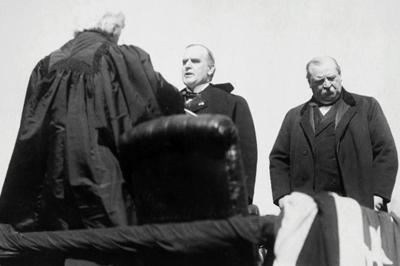
In the fall of 1894, President Grover Cleveland, the former Democratic governor of New York, was in the middle of his second, nonconsecutive term. It was not going well. Another financial panic, bigger than the one in 1873, accompanied his second inauguration and set in motion a series of economic disasters that produced the largest economic downturn in American history before the Great Depression of the 1930s.
When voters went to the polls in the 1894 midterms, they gave the president’s political party the biggest defeat in U.S. history. Over 100 seats in the House were lost to Republican or third-party candidates. The realignment had begun.
A ‘wake-up call’ election
Huge seat shifts in midterm elections, like those in 1874 and 1894, are extremely rare. Smaller midterm shifts, which occur more often, can be a “wake-up call” that forces a sitting president to recalibrate political strategies.
That’s what happened to many modern presidents: Harry Truman in 1946, Dwight Eisenhower in 1958, Lyndon Johnson in 1966, Gerald Ford in 1974, Bill Clinton in 1994, Barack Obama in 2010 and Donald Trump in 2018. Their midterm losses in the House involved 40 or more seats, losses large enough to put the president’s party on notice that something had to change.


Change came in different forms. Truman, Clinton and Obama fought back against a Congress with an opposition majority in the House and won reelection.
Eisenhower could not run again, and a weakened Johnson chose not to. Ford lost to Jimmy Carter; Trump lost to Joe Biden. All four turned the keys to the White House over to a successful candidate from the other political party.
What about 2026?
The 2026 midterm elections are unlikely to produce the kind of dramatic political changes that occurred in 1874 or 1894.
“Wake-up call” elections are much more common and are more reasonable to expect. That result is more likely in a closely divided nation, with heavily gerrymandered congressional districts, because even a small shift in House seats matters.
Democrats don’t need a 40-seat swing to retake the House. If they flip a handful of districts, they become the majority party. In the betting markets, that appears to be the likely 2026 outcome.
Every president in the last 80 years who was underwater in presidential approval polling – as President Trump now is – lost seats in midterm elections. The smallest number of seats that flipped in those eight decades was five. A five-seat shift to Democrats in 2026 could make Hakeem Jeffries the Speaker of the House.
A 2026 midterm election in which Republicans hold their slim majority in the House would be a monumental achievement, even if it looked like nothing had changed. It would break a pattern that has been in place since Harry Truman was president in the 1940s and 1950s.
Most Americans pay more attention to presidential elections than they do to midterms. That might be a mistake.
A sizable midterm shift can signal large and long-lasting changes in American politics. A smaller shift can pull a president in a new direction or set the stage on which the next presidential campaign plays out.
The 2026 midterm elections will almost certainly produce significant consequences for American politics. The scale of those consequences and their longevity remain open questions that only American voters are able to answer.
This article is republished from The Conversation, a nonprofit, independent news organization bringing you facts and trustworthy analysis to help you make sense of our complex world. It was written by: Robert A. Strong, University of Virginia
Read more:
- No cheery time for election pollsters in run‑up to US midterms
- How red went from the color of revolution to the color of Republicans in US politics
- For 80 years, the president’s party has almost always lost House seats in midterm elections, a pattern that makes the 2026 congressional outlook clear
Robert A. Strong does not work for, consult, own shares in or receive funding from any company or organization that would benefit from this article, and has disclosed no relevant affiliations beyond their academic appointment.


(0) comments
Welcome to the discussion.
Log In
Keep it Clean. Please avoid obscene, vulgar, lewd, racist or sexually-oriented language.
PLEASE TURN OFF YOUR CAPS LOCK.
Don't Threaten. Threats of harming another person will not be tolerated.
Be Truthful. Don't knowingly lie about anyone or anything.
Be Nice. No racism, sexism or any sort of -ism that is degrading to another person.
Be Proactive. Use the 'Report' link on each comment to let us know of abusive posts.
Share with Us. We'd love to hear eyewitness accounts, the history behind an article.