


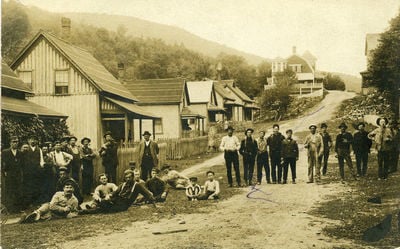
Main St. with the Saunders’ mansion in background, courtesy of WhiteMountainHistory.org
By Gordon DuBois
The roar of Sawyer River accompanied us as we made our way along an abandoned road to the once flourishing village of Livermore. As we walked along, I imagined the villagers of Livermore village heading to the Sawyer River Railroad Station in Crawford Notch. The once busy road is now just a pathway in the woods. In several areas the trail is obscured due to flooding and forest encroachment. I could hear a stiff wind blowing through the naked trees overhanging the path. The sound of the wind gusting through the bare trees brought me back to the time when the train engines would sound their whistle as they hauled loads of lumber from the Livermore saw mill to the main line of the Portland and Ogdensburg Railroad.
Earlier in the day, I set out with several of my hiking partners – Karen and Tom Barker, Fran Maineri, Dick Widhu, Doug Hunt and Susan DiPietro – to find and explore the ruins of Livermore. We met at the Sawyer River Road trail head just a few miles west of Bartlett. Hiking along the old Livermore Road, we arrived at the ruins after a pleasant walk through a stunning hardwood forest. Now the fun began, exploring the crumbling foundations and trying to figure out what they were. At first we noticed the stone foundation of the company store, office and post office. A safe was lying at the bottom of the foundation. It was here where workers probably lined up for their paychecks. Livermore was a company town.
We explored further and found the ruins of the steam-powered saw mill and power house, along with the school, two boarding houses, aqueduct pillars and several cellar holes. The village of Livermore has but disappeared except for the foundations and brickwork that now define the town. In its heyday it had its own railroad and was home to over 200 inhabitants: loggers and woodsmen, mill workers and railroad men, along with their families. However, by the mid-1930s Livermore was practically a ghost town, with only a few inhabitants. The majestic spruce and fir trees that supported the community were cut and sold as millions of board feet of lumber used to build the mill communities further south. All that remains now are crumbing foundations. The forest and the Sawyer River are slowly reclaiming their terrain that was taken away in the early 20th century, when the timber barons ruled the north country of New Hampshire.
Several years ago, I was fortunate to hike with Dr. Peter Crane. Peter oversees the Mt. Washington Observatory's Gladys Brooks Memorial Library, which has a prized collection of books, maps, prints, photos and other material relating to the Observatory, Mt. Washington and the White Mountains. Peter has a wealth of information on the history of the White Mountains and wrote his doctoral dissertation on the history and folk life of Livermore village. He was kind enough to send me a copy of his doctoral dissertation and I devoured it in one night of reading. It told about this tiny village carved out of the wilderness by the Saunders family and the people who lived there who called this community home.
At the turn of the 19th century, there were many villages centered on the logging industry: Zealand, Carrigain, Thornton Gore, Johnson Village, Gale River Settlement, Passaconaway. Most of these villages have been lost to time, their history forgotten and town folk long deceased. However, thanks to Bartlett Historical Society, Peter Crane and other historians such as C. Francis Belcher, and Bill Gove, the history, folk culture and stories of Livermore Village have been kept alive.
Having dug into this wealth of information about Livermore Village and the Sawyer River Railroad I found their history to be fascinating. Livermore was founded by the Saunders family. The Saunders made their money in the textile business, building and operating mills along the Merrimack River in Lawrence, Massachusetts. Later, they realized the potential of harvesting lumber from the extensive forests of Northern New Hampshire. In 1874 the Saunders Family founded the Grafton County Lumber Co. and thus began the Sawyer River Railroad and the village of Livermore. The first mill was built in 1875. This mill was destroyed by fire the same year it was built, but a second mill was put up shortly after.
From this point forward the town grew quickly and took on the identity of a typical sawmill and logging village: babies were born, weddings celebrated, funerals occurred and holidays celebrated. The 1890 census indicates that the population of Livermore was 103 persons living in 18 separate dwellings. By 1920 the population rose to 200. Livermore was different than many other logging towns at the time. It was a family oriented community. Households were dominated by immediate and extended families. The school, serving up to 28 students with two teachers had an extensive collection of writing and arithmetic books as well as copies of classics including "Robinson Crusoe", "The Song of Hiawatha", "Tom Brown's School Days" and others. The Saunders' mansion overlooked the village and was an impressive structure that was the pride of the community.
Livermore continued to prosper through the early part of the 1900s due to the extensive holding of the Saunders. The mill was cutting between 3 million to 11 million board feet annually. In addition the Saunders operation was using selective cutting, meaning the forest was managed for long-term productivity, rather than short-term profit. This practice was in sharp contrast to that of other timber barons, like J.E, Henry who clear cut, or mowed down, thousands of acres of forest with little regard for long-term production or stewardship. Henry was referred as, "A wood-butcher, a mutilator of nature, a destroyer of the property of a thousand for the benefit of himself." (The White Mountain Echo).
By the late mid-1920s, with the oncoming Great Depression, the value of sawed lumber dropped substantially. That, combined with a massive flood on the Sawyer River, wiping out many sections of the railroad, including several bridges, spelled the demise of the Grafton County Lumber Company, the Sawyer River Railroad and the township of Livermore. Eventually in 1936, under the Weeks Act, all the Saunders' forest holdings, including the village were sold to the U.S Forest Service, and became part of the White Mountain National Forest. A few residents remained as "hangers-on," not wanting to leave the village they loved. In 1944 the federal government auctioned off some of the equipment in the mill and boarding house. Finally, in 1951, the New Hampshire State Legislature revoked the town's charter and Livermore disappeared into obscurity.
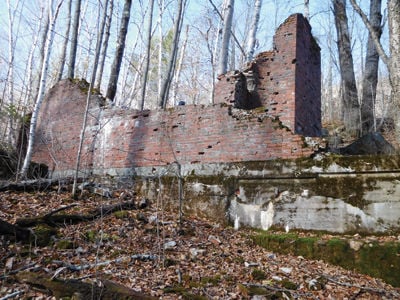
As we continued on our archeological quest, we spent quite some time trying to figure out how the mill's sophisticated technology of the early 20th century was used to saw timber. Fran pawed though the fallen and broken bricks of the powerhouse and found an inscription printed on the bricks, "ASCOT." Playing detective, Fran returned home and learned that the bricks were manufactured near Sherbrook, Quebec, and must have been transported by rail to construct the powerhouse. We also imagined what the community looked like in the bygone era when the timber industry dominated the North Country and this town bustled with activity. Fortunately, we had an old map of the town along with several pictures of village buildings. Excitement ran through our small group of "want to be" archeologists as we continued to look for more ruins.
We combed through old relics of the town, finding several foundations of homes, steel rails left behind when the Sawyer River Rail Road was abandoned and the rail sold as scrap metal. We even discovered the cement school foundation complete with a two-holer still intact. We scoured the area for other remnants of town life such as jars, dishes and tools. We only found some shards of glass and pottery and a baker's warming oven used at the boarding house.
We wrapped up our archeology/history hike by returning to the parking lot the way we came, following the abandoned Livermore Village Road. We passed by the foundations of the Saunders' mansion and houses that had lined Railroad Row, the village main street. We passed the boarding house that housed many woodsmen who worked to bring down the giant spruce. The last memorabilia we found were parts of the boiler from the train engine that hauled logs and lumber up and down the rail line. The village of Livermore is no longer, but the past in still alive, found in the crumbing foundations of this once proud mill town. You can explore an important part of New Hampshire history by visiting this site and experiencing history when timber barons ruled the North Country.
The Power House Foundation


(0) comments
Welcome to the discussion.
Log In
Keep it Clean. Please avoid obscene, vulgar, lewd, racist or sexually-oriented language.
PLEASE TURN OFF YOUR CAPS LOCK.
Don't Threaten. Threats of harming another person will not be tolerated.
Be Truthful. Don't knowingly lie about anyone or anything.
Be Nice. No racism, sexism or any sort of -ism that is degrading to another person.
Be Proactive. Use the 'Report' link on each comment to let us know of abusive posts.
Share with Us. We'd love to hear eyewitness accounts, the history behind an article.