


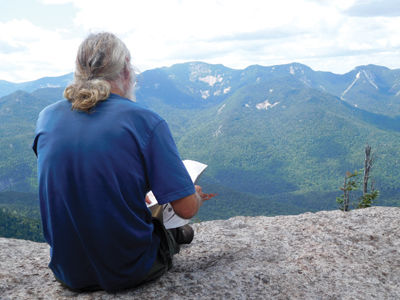
Tom studying map, overlooking the Great Range
By Gordon DuBois
Two weeks ago, Tom Barker and I traveled to the Adirondack Mountains to climb five peaks: Colvin, Blake, Nippletop, Bear Den and Dial. A few days prior to our ramble in "The Dacks," we drove to the Whites to trek the Edmunds Path, summiting Mount. Eisenhower and Mount Franklin in The Presidential Range. These two hikes provided a stark contrast of trail building in two very different mountain ranges.
The Adirondack Mountains in northern New York State are not geologically part of the Appalachian Chain, as are the White Mountains. They are much older, formed over a billion years ago when upward doming of bedrock embedded under the earth's crust was thrust upward to create the mountain mass we know today. The White Mountains, on the other hand, are much younger, several million years old and formed by plate tectonics. The White Mountain National Forest comprises about 796,000 acres, while the Adirondack Park is more than 6 million acres.
The two mountain ranges also differ greatly in their settlement. The Adirondacks were mostly unknown until the 1840s. The source of the Hudson River was not discovered until the mid-1800s. Mount Washington, on the other hand, was first climbed in 1642 by Darby Field. Following the Civil War, people began to flock to the Whites for summer long retreats. The Cog Railway, which climbs Mount Washington, was completed in 1869. People were hiking to Mount Washington via the Crawford Path in the 1840s. Many trails in the White Mountains were built by the Appalachian Mountain Club and "professional" trail builders. The trails in the Adirondacks mostly follow routes created by early trappers, geologists, loggers and surveyors. Many of the trails to the higher summits are not even marked or maintained. They're called "herd paths."
Within one week Tom Barker and I had two different hiking experiences: trekking in the Adirondacks while summiting five mountains in three days. The other hike was a much more leisurely one day tramp on the Edmands and Crawford paths in the Presidential Range. The three day trip in the Adirondacks involved climbs up rock ledges, along steep ridges and through knee deep mud. The hike on the Edmands and Crawford paths was along well-graded trails. These two adventures offered us an interesting contrast between two different mountain ranges with very different histories.
The Edmands Path starts at a parking area on Mount Clinton Road, not far from the AMC Highland Center. The Trail climbs gradually about three miles to the junction with the Crawford Path. As with many trails in the White Mountains, experienced and dedicated trail builders created the paths to the mountain summits. The Edmands path was built by John Rayner Edmands, who dedicated much of his life to preserving and protecting the White Mountain Forests from destruction by the woodsman's ax. Edmands wanted to bring people to the mountains so they could experience the beauty and wonder of the forested landscape and be inspired by the untouched beauty of mountain vistas. In so doing, he believed they would become advocates for wilderness conservation and preservation. What followed was a number of trails he laid out and built with trail crews dedicated to his vision. He referred to trails as boulevards, trails that were well graded and of moderate difficulty. He not only built the path named in his honor, but also the Gulfside and Westside Trails below Mount Washington, the Israel Ridge, Valley Way and Randolph Trails in the northern Presidentials. He also constructed the Perch Campsite which sits on the side of Mount Adams.
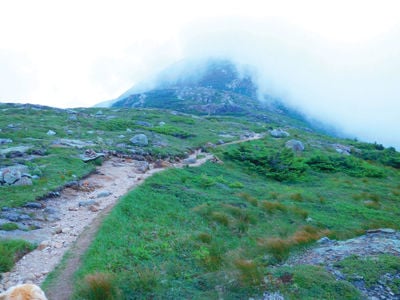
Edmands was a master trail builder and his masterpiece is the Edmands Path. Tom and I, along with his wife, Karen, began our hike with a slow meander through a hardwood forest and across several streams. After a mile the trail began a gradual climb up the west ridge of Mount Eisenhower. It was marked by carefully-placed rock cribbing, steps, walls of rock and a cobblestone-like pathway. The trail slabbed along the ridge, views of the Dartmouth Range were seen in the distance. When the trail broke above tree line we jumped along carefully placed rock steps before finally reaching the Crawford Path. Tom and Karen continued their journey to the summit of Eisenhower. I headed north to the little known summit of Mount Franklin, which lies just south of Mount Monroe, on a side trail off the Crawford Path. The Crawford Path is considered by some as the oldest continuously-maintained foot path in the U.S. The first section of the trail was completed in 1819 by the Abel Crawford and by 1840 a bridal trail was built to the Mt Washington summit by his grandson, Thomas Crawford. This trail can also be considered a boulevard as it winds its way from Crawford Notch to Mount Washington. Our return hike back down the Edmands Path was a quick and easy jaunt back to our parked vehicle.
Our excursion, a few days later to the Adirondacks, provided a sharp contrast to the "boulevards" we had hiked a few days earlier. We began our trek in Keene Valley, New York, not far from Lake Placid. The first few miles took us along a maintained gravel road through land owned by the Ausable Club. After the initial few miles the trail turned into a boulder-strewn path, climbing steeply into the Adirondack Forest Preserve. It seemed as if a giant had thrown these enormous rock obstructions directly onto our path. This was only the beginning of a long, hard slog, in the rain to Elk Pass where we made camp. The next day we scrambled to the summits of Colvin and Blake mountains. Tom and I had several substantial rock climbs using tree roots and small crevices in the rock face to boost ourselves up the steep ridge to the summits. There was no letup to the climbing challenges we had to confront, which included a 30-foot ladder that seemed to head endlessly into the fog-enshrouded peak of Mount Colvin. After making the summit of both mountains our we turned around and literally slid down many sections of rock faces to the valley below. When we got back to camp I was exhausted. Tom and I ate dinner and were in our sleeping bags before dusk.
The following day, we packed up camp, threw our packs on our backs and headed straight up to Nippletop, an elevation gain of 1,600 feet in less than a mile of hiking. At times we had to ascend hand over hand, and with 35 pounds of gear on our backs it was a challenge to remain upright. We did make the summit by noon and stopped to take in the stunning views of the Adirondack Wilderness. It was something to behold. The catch phrase for the Adirondacks is "rugged and remote." Our three-day excursion underscores this phrase.
After lunch we continued our hike over Dial Mountain, onto Bear Den Mountain and eventually back into the protected forest preserve of the Ausable Club. We made our way back to our vehicle, thought about climbing Giant and Rocky Top mountains the next day, but decided we had enough climbing for three days. The mountains will always be there waiting for our next climb.
Within a week, Tom and I had experienced two very different mountain ranges and two very different trail systems. I would invite you to experience the contrast. Every mountain range has its own identity. No two are the same. Hiking the Adirondacks and the White Mountains provides the contrast and the challenge that keeps me returning week after week to the mountain trails I love, no matter where they are.
Gordon has hiked extensively in Northern New England and the Adirondacks of New York State. In 2011 he completed the Appalachian Trail (2,285 miles). He has also hiked the Long Trail in Vermont, The International AT in Quebec, Canada, Cohos Trail in northern New Hampshire and the John Muir Trail in California. Gordon has summited the New Hampshire Hundred Highest peaks, and the New England Hundred Highest in winter. He spends much of his time hiking locally and in the White Mountains with his dog, Reuben, and especially enjoys hiking in the Lakes Region due to the proximity to his home in New Hampton. He is also a trail maintainer for the Belknap Range Trail Tenders and can be found often exploring the many hiking trails in the area. He can be reached at forestpd@metrocast.net.
Crawford Path leading to Mt. Franklin and Mt. Monroe



(0) comments
Welcome to the discussion.
Log In
Keep it Clean. Please avoid obscene, vulgar, lewd, racist or sexually-oriented language.
PLEASE TURN OFF YOUR CAPS LOCK.
Don't Threaten. Threats of harming another person will not be tolerated.
Be Truthful. Don't knowingly lie about anyone or anything.
Be Nice. No racism, sexism or any sort of -ism that is degrading to another person.
Be Proactive. Use the 'Report' link on each comment to let us know of abusive posts.
Share with Us. We'd love to hear eyewitness accounts, the history behind an article.