


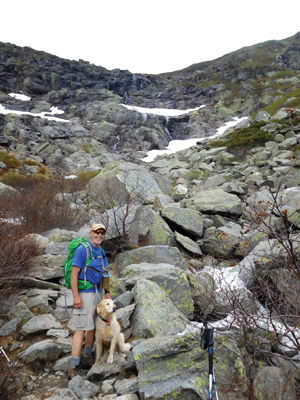
Reuben and Gordon at the base of Tuckerman Ravine
By Gordon DuBois
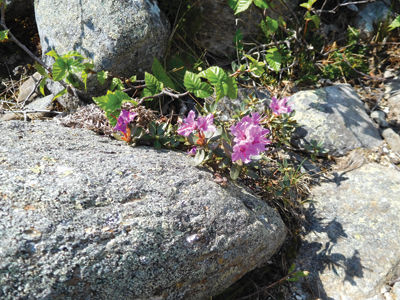
When I reached the alpine region on the Boott Spur Link Trail, I was greeted by a beautiful display of alpine flowers, diapensia and lapland rosebay. With Reuben leading the way, I scrambled up to the higher reaches of the trail. I had forgotten that the alpine zone of the Presidential Range would be ablaze with the flower show of early June. I was overtaken by the brilliant display of these early alpine flowers. It is truly amazing that these beautiful flowers can thrive, let alone even exist in this harsh and extreme environment. Yet, throughout the alpine zone in the Presidential and Franconia Ranges of the White Mountains these amazing plants are in full Bloom: diapensia, Lapland rosebay, mountain avens, cinquefoil, harebell, mountain aster, bog bilberry and many more. During this period, one can witness a marvelous display of flowers that defies the extreme conditions where these plants flourish. A sign at an AMC hut reads, "Welcome to the Alpine Zone. Enjoy the fragile beauty. Be a caring Steward. Stay on the trail or walk on rocks. Help preserve the delicate balance of the Alpine Zone. It's a tough place to grow."
With this in mind, we continued on our journey, with the main objective: the summit of Boott Spur Peak. All along the trail, above tree line, we were accompanied by the flowering diapensia, which resembles a large pin cushion, and the pink flowers of Lapland rosebay. It reminded me of a domestic rock garden. However this garden was not made by man, but by the hand of nature. We were careful to stay on the trail and not trample the delicate plant life around us. Even Reuben was careful where he placed his paws. I always knew he was a smart dog.
We started our day at the Pinkham Notch AMC Visitor Center, hiking the Tuckerman Ravine trail for 2.4 miles. I met a few other early hikers, heading into the ravine to begin their climb of Mount Washington. At the Hermit Lake Shelters, I began my climb to Boott Spur Ridge via the Boott Spur Link trail. With Reuben in the lead, we climbed the steep ascent to Boott Spur trail which would lead us to the peak of Boott Spur (5,500 fet) The trail follows a prominent ridge running south from Mt. Washington, located on the east side of Tuckerman Ravine. The ridge was named for Dr. Francis Boott who was a member of the Bigelow scientific expedition to the White Mountains in 1816. Some speculate that this ridge was the probable route of the first ascent of Mt. Washington by Darby Field in 1642.
As we made our way along the trail, dark storm clouds were gathering to the south, and I became anxious about continuing my venture, knowing that I would be in danger if a storm hit when I was above tree line. I continued on, rushing to make my goal. As many know, the weather can turn quickly in the mountains. However, to my good fortune, the thick bank of clouds began to break up as they blew into Tuckerman and Huntington ravines and Mount Washington above. I was in luck, no storm today, just a minor weather system pulling through. I made the summit of Boott Spur and turned onto the Davis Path, which would lead me to the Tuckerman Ravine trail and back to the Hermit Lake Shelters.
The Davis Path is a 15 mile trail running from Crawford Notch and Rt. 302 to the summit of Mount Washington. It was built by Nathanial T.P. Davis, manager of the Crawford House, and son-in-law to Abel Crawford, patriarch of the region and premier trail builder (Crawford Path). The Davis Path was built as a bridle path to Mount Washington and completed in 1845. In the years following, the trail was used less frequently due to the popularity of the carriage road and the Cog Railroad, and reclaimed by the forest. In 1910 the trail was reopened by the AMC as a foot path to the summit of Mount Washington and now closely follows the route of the original bridal trail.
When I arrived at the junction of the Tuckerman Ravine Trail, I considered continuing on to the summit of Mount Washington, but thought better of it, as I have been on the summit many times and it wasn't worth climbing another mile and over 600 feet in elevation. I began my descent into Tuckerman Ravine, excited to view the massive walls of the ravine and the spring runoff tumbling down over the headwall, 1,000 feet to the valley below. The ravine is a classic glacial cirque that was carved out of the southeast slope of Mount Washington during the ice ages. It was named for distinguished botanist Edward Tuckerman, who taught at Amherst College and studied alpine plants and lichens in the area during the 1830s and 40s. He is best known for categorizing botanical life zones in the Presidential Range. Tuckerman Ravine is famous for the huge amounts of snow that blow off Mt. Washington into the bowl-shaped cirque, providing challenging and unique opportunities for skiing enthusiasts. In 1939, at the Third American Inferno Ski Race, 19 year-old Austrian Toni Matt became a ski legend. Starting from the summit of Mt Washington, he hit the Tuckerman headwall and schussed (skied in a straight line) down the headwall close to 85 miles per hour, finishing at the Pinkham Notch Visitor Center in just six minutes and 29 seconds.
Unlike Toni Matt, Reuben and I carefully made our way down the Tuckerman Ravine trail. We could see massive ice sheets still hanging on the cliffs. Snow fields lingered in the recesses of the ravine. Indian poke was beginning to unfurl its large deeply veined leaves from the side of trail. Soon they would be in bloom. The famous snow arch that is created by water flowing under many feet of snow had collapsed and was now just huge chunks of ice laying at the bottom of the ravine. I spent a good deal of time gazing at the raw beauty of this magnificent cirque, reluctant to leave. But I must, as darkness was setting in. I slowly hiked out of the ravine, occasionally looking back at the beauty behind me. I paused to eat a snack at the ranger station before beginning my final leg of the hike down to the AMC Pinkham Notch Visitor Center. As I was getting up to leave I met a couple from Norway who shared with me that they had returned to Tuckerman Ravine, drawn back to this very special place, to celebrate their wedding anniversary at this spot where they were married 40 years ago. Tuckerman Ravine and the alpine gardens have a magnetism that draws people from around the world to experience their majestic beauty. Take the opportunity now to visit Tuckerman Ravine and the alpine zone to view the spring flower show. You have one week left.
Gordon has hiked extensively in Northern New England and the Adirondacks of New York State. In 2011 he completed the Appalachian Trail (2,285 miles). He has also hiked the Long Trail in Vermont, The International AT in Quebec, Canada, Cohos Trail in northern New Hampshire and the John Muir Trail in California. Gordon has summited the New Hampshire Hundred Highest peaks, and the New England Hundred Highest in winter. He spends much of his time hiking locally and in the White Mountains with his dog Reuben and especially enjoys hiking in the Lakes Region due to the proximity to his home in New Hampton. He is also a trail maintainer for the BRATTS (Belknap Range Trail Tenders) and can be found often exploring the many hiking trails in the area. He can be reached at forestpd@metrocast.net
Lapland rosebay


(0) comments
Welcome to the discussion.
Log In
Keep it Clean. Please avoid obscene, vulgar, lewd, racist or sexually-oriented language.
PLEASE TURN OFF YOUR CAPS LOCK.
Don't Threaten. Threats of harming another person will not be tolerated.
Be Truthful. Don't knowingly lie about anyone or anything.
Be Nice. No racism, sexism or any sort of -ism that is degrading to another person.
Be Proactive. Use the 'Report' link on each comment to let us know of abusive posts.
Share with Us. We'd love to hear eyewitness accounts, the history behind an article.