



On March 1, President Donald Trump signed an executive order designating English as the official language of the United States. If you are like many of the college students who take my class on language in the U.S., you might not have been aware that English was not already the official language.
Clearly, English is the dominant language in the country, and so, does the official designation actually matter?
The executive order states that “A nationally designated language is at the core of a unified and cohesive society.” Given that the country has existed since inception without an official language and that before and since the arrival of the earliest European colonists, America has always been a multilingual society, it begs the question, has the country never been unified and cohesive? And further, will this executive order create the unity and cohesion the country needs?
Throughout history, numerous languages have coexisted in the United States, but there has been a consistent movement, occasionally subtle and at other times violent, to eradicate languages other than English. In early America, enslaved people were strategically separated from others of their language groups, with the purpose of replacing their languages with the English understood by their masters in order to impede attempts at rebellion. Similarly, during the long period of Native American boarding schools, children of the same language groups were often separated and punished for speaking native languages with the stated goal of “Americanizing” and “civilizing” Native American children. In contrast to these more extreme attacks on language are the everyday experiences of people whose languages and accents tell a story some Americans do not want to hear, one of immigration.
In the early 1900s, my grandmother’s family immigrated from rural Quebec to Laconia, in search of their own American dream. When she arrived in the U.S., only French words had ever fallen from her tongue, but very soon she would need to divide that tongue to become bilingual.
In the years before she passed away, my grandmother, leaning back in her soft leather chair, recounted some of her earliest stories of going to school as a French speaker in a land where the English language ruled. She shared stories of being shamed by her teachers for speaking in her first language, and when she left the classroom walls, she remembered being shamed by members of the community, too. She held these memories from her early life through the end, and they impacted her in silently distressing ways. As Gloria Anzaldúa poignantly expressed, “If you want to really hurt me, talk badly about my language. Ethnic identity is twin skin to linguistic identity — I am my language. Until I can take pride in my language, I cannot take pride in myself.”
My grandmother’s superlinguistic power of speaking French was one she quickly learned to hide, only allowing the French words to roll off her tongue when surrounded by other French-Canadian immigrants. She developed a contradictory relationship with her first language, in that hearing it spoken by others brought her a feeling of unquestionable and instantaneous connection and yet, at the same time, it was a source of shame. I wish my grandmother had never learned this lesson about her language and her history. Rather, I wish she had learned to take pride in both her first and second languages and to value her unique translinguistic identity in a country that is perhaps the only country on Earth where most citizens can, often within a few generations, trace their family’s history to various corners of the world.
Throughout my career, I have welcomed students from their various corners and taught them to speak and read the English language. These students bring with them languages and experiences that are essential to who they are. I know, at my core, that there is a way for students to learn English in which their first languages and experiences are valued and honored, and that it is the only way that a person should learn a new language.
I have a photograph of my grandmother as an adorable 6-year-old child, and I often think of the lessons she learned in an American school and community intent on erasing her history, one word at a time. In the picture, my grandmother has the same dark eyes as my younger sister and the same dark curls and round face as my older cousin. She passed on these genetic bits of herself; I wonder what else we (and she) might have gained, if she had been able to pass on her language, too.
I wonder if, perhaps what has kept the United States from being “unified and cohesive” has not been the absence of an official language, but the undervaluation of the languages and histories of all its people.
•••
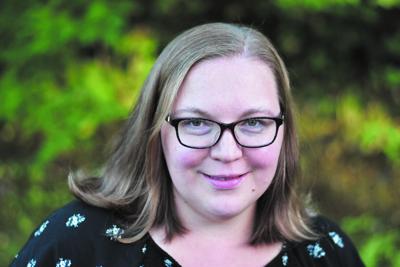
Kristin Roberts-Raymond is a college instructor who teaches courses on the English language and the linguistic identity of the United States. She was raised in the Lakes Region, and she has taught in various contexts within the United States and in Morocco, where she previously resided. She currently lives in Belmont with her husband and three sons.


(0) comments
Welcome to the discussion.
Log In
Keep it Clean. Please avoid obscene, vulgar, lewd, racist or sexually-oriented language.
PLEASE TURN OFF YOUR CAPS LOCK.
Don't Threaten. Threats of harming another person will not be tolerated.
Be Truthful. Don't knowingly lie about anyone or anything.
Be Nice. No racism, sexism or any sort of -ism that is degrading to another person.
Be Proactive. Use the 'Report' link on each comment to let us know of abusive posts.
Share with Us. We'd love to hear eyewitness accounts, the history behind an article.