


CONWAY — Several alternatives for keeping the Saco River from intruding on the North Conway Water Precinct’s wastewater treatment facility were presented by consultants at the precinct offices on Dec. 6.
Three river banks closest to the facility are eroding, and four separate mitigation plans were floated at the sparsely attended forum. More hearings will be held in the future, said NCWP Superintendent Jason Gagnon.
The precinct is working with project consultant Inter-Fluve, a firm with local ties that has experience in river morphology and stabilization projects.
The hope is to find a consensus in 2024 and to begin the project in 2025 after funding is secured from local, state and federal sources.
“If we don’t secure the funding by then, we will keep working to put that all together,” Gagnon told The Conway Daily Sun this week.
“This is a large-scale project that will likely have a significant cost associated with construction,” said Gagnon. But he said that “precinct voters approved $7.8 million for the project in 2022 with the condition that at least 50% of the cost be offset by grant funding.”
They are also working with the New Hampshire Department of Environmental Services, which has funded all work to date through the Clean Water State Revolving Fund Loan Program.
The Swift-Saco Rivers Local Advisory Commission has also been brought in to provide local knowledge and feedback as design work progresses. Mark Dindorf, chair of the group, was among the 10 people who attended the recent forum.
Consultants on hand included fluvial geomorphologist Nick Nelson, regional director at Inter-Fluve; colleagues, Keith Kantack, raised in Jackson, and Cameron Twombly, raised in Conway; and Deborah Loiselle, stormwater coordinator for the state Department of Environmental Services, Water Division, Watershed Management Bureau.
In addition to Dindorf, others in the audience included longtime NCWP consultant Bill Hounsell; his brother, Conway Planning Board member Mark Hounsell; landowner Karen Junge-Dennison; Nat Lucy of the Conway Conservation Commission; Andrew Smith, public works director for the town of Conway; local fishing enthusiast Steve Angers of North Country Angler; and NCWP Commissioner Jim Umberger and his wife Karen Umberger, a former Conway state representative.
Among the initial findings is that since 1939, the river has moved more than 600 feet toward the facility.
The three riverbanks closest to the facility were described as:
Bend 1, the most directly below the plant, just as the river makes a big arc left toward the area that 40 feet above houses the NCWP’s solar array. It is a steep bank.
Bend 2, across from the NCWP, on the west side of the river and abutting farm land. It is a lower bank but eroding and if breached it could change the course of the river, making the impact on the wastewater plant unknown and a risk.
Bend 3, south of the NCWP and mostly made up of river stone and sand.
Stabilization options range from limited wood/stone bank armoring to full channel relocation.

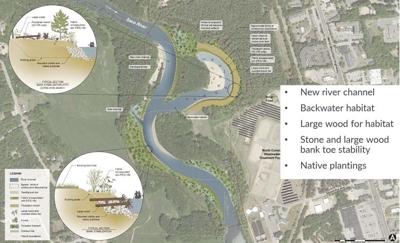
The first alternative would be the most impactful and potentially the most expensive, and that is to divert the Saco into an existing dry overflow channel, away from the first of the three meandering bends that are threatened by erosion.
A benefit of that approach would be to create a back channel in the area on the east bank of the river where it currently flows. That would create good habitat for aquatic species and wildlife.
Speaking in favor of that alternative was Angers, of Saco Valley Anglers, who said anglers support measures that improve the river’s fish habitat.
Fill would be used to create a forested wetland in the area through which the Saco currently flows; and to stabilize the eroding cliff nearest to the precinct’s extensive solar array, measures would include creating a floodplain bench 50-75 feet wide, as well as fabric encapsulated soil lifts for a middle section between the bench and the area closest to the river, the latter of which would be stabilized with large round riverstones and wood.
A sand/gravel bar would be placed alongside the west bank of the new channel for the main course of the Saco.
The second alternative would not involve redirecting the main course of the Saco but involves stabilizing the first river bank with stone and wood. It would add a 25-foot wide floodplain bench and use native plantings.
The third alternative would also not involve redirecting the course of the main Saco. It would also use stone and large wood inserts into the riverbank and toe for stabilization and would also use native plantings but it would build a narrower, 12-foot-wide floodplain bench.
The fourth approach would add a 25-foot wide floodplain bench to Bends 1, 2 and 3 for their protection along with stone and large wood bank toe stabilization on Banks 1, 2 and 3.
The value of the wastewater plant was not in question: All present agreed that it is a key to the economic vitality of the greater Mount Washington Valley and needs to be protected.
“This isn’t a Conway issue — it is a valleywide issue,” said Bill Hounsell.
“If we do not take the global approach,” he said, “future generations may look back and ask why.”
The meeting was recorded by Valley Vision and is posted in their archives.
For more information, call 603-356-5382 or go to ncwp.nh.gov.
•••
These articles are being shared by partners in The Granite State News Collaborative. For more information visit collaborativenh.org.


(0) comments
Welcome to the discussion.
Log In
Keep it Clean. Please avoid obscene, vulgar, lewd, racist or sexually-oriented language.
PLEASE TURN OFF YOUR CAPS LOCK.
Don't Threaten. Threats of harming another person will not be tolerated.
Be Truthful. Don't knowingly lie about anyone or anything.
Be Nice. No racism, sexism or any sort of -ism that is degrading to another person.
Be Proactive. Use the 'Report' link on each comment to let us know of abusive posts.
Share with Us. We'd love to hear eyewitness accounts, the history behind an article.