


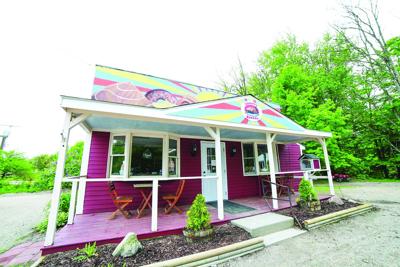
CONWAY — The town’s sign ordinance is still in effect, but the ordinance regulating public art is not. That’s the upshot of a court ruling in favor of Leavitt’s Country Bakery, which sued the town after being cited for having an illegally large sign.
But while the court decided in Leavitt’s favor, lawyers are negotiating the resolution in the long-running conflict, which a judge ordered to be filed by Nov. 1.
At the selectmen’s meeting on Sept. 30, the Sun asked Conway Town Planner Ryan O’Connor about the status of the ordinances, given the ruling and the pending agreement.
“We’re going by the sign code,” said O’Connor. “That’s what we have right now. We’re not going to enforce the public art ordinance.”
Lawyers say that the proposed agreement, which isn’t final until U.S. District Judge Joseph Laplante approves it, would include allowing the painting of baked goods over its entrance to stay and not be challenged by the town again, and for the town to work with Leavitt’s attorneys on revising the sign ordinance. It also calls for the town not to enforce the public art ordinance and to recommend to voters to rescind it at next April’s town meeting.
The case started in 2023 after a painting of pastries created by Kennett High Schol students, was judged to be an illegally large sign. In response, bakery owner Sean Young sued. In his decision, the judge acknowledged the painting could be commercial speech but ruled in favor of Leavitt’s because of the town’s faulty enforcement, which he said violated Leavitt’s First Amendment rights (the town seemed to be going after the display based the art depicting what was sold in the building).
The public art ordinance, approved in 2024 in a 1,277-423 town vote, was not in effect when the court case started and didn’t apply to Leavit’s case. The sign ordinance governing the size of signs was approved decades ago. The public art ordinance is separate.
Leavitt’s lawyers, who include several from the Institute of Social Justice, a nonprofit public interest law firm based in Virginia, are within their rights to collect legal fees from the town, but say their motivation is to fix the sign ordinance to avoid more lawsuits, not collect the money.
Robert Frommer, a senior attorney with the Institute, believes the public art ordinance could lead the town into more legal challenges.
“It puts the [Conway] planning board in the position of being the town censor,” said Frommer. “That’s one thing that the First Amendment just simply doesn’t allow.”
The stated purpose of the public art ordinance is to “maintain a quality visual aesthetic while allowing for creative expression in appropriate locations.”

The public art ordinance’s “criteria provide guidance concerning the compatibility and appropriateness of theme, location, design, placement, massing, scale and materials of publicly displayed art with no intrusion into the artistic expression or the content of work.”
Among the criteria for the public art ordinance’s application for a proposed or altered artwork is that the applicant provide a “design of the mural or artwork, in full color, drawn to scale. Designs should be representative of the community and the natural beauty of the Mount Washington Valley.”
Sign ordinance regulations mostly concern the size, location, whether the sign is illuminated and how the sign is constructed.
Another victim of the sign ordinance was Settlers Green, whose “Wings” mural was deemed illegal but who successfully fought to keep the mural on the side of a store wall. The art ordinance came in the wake of that decision.
Given the notoriety of the decision and the confusion about signs, the Sun asked New Hampshire Municipal Association Executive Director Margaret Brynes if the association has issued any guidance about signs and she said on Wednesday that the association has not.
Attorneys for the bakery also include Frommer, Elizabeth Sanz, William Aronin and Bobbi Taylor Institute for Justice and John Crabbs of Cooper Cargill Chant of North Conway.
The town’s legal team consisted of Jason Dennis of Hastings Law Office of Fryeburg, Maine, and Madeline Kate Osbon, Brooke Lovett Shilo and Russell Hilliard, all of Upton Hatfield of Portsmouth.
Laplante, in his order against the town, said repeatedly he was not ruling on the text of the sign ordinance itself but only on how the town attempted to enforce it against Leavitt’s. Laplante said there was a “complete disconnect” between the language of the code and the town’s actions.
Frommer, reached in June, said the Institute is more interested in working with town officials to make sure the town adheres to the Constitution than collecting fees that he estimates would come to more than $100,000.
The baked-good artwork over Leavitt’s entrance was painted by Kennett High School students several years ago. Code Enforcement Officer Jeremy Gibbs determined it was an oversized sign, and the zoning board of adjustment agreed. The town then demanded Young take it down or change it.
In response, Young filed suit in 2023 with the help of attorneys from the Institute for Justice, challenging the enforcement on constitutional grounds. The case went to trial on Feb. 14, and on May 19, Laplante, sitting in Concord, ruled in Young’s favor.


(0) comments
Welcome to the discussion.
Log In
Keep it Clean. Please avoid obscene, vulgar, lewd, racist or sexually-oriented language.
PLEASE TURN OFF YOUR CAPS LOCK.
Don't Threaten. Threats of harming another person will not be tolerated.
Be Truthful. Don't knowingly lie about anyone or anything.
Be Nice. No racism, sexism or any sort of -ism that is degrading to another person.
Be Proactive. Use the 'Report' link on each comment to let us know of abusive posts.
Share with Us. We'd love to hear eyewitness accounts, the history behind an article.