


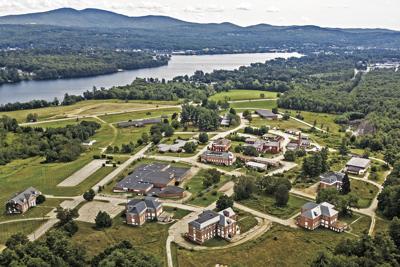
LACONIA — The 250-acre Laconia State School campus leads the 2018 list of "Seven to Save" announced yesterday by the New Hampshire Preservation Alliance.
Ruggles Mine, a 236-acre mica mine in Grafton, was also on the list, along with a dam of a water-power system at Canterbury Shaker Village and the enormous exhibition barn at the Rochester Fairgrounds. The list — which highlights endangered historic landscapes and iconic structures — also included a home dating from the 18th and 19th century that stretches along the common at Haverhill Corner, an Italianate parsonage in Lee and a Prairie-style residence built for the director of the Veteran’s Administration Hospital in Manchester.
The 2018 list was announced in Washington, New Hampshire, at a Preservation Alliance event celebrating the rehabilitation of that town's iconic 1787 Meetinghouse (which was listed to Seven to Save when its future was uncertain in 2014).
“These places make our state distinctive, and help connect us to our rich and complex history,” said Jennifer Goodman, executive director of the Preservation Alliance. “The need for new investment and creative re-uses as well as deterioration and demolition are varied threats to the historic properties on this list. Here are seven great opportunities to transform threatened resources into vibrant assets once again that help meet community and economic goals.”
She noted that the list is the most diverse in the program’s 12-year history, and many of the listees are not yet well-known or understood, even in their own communities.
The New Hampshire School for Feeble-Minded Children opened in Laconia in 1903, with three buildings housing 82 residents, ages three to 21. The campus was situated on 250 acres of land overlooking Lake Winnisquam and Lake Opechee — a bucolic environment that was intended to be curative and instructive for residents.
The school grew in the number of buildings and residents, but overcrowding became an issues by 1916 when 300 residents lived on campus. In 1924, the name changed to the Laconia State School, and conditions worsened through the Great Depression. By 1942, the population had increased to 600, and by 1974 more than 1,000 residents called the Laconia State School home.


Calls to increase funding were rejected by the state Legislature until a successful lawsuit in 1978 forced the state to reduce the number of residents, increase staffing, renovate several buildings and develop community-based mental health initiatives. The school closed its doors in 1991.
Over the objection of city leaders, the state converted portions of the property to house prisoners, and it became known as the Lakes Region Facility. The state closed that facility in 2009.
A state-sponsored redevelopment planning procedure is currently underway to explore the re-use of significant National Register-eligible historic buildings at the 250-acre site in a way that adds to community and economic values and memorializes its complex history of both benevolence and suffering, the Alliance said in its statement.
Appearance on the Seven to Save list has helped to attract new investment and re-use options for more than 50 percent of the community landmarks that have received the designation since the program began in 2006, according to a press release from the Alliance.
Criteria for Seven to Save include the property’s historical or architectural significance, severity of the current threat, and the extent to which the Seven to Save listing would help in preserving the property. Typically, nominated properties are owned by non-profit groups, municipalities or commercial entities, and have local advocates willing to work toward a creative “save” rather than allowing continued deterioration and possible demolition.
Seven to Save attracts attention to threats and helps forge possible solutions for endangered properties. Examples of successes include the Wolfeboro Town Hall, Charlestown Town Hall, Kensington Town Hall, Pickering House in Wolfeboro, Watson Academy in Epping, the Pandora Mill in Manchester, Littleton Community Center, and the Langdon Meetinghouse.
Seven to Save sites that still need more creative planning, new investment, and advocacy include the Balsams in Dixville Notch, Concord’s iconic Gas Holder House, the Chandler House in Manchester, Sanborn Seminary in Kingston, and the former Brown Paper Company’s R & D building in Berlin.


(0) comments
Welcome to the discussion.
Log In
Keep it Clean. Please avoid obscene, vulgar, lewd, racist or sexually-oriented language.
PLEASE TURN OFF YOUR CAPS LOCK.
Don't Threaten. Threats of harming another person will not be tolerated.
Be Truthful. Don't knowingly lie about anyone or anything.
Be Nice. No racism, sexism or any sort of -ism that is degrading to another person.
Be Proactive. Use the 'Report' link on each comment to let us know of abusive posts.
Share with Us. We'd love to hear eyewitness accounts, the history behind an article.