


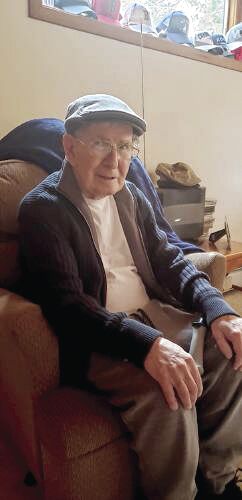
TILTON — When Tracy Gassek walked into her father’s room at the New Hampshire Veterans Home, she was horrified.
Donned in full personal protective equipment, she had come to visit her father, Robert Labore, whose condition had rapidly declined since his positive COVID-19 test. Robert Labore had lived in the Veterans Home with dementia for a couple of years when the COVID-19 outbreak struck.
The man curled up in front of her was very different from the man who arrived at the home 3 years ago. She said his hearing aids were out, the nurses seemed to have misplaced his dentures, food was smeared around his mouth and his hair stuck straight up.
What haunted her the most was his quiet pleas for water. When she offered him a Gatorade, he drank the whole thing, only pausing once for air.
“He was saying ‘I’m so thirsty, I’m so thirsty,’ ” she said. “I could see the crust around his mouth. I could see the elastics snapping in his mouth from the saliva and the dryness.”
Labore’s family is the second one to publicly accuse the state Veterans Home of neglecting their loved ones during the facilities’ COVID-19 outbreak.
Despite Labore’s grim conditions, he was one of the lucky ones at the home who survived. In total, 36 veterans living there have died since the virus entered the home in early November, making it the second most fatal outbreak at an assisted living facility in New Hampshire. Only the Hillsborough County Nursing Home with 39 deaths was worse.
To date 91 of the residents of the Veterans Home were infected, more than three-quarters of those who lived there.
“Our team of employees continue to achieve our mission of serving our residents with dignity, honor and respect,” said Margaret LaBrecque, the home’s Commandant. “We appreciate the many accolades we receive from family members as well as the veterans we serve.”
Gassek hadn’t spoken to her father in weeks before she visited – she said nursing home staff told her Zoom calls weren’t offered to residents in quarantine.
Gassek received information about her father through the nursing home staff who usually called to update her on how many pounds her father had lost that week. She was worried about his condition — Labore, who was already a thin man, had dropped 16 pounds in just a couple of weeks.
Labore told his daughter he had only been giving him a couple of ounces of water a day. Gassek said it’s also possible he had refused water because the new isolation room and staff were disorienting for Labore, who struggles with dementia.
Either way, Gassek said she felt more should have been done to ensure his basic needs were met.
“He was not eating or drinking and they weren’t doing anything about it,” she said. “They had no plan to do anything about it.”
Labore was taken to the hospital twice for dehydration after being transferred to the isolation unit of the Veterans Home. After the second stint in the emergency room, the family decided to take him out of the nursing home. Tara Croteau, Labore’s other daughter, said she just didn’t believe they were doing enough to make sure he didn’t die.
“We couldn’t leave him there to die from dehydration and malnutrition,” she said. “COVID wasn’t what was killing him. It was not being fed and not being given water.”
Labore, who was a flag signalman in the Navy and served during the Korean conflict, is now living with Gassek in Campton. Labore grew up in Manchester and lived most of his adult life in Gorham after leaving the military.
Until recently, Labore’s family had been happy with his care at the Veterans Home – it was always clean and their father seemed happy.
Croteau thinks the shortages in employees have stretched the staff too thin.
Earlier this month, the Veterans Home pleaded with the public to volunteer at the facility. In total, 95 staff members have tested positive for COVID-19, leaving the facility with vacancies for weeks. They needed people to fill nearly every position – security officers, food workers, business maintenance workers, laundry workers, and nurses.
Most of the staff have since recovered and only 10 are currently infected and the outbreak seems at bay.
“I know they’re having struggles with staffing,” Croteau said. “But these patients are going to require more care with COVID. If they can’t provide that level of care, they have no business of keeping those patients there.”
Croteau said she was disturbed by her dad’s appearance the day he left the home.
“His face was full of food. There was food all under his fingernails,” she said. “I don’t think that man had a shower in two months. ”
The allegations from Labore’s family comes on the heels of an internal investigation into the treatment of Richard Rajotte, whose family says he was not properly monitored and cared for during his battle with COVID-19, ultimately leading to life-threatening complications.
Pam Lariviere, Rajotte’s niece said the Veterans Home waited too long to send him to the emergency room. Records from the Veterans Home, reviewed by the Monitor, show Rajotte wasn’t responsive the evening before he was admitted to the hospital. When a nurse attempted a sternum rub, a slightly painful technique used to elicit a reaction, Rajotte did not respond.
Still, Merritt Jonathan Mishcon, the home’s Medical Director, said he decided to wait to transfer Rajotte to the hospital while they waited for the results of a blood test. Mischcon noted Rajotte’s vital signs were normal and an ambulance transfer could increase delirium.
“Shouldn’t actual medical necessity to save a life trump delirium?” Lariviere said.
When Rajotte arrived at the hospital, at Rajotte’s niece’s insistence, he had been admitted to the ICU with kidney failure, severe dehydration, sepsis, and a blood oxygen saturation level of 91% (the CDC recommends hospitalization for patients with oxygen saturation under 95%), according to Rajotte’s medical records reviewed by the Monitor. Nurses at the ICU reported decay in his mouth and tongue. The day after he was admitted, one doctor noted he “was not eating or drinking for the last 11 days.”
“I was trying hard to use the information in the chart (and the information that I knew was coming shortly) to pick the ‘least risk’ path for Richard,” Mishcon said. “His event appears to have been another unusual manifestation of COVID-19.”
Gassek said she won’t be requesting an internal investigation from the Veterans Home.
“I don’t hold out a lot of hope for the state investigating itself,” she said.
State Sen. Lou D’Allesandro of Manchester said he has received letters from people with family members at the Veterans Home who are also concerned about the treatment of their loved ones.
He declined to say how many families reached out or the specifics of their complaints out of respect for the families’ privacy.
•••
These articles are being shared by partners in The Granite State News Collaborative. For more information visit collaborativenh.org.


(0) comments
Welcome to the discussion.
Log In
Keep it Clean. Please avoid obscene, vulgar, lewd, racist or sexually-oriented language.
PLEASE TURN OFF YOUR CAPS LOCK.
Don't Threaten. Threats of harming another person will not be tolerated.
Be Truthful. Don't knowingly lie about anyone or anything.
Be Nice. No racism, sexism or any sort of -ism that is degrading to another person.
Be Proactive. Use the 'Report' link on each comment to let us know of abusive posts.
Share with Us. We'd love to hear eyewitness accounts, the history behind an article.