


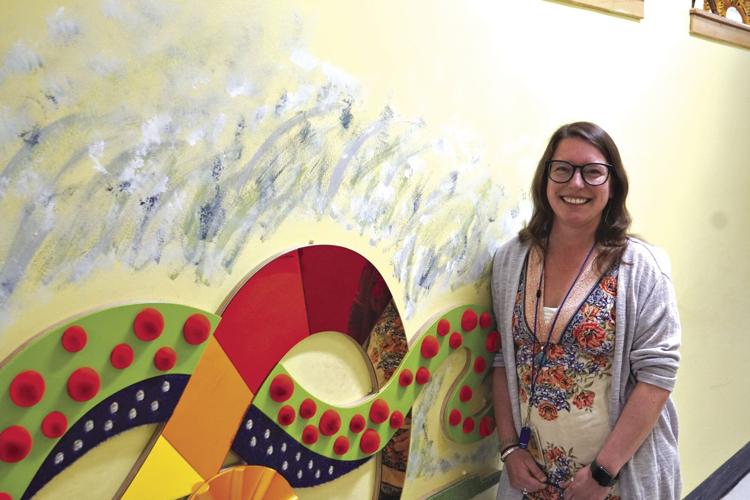
FRANKLIN — Kelli Kneeland is no ordinary kindergarten teacher - and her young students vary greatly, too, in their early reading and writing skills and ability to sit and learn.
To her pupils at Paul Smith School, she is a playtime coach, a role model for kindness and behavior, a story reader, question asker, explainer, attendance taker, and guide for exploring a novel world.
She’s also a spotter of individual needs and levels – a job made more pressing and complex by COVID.
“This year I have a kindergartener already reading at a first-grade level. The kindergartener next to her did not know the letters in her name,” said Kneeland, who has taught for eight years at this pre-k -through-grade three school in Franklin.
Kneeland and others suspect that not attending pre-school, day care or readiness programs during the pandemic’s shutdowns and isolation at home caused delays in children whose parents and caregivers could not prepare them for school because of illness, personal circumstances, work or other reasons.
Whatever their origin, the early learning delays are now poised to trickle forward.
“The academic abilities are all over the place. It’s not just one grade level. It’s all grade levels,” said Kneeland.
In the aftermath of COVID, which uprooted education in visible, invisible and unanticipated ways, teachers in New Hampshire and nationwide are confronting seismic challenges in how to catch children up after their learning, socialization and sense of belonging were stalled or frozen in time.
Learning loss is a universal problem that hits younger children harder
Research published in December by UNICEF, the World Bank and UNESCO found that during COVID, younger students had less access to remote learning and were more affected by learning loss than older kids, especially pre-school age children in critical early learning and developmental stages. Children from low-income households, those with disabilities and girls were less likely to access remote learning, according to the report. COVID’s fallout had tentacles: it was nearly impossible to practice and simulate social and emotional learning and normal interaction online.
Now that children are back in school, educators are witnessing myriad effects.
In the absence of group interaction, practicing listening and basic manners before entering kindergarten, little ones seem less focused and more fidgety, teachers say. First graders are having to catch up academically because they didn’t learn the social and emotional skills which are precursors for academic learning. For second graders, this may be their first uninterrupted year in a physical school.
Standing in line, waiting your turn and following directions are skills youngsters acquire in school. Before the pandemic, not every student was in the same place academically, socially or emotionally. After the pandemic, those differences became greater, Kneeland said. More younger students have trouble stifling impulses to grab, pull, throw things or shout, and have challenges dealing with frustration and anger. Others seem to have less ability to trust.
“Third graders are the only grade that had a full year of normalcy in their school background. First-grade teachers are having to take a step back and teach kindergarten social and emotional skills, which is putting them behind academically,” said Kneeland. “Second graders missed the academic growth that happened in the second half of kindergarten, when COVID hit.”
As a result, needs are “all over the map,” she said, especially in the early years. “Everyone is saying the same thing. It’s affecting schools across the entire country. And it’s going to take a lot of extra work to get kids back to whatever state standards they’re supposed to be at.”
“With the disruptions we had for 18 months, when they came back in person, it took a while for kids to settle in,” said Franklin School Superintendent Dan LeGallo. “We’re still dealing with behaviors and mental health issues specific to the pandemic. Until kids’ basic needs are met, it’s hard to meet their academic needs.”
How it plays out in school
In Franklin, demographics, income levels and family dynamics can create a hodgepodge of issues for children. But the post-COVID challenges in schools are universal. In academics as well as social and emotional maturity, functioning and ability to adapt and get along with others, the pandemic's effects are playing out like earthquake aftershocks. In some students, they persist like a low-level storm that makes it tougher to pay attention, understand, remember or advance in school.
Teachers are encountering a varied landscape in personality and behavior, and ways in which the pandemic undermined learning.
Some youngsters appear to be capable, engaged and resilient. Others are quiet or withdrawn. Some are hyper-aware and have difficulty shifting between activities. Others are rowdy or anxious, and more easily cry or explode. Coping and self-calming skills are lagging. There’s less of a common, classroom middle ground. The return to in-person learning, although happy and welcome and critical to future development, comes with a menu of challenges that aren’t easy to predict or overcome.
“I really think it’s going to be a long term process to make up for learning loss,” said LeGallo. It’s a conclusion shared with many educators nationwide.
Barbara Slayton, a social worker and wellness coordinator for Franklin schools, said this year, in the wake of the pandemic, seven kindergarten and first graders arrived without having been potty trained, some because of disabilities. “A lot of developmental stuff was delayed,” she said. “For kids who weren’t in pre-school or Head Start programs, more were showing up without passing the milestones they would have passed earlier.”
Delays in behavior and skills acquisition can impact a child’s future success, even as the deficits lessen with time. For teachers, there’s no one-size-fits-all approach to bringing kids up to speed. Schools are racing to find and implement solutions, and the strategies vary between individuals and age groups.
“In kindergarten, we learn a lot through playing. Kids learn how to play with each other” and in the process, assimilate rules of interaction from each other, Kneeland said.
Mental health problems, including anxiety and depression, can get in the way, making any learning harder and slower. According to experts at the National Alliance on Mental Illness, anxiety and depression peaked during COVID, hitting old and young people hardest.
Young students carry stress from home, after listening to their parents’ concerns about money, jobs or the future, Kneeland said. “It’s hard to learn when everyone around you is so stressed, or you can’t be around people.
“We’re trying to make sure they’re happy and safe and comfortable here. Now that we can take off the masks, students can see our faces, and see the emotions on our faces.” Students are able to smile, react to others’ expressions, draw lessons and reinforcement from that, and more seamlessly be kids again.
At Paul Smith School – and how parents can help their children
At Paul Smith School, which serves pre-k to grade three, primary education takes a home-like approach. A social-emotional curriculum, Fly Five, adopted this year, encourages cooperation, assertiveness, responsibility, empathy and self-control. “We do a lot of talking about what we’re feeling, and finding a different solution, as opposed to chucking a toy across the room,” she said.
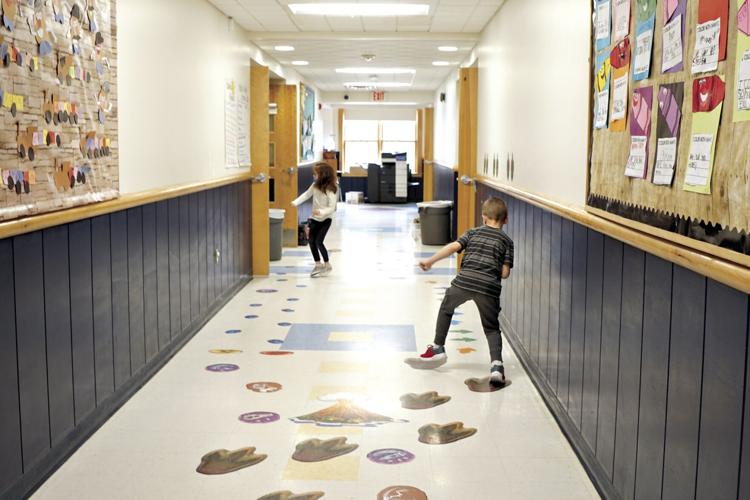
The school is divided into three multi-grade wings. Each is set up like a house. “We take all the kids and put them in groups according to their skill level. We teach the kids where they’re at,” Kneeland said. The hallways have sensory paths lining the floors that kids are free to use when they feel overloaded or need a break. “Teaching to what these kids need right now will help any really high and really low achievers” regain a trajectory and progress without losing interest or being overwhelmed and giving up.
“For kindergarteners, half their lives have been in COVID times. We can’t expect them to jump right out of it,” said Kneeland. There have been no field trips or parent volunteers during the past two years. “No one knows how long it will take to bring kids to where they should be.”
Parents and caregivers play a decisive role. They help by showing children that they value what they do in school, she said. That can take the form of asking about their day, showing what they learned in class, or taping their artwork or writing to the refrigerator door.
“The number one thing that parents and guardians can do to help is read to and with their kids,” she said. Reading out loud together is bonding time that can fill in gaps in learning, encourage a lifelong love of reading, expand curiosity and build confidence and self-esteem. “Children love to learn the sounds of language even before knowing what printed language looks like on a page.” Nursery rhymes and rhyming songs help them recognize patterns in words and phrases.
In these chaotic times, the parent-child-school connection becomes especially important. “Just show the kids as much love as you can. We’re all having a tough time right now. If a child feels they have love and safety and are happy, that helps with learning. I just want them to love school.”


(0) comments
Welcome to the discussion.
Log In
Keep it Clean. Please avoid obscene, vulgar, lewd, racist or sexually-oriented language.
PLEASE TURN OFF YOUR CAPS LOCK.
Don't Threaten. Threats of harming another person will not be tolerated.
Be Truthful. Don't knowingly lie about anyone or anything.
Be Nice. No racism, sexism or any sort of -ism that is degrading to another person.
Be Proactive. Use the 'Report' link on each comment to let us know of abusive posts.
Share with Us. We'd love to hear eyewitness accounts, the history behind an article.